Book/page totals

Top 10 Lists

Showing posts with label young adult. Show all posts

On this page:

Friday, July 26, 2013

read full post >

A delightful fairy tale retelling that takes the familiar story of the twelve dancing princesses and fleshes it out-- adding completely plausible reasons for just about every aspect of the story: why the princesses dance every night, whey they can't tell anyone, and even why there are twelve of them. It even adds to the mundane aspects of what life must be like if you had to go dance every night-- what if you get sick (as the oldest, Rose, does) but still had to go dance every night? And with twelve sisters, the youngest are quite young - one dancing since she could walk, and hates balls because she has had to dance every night.

Read more...

Saturday, May 04, 2013

read full post >

cover of Tera Lynn Childs' "Forgive My Fins"

Lily Sanderson is a high school pining for the school jock, Brody-- but unlike most normal high school girls, Lily is half-mermaid. Her father only told her a few years ago that her mother was huma, and gave her the option to live with her aunt Rachel and attend high school to get some experience with the human world and the other half of her heritage. Lily has been plotting with her best friend Shannen how to ask Brody out to the spring dance, but she can't quite get up the nerve. Then, for some reason, her neighbor Quince Fletcher-- whom she hates because he is always teasing her and giving her a hard time-- decides to help her out. Naturally, things don't go quite as planned; when Quince goes to check on Lily he ends up kissing her (because, of course, he likes her). But what he doesn't know is that she's a mermaid, and merfolk have a magical mate-bond which is triggered by a kiss. Lily has to take Quince to her home, Thalassinia (where of course she is a princess) and present him to her father the king in order to ask for a ritual separation that will dissolve the bond between them. But that doesn't go quite the way she planned it, either.

Read more...

Thursday, August 09, 2012

read full post >

cover of 'Dreamless' by Josephine Angelini

By the end of Starcrossed (which I read last October), Helen has learned that not only is she a Scion, a member of a superhuman race descended from the demigods of Greek mythology, but also that she is the Descender-- a special Scion who can physically enter the Underwold and may be able to end the curse on the Houses, the blood lust incited by the Furies which forces them to kill members of other houses or any family members who are kin-killers. This book picks up shortly after that, and Helen is exhausted because she spends every night in the Underworld, stuck and and in pain; she's emotionally upset because she is still incredibly drawn to Lucas (the Paris to her Helen), even though they are apparently cousins and now they really can't be together-- since inbred Scions tend to be the dangerous kind of crazy, in addition to that whole problem of uniting two of the Houses resulting in a war. Eventually, Helen finds a new ally to help her with her quest in the Underworld: a young man named Orion.

Read more...

Monday, April 02, 2012

read full post >

cover of 'Blue' by Lou Aronica

Chris and his daughter Becky created the imaginary world of Tamarisk wen Becky was a little girl going through scary leukemia treatment. They invented a world with fabulous colors and fascinating colors, and told stories about Princess Miea night after night in Becky's bed, before bedtime. Now, Chris has a strained relationship with his teenage daughter, and the haven't told any Tamarisk stories in the 4 years since Chris and Polly, Becky's mother, were divorced. Suddenly, Becky discovers that Tamarisk is real, and that she can visit - and even take her father - but only from her childhood bed, where they invented Tamarisk, now in her father's apartment.

Read more...

Wednesday, March 28, 2012

read full post >

cover of Kathy Reichs' 'Virals'

Tory (Victoria) Brennan is grand-niece to the famous Temperance Brennan. She lives on Morris Island with her father, who is a professor at Charlotte University and a researcher at nearby Loggerhead Island. Tory hangs out with the other kids who live on Morris - Ben, Hiram, and Shelton - and together they stumble into an adventure and discover a decades old unsolved murder. While wandering on Loggerhead Island, they run into a group of chimps, one of whom has found some soldier's dog tags, now heavily encrusted; they sneak into an unused lab to clean the tags, and while they are there they discover a secret experiment being done on the island wolf-dog pup Cooper. They Rescue him and nurse him back to health, but somehow they all get sick, even though parvovirus shouldn't be contagious to humans; they also start to experience weird side-effects somehow related to this cross-bred parvovirus variant with wolf DNA.

Read more...

Saturday, October 22, 2011

read full post >

Warning! This book is dangerously engrossing. I started it in the evening, thinking I would just read a few chapters before I went to sleep, and I ended up staying up much later than I intended. (I think the last book I read like that was The Hunger Games...). Helen is a teenager who lives on the island of Nantucket, and she does her best to avoid attention (attracting people's attention actually gives her painful cramps); this is difficult, because she is very tall, quite beautiful, and stronger than a girl her size should be; she is afraid that she might be a freak, but doesn't admit it to herself and does her best to keep others from thinking it. The book begins just as the school year is about to start up again, and the whole island is buzzing with gossip about a new family that has just moved to the island. Helen isn't particularly interested in them, but she has started seeing visions of three bloody women (the Furies, but she doesn't know that), and having strange nightmares that seem a little too real; and the first time she sees some of the Delos boys at school, she launches herself at Lucas with an immediate, irrational hatred and tries to kill him. Eventually, Helen discovers that Lucas and his family are special, and that she is like them--they they call themselves Scions-- and that is really only the beginning of her discoveries. Apparently, the Fates are really into re-runs, and one of their favorites is the Starcrossed Lovers.

Read more...

Friday, July 15, 2011

read full post >

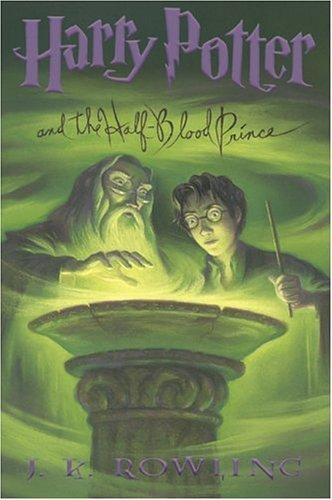
Cover of Harry Potter and the Half Blood Prince

I haven't felt very "into" Harry Potter in a while-- I think that maybe after I finished reading the last book, I felt like I was done; I found it to be a satisfying conclusion to a good series. When "The Deathly Hallows Part 1" movie came out last fall, I wasn't excited about it and I didn't actually end up seeing it until just a few weeks ago. But I guess the enthusiasm of other Harry Potter fans and seeing a few of the later movies again was contagious and got me back into it. So, I decided to re-read the last two books in the series, leading up to seeing the last movie, and I'm glad that I did. This is the book where we, with Harry, learn who Voldemort really is, and how the boy Tom Riddle became the fearsome Lord Voldemort. And we also get to see a bit more human and vulnerable Dumbledore.

Read more...

Sunday, May 22, 2011

read full post >

cover of Dogsbody

dogs·bod·y: A person who is given boring, menial tasks to do; naval slang for someone of very little importance.

Like the title, this book works on so many levels; it is well worth repeat readings. The luminary of the dog-star Sirius, as punishment, is sent to Earth where he is born as a half-breed pup. So, he is literally born into a dog's body, but in the process, he's also given a pretty low status, especially for someone who used to be something like an angel. I've lost track of how many times I've this book, but I still had new insights into the book this time around. When I first read of Diana Wynne Jones' death, my first thought was that I should re-read my favorite of her books as a kind of memorial, and this was the first favorite DWJ book that came to mind (although then I remembered the Chrestomanci books, and Howl's Moving Castle...).

Read more...

Tuesday, November 09, 2010

read full post >

cover of 'Mockingjay'

What an intense, powerful book. After the crazy escape/rescue from the Quarter Quell, Katniss finds herself recovering in the fabled District 13, where they want her to be their "mockingjay", their symbol of revolution. Katniss finally agrees, but then discovers that they want to dress her up and make her look good so they can use her for propaganda videos: which seems not all that different from the way the Capitol used her. But Katniss isn't an actress, and she sounds terrible saying the words they want to put in her mouth-- so finally Haymitch has the brilliant idea to send Katniss out to do things, visit the districts that have rebelled, and just film her doing what comes naturally to her. This works out pretty well, but as the rebellion goes on and more and more districts break free from the hold of the Capitol, Katniss sees more of the war and more of District 13, and begins to wonder who she can trust, and whether or not the new regime would be that different than the old one.

District 13 is a tough place for Katniss to live-- very regimented and orderly, scheduled and efficient, living underground and away from nature most of the time. With their limited resources and a bombed district above-ground, they have had to live like that to survive, and they've done fairly well, although it is hard for Katniss to come to terms with the idea that District 13 had a cease-fire with the Capitol while the other districts suffered-- they agreed to be left alone in exchange for letting the Capitol make the other districts think that 13 had been completely destroyed.

War changes people, and we see that in many characters in this book, just as having to fight in the Hunger Games changed Katniss and Peeta. One of the most heartbreaking story-lines in this book is what happens to Peeta-- he and a few others were left behind when Katniss was rescued, and Katniss sees him on TV as a mouth-piece for the Capitol-- first well-fed and healthy, but then more and more gaunt, confused, and unhealthy. Finally they are able to rescue Peeta and Johanna, but they have been tortured, and sweet, gentle Peeta has been brain-washed into something cold and hateful. Another character who we see changed by war is Gale-- he turns his cleverness in fashioning traps for hunting animals towards bombs and other mechanisms of war; from the first book in the trilogy there were hints about his anger at the Capitol, but we see that hardness come out in his actions in this book. Towards the end, the parallels between war and the Hunger Games are made explicit when Katniss, Finnick, and the rest of their team must work their way through the Capitol, which has been laced with mines and traps, just like the arena in the Games.

There are hints occasionally throughout the book that the leadership of District 13 may be no better than the Capitol-- in fact, I wondered if the name of President Coin was a hint towards that; she is just another side of the coin of the evil and manipulative President Snow. There is a chilling moment late in the book when a question is posed that makes the human capacity for evil explicit, when a new round of Hunger Games is suggested as a possible solution to deal with the horror and death of the war.

The world Collins has created in this trilogy is so rich and full and believable (if horrible in some ways). The mockingjay of the title is one of those wonderful details that has been present since the first book, when Madge pins a gold pin onto Katniss' dress before she leaves on the train to go to the games. The mockingjay becomes an apt symbol of the revolution because it is a cross between the mockingbird and the jabberjay that the Capitol engineered as a bird-spy, which the rebels figured out and turned against them-- and the mockingjay is a reminder and a sign of that technology living on in another form, in a way that the scientists of the Capitol could never predict or control. In this book we also get the explanation for the source of the name of the country of Panem-- it's taken from the Latin panem et circenses, bread and circuses, which refers to appeasing the populace with food and spectacle, drawing a parallel between the Colosseum of Rome and the Hunger Games of Panem.

As the book ends, we get a glimpse of Peeta, Katniss, and Haymitch, and their life after the turmoil of the events of the book. I was glad to read some small part of their story, and what they did to mourn and remember the things they went through and the people that they lost, and to think of them wrestling with how to tell their story, the awful things they did, to the next generation. Afterwards, it struck me that the people who were victors in the Hunger Games and instrumental in winning the war ended up pretty far-removed from the actual running of the government after the fact; and I can't help but think, perhaps this is because the kind of people who can win these deadly games (war or otherwise) aren't the ones you want holding the pieces after.

Title:Mockingjay
Author:Suzanne Collins
Date published:2010
Genre:Young Adult / Science Fiction
Series:The Hunger Games Trilogy
Number of pages:390
Notes:borrowed from Catey

Read more...

Saturday, November 06, 2010

read full post >

cover of 'Catching Fire'

I had heard that the sequel to The Hunger Games (which I read last month) wasn't quite as good or as enthralling as the first book in the trilogy-- but I found this book quite engaging and easy to read, and almost as hard to put down. We find Katniss and her family more or less settled into her posh house in the nearly unoccupied Victor's Village of District 12, with running water and a telephone but no one to call; she still hunts with Gale, but not because she or her family need it, but his does-- and she needs something to do, to keep herself busy. We pick up the story just before Katniss and Peeta go on the road to visit all of the districts, in a terrible victory tour that reminds all the other districts and families and parents what they lost-- but Katniss gets a secret, threatening visit from President Snow to tell her, she'd better continue pretending to be crazy in love with Peeta, because otherwise... Katniss' clever solution to keeping both herself and Peeta alive at the end of the last book has become a symbol of rebellion, of out-witting the all-powerful Capitol; Snow threatens her family and friends if she doesn't do everything she can to discourage that view of things, but as they make their way through the districts, Katniss begins to realize maybe it doesn't matter what she does or says, she can't convince anyone or change anyone's mind...

Read more...

Saturday, October 16, 2010

read full post >

cover of 'The Hunger Games'

It's a little hard to believe that this intense, violent story set in an oppressive, dystopic world was written for young adults, but now that I've read it I can understand why the series is so popular. The story is narrated by Katniss, a teenager who's provided for her family (mostly by illegal hunting) ever since her dad was killed in a mine explosion. They live in District 12, one of the poorest districts of the nation of Panem, in what used to be North America. Out west beyond the Rockies is the luxurious, wealthy Capitol city-- but the people of the districts are oppressed and kept poor even as they work for all the goods that supply the Capitol. As punishment for an old rebellion that left a thirteenth district completely destroyed and as a reminder of who has the power, every year each district must send two of their children-- a boy and a girl-- as "tributes" to participate in the Hunger Games, something like a reality TV show in a huge (but controlled) outdoor setting where the children must fight to the death. Katniss's little sister, Prim's (the only person Katniss is sure she loves) name is the one that is drawn-- so Katniss volunteers to take her place. Of course, that's only the beginning of what is quite an engaging, page-turning, compelling story.

Read more...

Wednesday, March 24, 2010

read full post >

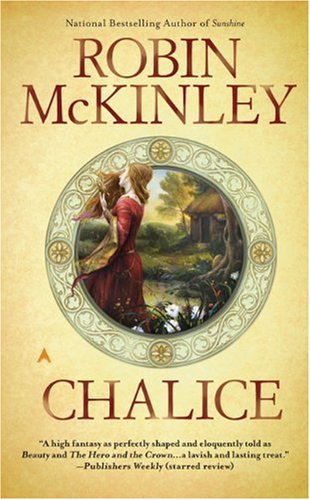
cover of Robin McKinley's 'Chalice'

Mirasol was a beekeeper and woodskeeper until the Master and Chalice of the Willowlands were both suddenly and violently killed, without heir and apprentice. The land chose Mirasol to be the next Chalice, and so she had to step into the official role, second in the Circle, without any training or apprenticeship (and to the apparent dismay of the remaining members of the Circle). The Chalice is a magic user and a cup-bearer who mixes drinks to bind, or connect, or help make decisions, and is part of many rituals of the ruling of the demesne, and who works with the Master of that demesne to protect the land and the people. But the Master that Mirasol must learn to work with is the younger brother of the dead Master, who was sent away to become a Fire Elemental Priest six years ago. The Grand Seneschal sent for him out of desperation, and he returned out of loyalty and responsibility to the land; but he had gone far enough into the priesthood that he is no longer quite human, and certainly looks and moves very strangely, with blackened skin and reddish eyes. However, Mirasol is also different than any other Chalice; usually their magic runs in wine or water, or occasionally milk (and, in ancient, more violent times, occasionally blood); but the power of the Chalice manifests itself in Mirasol's honey and her bees.

Read more...

Sunday, December 13, 2009

read full post >

cover of 'Searching for Dragons'

The sequel to Dealing with Dragons, this story starts with Mendenbar, the young king of the Enchanted Forest, out for a walk when he discovers a patch of forest that seems to have been burned, and all the magic sucked out of it.  A little investigation and a consult with Morwen shows that someone is trying to frame the dragons for this destruction, and perhaps provoke war between the dragons and the Enchanted Forest, so Mendenbar sets off to meet with King Kazul (although he's a little dismayed to hear the dragon has a princess, as he prefers to avoid silly, hero/husband-hunting girls).  When he arrives, he meets Cimorene (not at all what he expected from a princess), who is just about to head out to try to find Kazul, who seems to have gone missing.  Since it seems to involve his kingdom as well, Mendenbar joins her.  Along the way, they sup with giants, ride on a broken-down magic carpet (decorated in pink with teddy bears!), meet Rumpelstiltskin's descendant Herman, as well as a scholar-magician named Telemain, before they face the nefarious wizards and, of course, fall in love.

Read more...

Friday, November 27, 2009

read full post >

cover of 'Dealing with Dragons'
Cimorene is a princess who gets bored with all the proper things she is supposed to learn (etiquette, sewing, and the like), and keeps finding more interesting things to do-- like fencing lessons, learning magic, or even how to cook-- but her more interesting lessons are always halted as soon as her parents find out. Despairing over what to do with her, they decide to marry her off to a prince in a neighboring kingdom. When Cimorene figures this out, she decides to run away-- and with a helpful tip from a talking frog, she finds some dragons and volunteers to be a dragon's princess-- which is quite "proper," since it happens to princesses all the time, and much more interesting for Cimorene.

Read more...

Sunday, November 08, 2009

read full post >

cover of 'House of Many Ways'
Charmain is volunteered by her aunt Sempronia to watch her great-uncle William's house while he is away for health reasons. William is a magician, and both he and Sempronia assume that Charmain has basic knowledge of magical things-- but she doesn't, because her mother doesn't think it is nice or proper to learn such things. Charmain is excited about it only because she thinks it will give her more uninterrupted time to read books. The house is a magical one-- it seems to have only two rooms, but if you go through the door to the kitchen and turn just as you go through, you find yourself in a long hallway with the study and several bedrooms, and a window that lets out onto a meadow-- and that is just one of the simpler of the "many ways" of this house. Charmain finds herself adopted by a dog named Waif, and becomes friends with Peter, who has come to be an apprentice to her uncle; Peter is a bumbling magician, but has much more practical knowledge than Charmain herself, who doesn't know how to do laundry or dishes.

Read more...

Friday, September 25, 2009

read full post >

After finishing reading Howl's Moving Castle, I wanted to re-read Castle in the Air. It is an unusual sequel, because the characters we know from the first book are in disguise (by magic of course, in this case not their own) when we first meet them in this story, and even that is not right away. We actually follow a day-dreaming carpet merchant named Abdullah, whose fairy-tale daydreams start coming true after he buys a magic carpet-- he meets a beautiful princess, he ends up wandering in the desert and runs into the villainous bandit he dreamed up, and ends up on a quest to rescue the princess he loves. Of course, his daydreams literally are coming true because a djinn has overheard them and is playing a bigger game.

Read more...

Sunday, September 20, 2009

read full post >

cover of Howl's Moving Castle
The delightful story of Sophie, Howl, and Calcifer. In a magic, fairy-tale land where seven-league boots actually exist (although they are demonstrated to be difficult to control when your balance is very good), Sophie doesn’t ever bother to seek out her fortune because she knows as the oldest of three sisters, she is destined to fail first and worst. Her sisters aren’t afraid to seek out what they want (even to the extent of deceiving their mother to trade places), but Sophie stays where she is. Only when she is cursed into old age does she venture out, and her “disguise” as an old woman gives her a new kind of freedom-- she isn’t afraid, she’s more willing to speak out and do what she wants, even to the extent of forcing herself into the castle of the wizard Howl as his housekeeper. Howl is selfish, vain, slapdash, and heartless (literally, in a way, because of his contract with Calcifer that Sophie is supposed to be trying to figure out and break), and yet he is also sweet, quite thoughtful at times, and tenderhearted. Of course, it is Sophie’s qualities as an older sister that make her capable of dealing with Howl-- when he has a tantrum of green slime, she and Michael push him to the bathroom and dump him in the tub, and Sophie mops up the slime that is everywhere.

Read more...

Tuesday, September 08, 2009

read full post >

cover of 'Sabriel'

As an infant, Sabriel nearly-- or, to be more accurate, briefly-- died. But her father, Abhorsen, stepped across the boundary between Life and Death, and brought her back. Abhorsen is a necromancer unlike any I have ever read about-- instead of summoning the dead, he binds the dead that haunt the living, and he assists-- or forces-- them to cross the final gate. Now a young woman and nearly finished with her schooling in Ancelstierre, Sabriel learns that something has happened to her father-- he is either bound somewhere in Death, or perhaps actually dead. So, she crosses back into the Old Kingdom, where she discovers that Abhorsen is not a name but a title, and that she has inherited it. A powerful, Greater Dead creature and its minions are stirring, and she must outrace them to find her father and save the kingdom.

Read more...

Saturday, August 22, 2009

read full post >

cover of  Buffy Omnibus Vol. 1

For some reason, I was unaware of the fact that there were so many Buffy comic books before the new Season 8 run. This is the first book in an omnibus series that collects them all in chronological order. This one starts with "All's Fair", a story about Dru and Spike on a rampage at the 1933 Chicago World's Fair, which I didn't particularly enjoy, but then it gets more Buffy-centric. "The Origin" is a comic-book adaptation of Joss Whedon's original screenplay for the Buffy movie; the stories after that cover the time between the movie and the TV series, while Buffy was on her own without a Watcher. She and Pike take a trip to Las Vegas to hunt down vampires in "Viva Las Buffy!". In "Dawn & Hoopy the Bear" we get a story of Dawn's experience while Buffy has run off and their parents are on their way to divorce; a teddy bear ensorceled with a djinn meant for the slayer is mistakenly delivered to Dawn, but her distracted mother just thinks Dawn has a wild imagination when she takes about the bear coming alive. Then, in "Slayer, Interrrupted" we get the story of Buffy's stay in the mental hospital, which is referred to in the TV series. Interspersed with these, we also get some interesting parts of Giles' path to becoming Buffy's Watcher.

I had a little bit of trouble getting into this book because I didn't enjoy the first story; I know some people really love Spike and Dru, but a whole story with them killing and destroying just isn't my thing. In this story and in some of the others, I felt like there might be references to characters or events in the TV series, but I'm not familiar enough with them to catch it-- and not sure I care enough to go to the trouble of looking it up. Angel shows up in the Las Vegas story, and I wondered about the time lines of that, but again, I guess I'm not familiar enough with all the details of his back story to know how this fits in.

As Scott Allie points out in his brief introduction, these stories include Dawn-- which is an interesting choice. Like him, I'm glad that we got the story of "Dawn and Hoopy the Bear"; but other things make me wonder a bit about how things would have worked without Dawn being there. For instance, Dawn is the one who reads Buffy's diary (because she misses her), and that is how Buffy ends up getting sent to a mental institute.

Artwork for comic books based on TV shows and movies can be a little strained sometimes-- either they are too creepily like the actors or they aren't quite recognizable. In this case, I found the artwork to be quite good, and it certainly never distracted me from the story being told.

I enjoyed this enough that I'd be interested to read the other Buffy Omnibus collections, although I'm a bit intimidated by the fact that there are 7 volumes.

Title:Buffy the Vampire Slayer Omnibus, Volume 1
Author:
Date published:2007
Genre:Young Adult, Graphic Novel, Horror
Series:Buffy the Vampire Slayer
Number of pages: 296

Read more...

Friday, November 07, 2008

read full post >

cover of Chronicles of Chrestomanci Volume 1

It was so delightful to read the newer Chrestomanci books and re-acquaint myself with the wonderful characters of Cat and Christopher Chant that I found myself wanting to go back and read their own stories again. Both stories tell stories about young boys with nine lives, destined to be the Chrestomanci, the only magic-user powerful enough to police the rest of the magics in the twelve related worlds. But when we meet them, both boys are quite powerless and pretty lonely, and don't have any idea that they are actually powerful magicians. In Charmed Life, the orphan Cat lives with his beloved sister Gwendolyn, who is very pretty and seems to be a talented young witch. What he (and we) don't realize for quite some time is that Gwendolyn isn't all that powerful on her own; she has simply been using Cat's magic. In The Lives of Christopher Chant, young Christopher isn't an actual orphan but he might as well be-- his rich, society mother drives away his kind, worried father (who has enough premonition to sense something bad is going to happen to Christopher, but not enough power to know what to do about it). In his dreams, Christopher travels to strange and wonderful lands, but the gifts from strangers that he carries back in his dreams actually end up in his bedroom. When a clever nanny figures out what this means, Christopher's uncle begins making use of this ability to do some "experiments"; the young, lonely Christopher is so eager to please his uncle that it doesn't occur to him for quite some time that he might be doing something dangerous or illegal.

Cat and Gwendolyn eventually go to live with Chrestomanci (the grown-up Christopher Chant). Chrestomanci decides that Gwendolyn cannot be taught or practice magic until she has caught up on other things (which she neglected entirely, devoting herself to magic). Her tantrums and spiteful magic on the castle grounds, in the house, at the dinner table, and the like are quite entertaining and an interesting look at what it might be like to live with a powerful and capricious teenager (hopefully anyone who has to deal with that has a staff of trained magicians to clean up and keep them in check, as Chrestomanci does). Eventually, she decides she isn't going to get what she wants so she decides to jump to a different reality where she will be worshipped and adored-- but in doing so, she burns up another of Cat's nine lives and shifts a whole sequence of alternate Gwendolyn doubles into different realities, leaving a girl named Janet from an unmagical world like ours in her place. Finally, Cat makes the painful discovery that Gwendolyn was completely selfish and uncarinng, and he finally decides that he does mind having his magic borrowed and used without his permission, and is able to use some of his powers to help save the day in the climactic fight.

The young Christopher Chant seems to have no aptitude for magic because of an undiagnosed magical "allergy" that inhibits his powers. When he finally goes to a teacher that his father finds, he is instructed to empty his pockets, and then when he does the spell that's asked of him he had so much power he lifts the whole roof of the house off. The travelling between worlds that he does is also quite powerful and beyond what most people can do; because of his nine lives, he can just leave a life behind in bed and go somewhere else. But there are consequences, too-- when an accident kills his dream-self, then something similar happens in real life to finish the job and takes on of his lives. In the midst of his world travels and unknown black-market smuggling for his uncle, Christopher meets and strikes up a friendship with a girl who is the living Asheth, a goddess-- in exchange for a temple cat named Throgmorten, he brings her books to read.

Although he is pretty unhappy about it, Christopher eventually goes to live with the current Chrestomanci, Gabriel de Witt. When de Witt is incapacitated in the fight against the mysterious smuggler they can't seem to catch (Christopher's uncle), Christopher has to take over organizing the fight (with some help from Throgmorten and Millie, the former Living Asheth, who chose a name from her favorite series of books about a schoolgirl), Christopher has a revelation-- he sees that de Witt doesn't enjoy his duties as Chrestomanci at all, but finds that he, Christopher, loves it and is actually pretty good at it.

Title:The Chronicles of Chrestomanci Volume 1 consists of Charmed Life (1977) and The Lives of Christopher Chant (1988)
Author:Diana Wynne Jones
Date published:2001
Genre:Young Adult Fantasy
Series:Chrestomanci
Number of pages:598
Notes:second reading

Read more...

Google Search

Google