Book/page totals

Top 10 Lists

Showing posts with label mary stewart. Show all posts

Saturday, February 07, 2009

read full post >

cover of 'Nine Coaches Waiting'

Perhaps the best of all of Mary Stewart's many suspenseful romance novels. Linda Martin has been living in England for the last 10 years, ever since she was orphaned. She returns to France (where she was born and spent her childhood years before her parents died) to take a job as a governess caring for the nine year old Comte de Valmy, Philippe. Her employers are Philippe's aunt and uncle: the beautiful but cold and distant Heloise, and the virile, forceful Leon-- a handsome, powerful man who was crippled in an accident years before, and since then has devoted his great, wheelchair-bound energies to running the Valmy estate. Because Linda is so set on getting back to France and away from her dismal life in England, shes conceals from her employers that she is half French and speaks the language quite well, and she tells herself it was just a silly impulse; but when things start to go wrong around her young charge, the situation begins to seems more sinister, and she wonders if her instincts were right.

There are lots of literary allusions throughout the text, and even the title is a reference to a line of poetry (where a young woman is being seduced by riches and luxury, but is hurrying "to the devil"). The allusions that are woven into the text don't seem as out of place as they might, though, because they are a part of the main character and narrator. At one point, Linda reflects to herself,

"I was sharply grateful to Daddy for making poetry a habit with me. ... Daddy had been right. Poetry was awfully good material to think with."
This is part of what makes the novel work so well: Linda and Leon are both aware of the similarity of their situation to that of Jane Eyre, and Leon suggests to others that he is a fallen angel, Milton's devil.

Soon, Linda meets and then falls in love with Leon's son, Raoul. Like his father, he is dark and handsome and powerful, and can turn on his immense charm at will. The relationship between Linda and Raoul (and people's perceptions of it, the servant's gossip) plays perfectly into the plot of the book, and become part of the plots against Philippe. The most difficult thing for Linda is that, she doesn't know if she can trust the man she loves. She still loves him, and if it were only her, she would take the chance, but when she tries to look at events and the evidence she has heard objectively, she sees that it could be read either way, and she dare not risk a child's life on the impulse of her own love. How she deals with this struggle and the outcome of her decisions is believable and touching.

It occurred to me after finishing the book that all the main characters are orphans, to some extent. Linda and Philippe are obviously so: their parents are dead, and they have to be cared for by people who don't care about them (or maybe even hate them and wish them harm). But Raoul is also a kind of orphan-- his English mother died long ago, and his crazy, hurtful, megalomaniac father may be worse than no father at all.

I don't think I noticed it before, but the chapters of the book are grouped and labeled as coaches, starting with the first and working up to the ninth. As far as I can tell, each of these sections actually does have a significant "coach" or car ride: Linda's taxi ride in Paris to see the old apartment where she had lived with her parent, the silent ride from Paris out to the country and Valmy, the fateful first meeting with Raoul on the mist-covered bridge, the outing with Raoul, the nerve-wracking car chase in the dark, Linda's final meeting with Raoul on the same bridge in a scene that echoes their first encounter perfectly. This structure perfectly plays out the title and its reference to a young woman being hurried to the devil.

This is my mother's favorite of all Mary Stewart's romance novels (maybe of any of her novels); I think it is probably the first one I ever read.

Title:Nine Coaches Waiting
Author:Mary Stewart
Date published:1958
Genre:Mystery/Romance
Number of pages:342
Notes:repeat reading; gift from Jane

Read more...

Sunday, March 30, 2008

read full post >

cover of Thornyhold

In Gilly's lonely childhood, the occasional visits of her older cousin Geillis were moments of sunshine and magic. Now Gilly is grown up and on her own, and discovers that her cousin Geillis has died and left her country house, Thornyhold, to Gilly. As she moves in and begins to get settled and meet her neighbors, she discovers that the people considered her cousin to be a kind of wise woman or witch, that the first owner of Thornyhold had an interested in herbs and remedies, and that some of Gilly's new neighbors expect her to continue the tradition. She has suspicious run-ins with the neighbor who lives at the gate-house, who claims to be looking for a special recipe hidden somewhere in the house (but it turns out she is looking for an old spell). Gilly also meets a young boy named William and his father (a handsome, divorced writer). And as the pigeons slowly return to the empty pigeon roost in the attic of the house, Gilly begins to receive messages-- mysterious, but encouraging.

The attitude towards magic and witchcraft is interesting here and a little ambivalent; it seems that Stewart is presenting different kinds of magic, because Cousin Geillis is definitely gifted in some kind of supernatural ways-- not only with her herbs and remedies for William's ferrets, but she also has some kind of foresight or prescience that's never fully articulated. However, Agnes thinks of herself as a witch, and even tries to recruit Gilly into her little coven-- which is almost more of a club, and seems harmless. But we discover, with Gilly, what means Agnes will use to accomplish her goals; for the love potion she is trying to make, she needs the hairs of a dead or dying dog, so she forces her dim-witted son to keep a dog tied up and starving in order to get her ingredient. When Gilly discovers, she is shocked and rescues the dog, nursing him back to health; it's clear that her attitude mirrors that of her cousin, who cared for all animals and life.

Enjoyable, quick read with engaging characters, a delightfully annoying villain, and a perfectly appropriate happy ending.

Title:Thornyhold
Author:Mary Stewart
Date published:1988
Genre:Romance
Number of pages:289
Notes:repeat reading

Read more...

Saturday, March 29, 2008

read full post >

cover of The Gabriel Hounds

I met him in the street called Straight.
How can you not love an opening line like that? It catches my attention right away and communicates so much with so few words.

Christy Mansel is vacationing in Damascus and runs into her cousin Charles. They decide to drop in and visit on their eccentric Great Aunt Harriet, who has been living on her own in a crumbling, isolated old palace, much like the legendary Lady Hester Stanhope. Charles is detained by business, so while Christy is out on a driving tour she decides to stop by and see if they can visit later. She finds things much stranger than expected, and ends up staying the night in order to meet her aunt, who keeps strange hours. But in the morning, the river is in flood and Christy is stuck. Christy's description of Great Aunt Harriet and the whole situation strikes Charles as being "a bit off", so he does a bit of rock climbing and sneaks into the palace, and they do some exploring and investigating together. Of course, they find that things are not at all what they seem; someone has been taking advantage of this isolated spot to smuggle drugs, which is both very lucrative and very dangerous.

I was surprised to find that this book reminded me of Touch not the Cat-- cousins discovering they love each other, a climax where the lovers are stranded in the middle of an exotic location (in one instance, a hedge maze in the middle of a flood, in the other, an island in the Seraglio garden while the palace goes up in flames), and then of course there are dogs and images of dogs everywhere instead of cats.

The "Gabriel" hounds of the title are a pair of china dogs that Charles admired and nicknamed, which Harriet promised to him (he was always her favorite nephew). As it turns out, this is another variation of the hellhounds of Arawn, like those in Diana Wynne Jones' Dogsbody [read in 2006 by Lark, 2007 by Sapphire]. Harriet also has a pair of Salukis, and missing in action is her beloved terrier Samson, whom Christy and Charles think is dead until they fail to find a grave for him with Harriet's other dogs. And actually, cats figure into the story too, because Christy has an unnatural loathing and fear of cats, and her encounter with one during her interview with Lady Harriet provides Charles with another clue to what is really going on.

A completely entertaining, engaging book. Plenty of danger and adventure, and, of course, love, since Christy and Charles figure out what their family has apparently expected for years (and what the reader probably expects from the first line of the book) figure out that they belong together.

Title:The Gabriel Hounds
Author:Mary Stewart
Date published:1967
Genre:Romance/Mystery/Adventure ?
Number of pages:244
Notes:repeat reading

Read more...

Tuesday, September 18, 2007

read full post >

Saw this book when I was in the Mary Stewart section of the library, and was intrigued enough to check it out and read them. I was mildly surprised (although maybe I shouldn't have been, since Stewart's writing is generally pretty tight, careful and well-crafted) to find myself enjoying them. For the most part, they are fairly formal and make use of rhyme schemes, although not all of them. There's one about a petrel that reminded me very strongly of Hopkin's sprung rhythm, particularly his poem "The Kingfisher."

There were also several mythological poems (none of them particularly struck me), and the book ends with her Merlin poems which I guess were originally published in her Hollow Hills series.

(The copy I read is a hard-bound library book with no cover; I looked all the usual places online and couldn't find a single book cover image for this book.)

Title:Frost on the Window
Author:Mary Stewart
Date published:1990
Genre:Poetry
Number of pages:110

Read more...

Wednesday, September 12, 2007

read full post >

cover of The Ivy Tree

This book is rather different from most of the other Mary Stewart books I've read. A young woman visiting northern England is mistaken for a missing heiress who disappeared years ago. Con, the cousin of the missing girl convinces Mary to pretend to be the missing Annabel and come visit her father's farm-- all in order to cement the disposition of the property on Con, who has been managing the land for years. Of course, when she gets there things are much more complicated than she expected, and she becomes less and less certain that Con can be trusted, as it seems he will do anything (even commit murder) to accomplish his goals. She also discovers, seemingly by accident, that the missing Annabel had a relationship with a neighboring farmer-- they used to leave each other notes in the hollow of an old ivy tree where the road split between the two properties.

This is one of those books that intentionally tricks the reader-- and at the end, when all is revealed, you flip back through the pages and realize, yes, the evidence was all there, carefully placed, but obscured and easy to miss. In Stewart's novels, things are rarely what they seem-- but in this book that is even more so than with the others I've read. Characters in the book are often surprised at Mary-- she seems so changed from the Annabel they knew, and yet she knows and does things that fit so well. Even as the reader I found myself wondering and then second-guessing myself-- in spite of the fact that Annabel was a masterful horsewoman, and Mary Grey seems quite terrified of horses. Of course, this made it a much more interesting and exciting read.

This seemed like a darker book and a more questionable romance than I remember in other Stewart novels. Annabel, as a young woman, was having an affair with a married man who detested his wife. This forbidden love was the reason she left her home and fled to America, and now the old lover is scarred and wounded by his terrible life. It has a fairly happy resolution, but it seems bittersweet, and there is plenty of darkness and evil around, too.

Title:The Ivy Tree
Author:Mary Stewart
Date published:1961
Genre:Mystery / Romance
Number of pages:320
Notes:recommended by Nancy Pearson, author of Book Lust, on her NPR radio show / podcast

Read more...

Monday, September 10, 2007

read full post >

cover of Touch Not the Cat

Bryony is a young woman from an old British family, the Ashleys, and she returns to her family home under strange circumstances, after her father dies in a suspicious hit and run. There are plenty of legends and colorful stories about the Ashley family history, but one story-- that some family members have a "gift," some kind of psychic ability-- turns out to be true, because Bryony has had a special connection with one of her cousins since she was a child, and now thinks of him as her psychic lover. The only problem is, she isn't quite sure which cousin it is; none of them quite seem to fit. Of course, there turns out to be a cousin she didn't know about, and another interesting complication to the Ashley family legends. It's been long enough since I read this book that I didn't remember right away who Bryony's love was, which made reading it more fun.

As in most Mary Stewart novels, there's plenty of intrigue and mystery. Bryony's cousins (twins who were always partners in crime as children) have started selling off heirlooms from the estate (which they will inherit) because they have a "cash flow problem," in the process corrupting the young American girl whose family is renting the estate (and who is in love with one of the twins). There's also a cryptic message from her father that she can't quite make out, and interesting connections and revelations about their family history, the family crest and motto (which is where the title comes from), drawn and combined from various sources over history. And then, near the end of the book, after the trauma of a flood and near death, the discovery of a ancient Roman mosaic (of a cat, of course) that might be enough to save the family home.

The cover image is from my copy-- an old paperback I bought somewhere with a strange design, but it plays with the idea of the family crest and the maze and the cat images that run through the book.

Title:Touch not the Cat
Author:Mary Stewart
Date published:1976
Genre:Mystery / romance
Number of pages:302
Notes:repeat reading

Read more...

Sunday, October 09, 2005

read full post >

cover of Rose Cottage

The heroine of this Mary Stewart novel is a young war widow who returns to her childhood home (the cottage of the title) to take care of a few things for her grandmother. One of those things is a secret safe, hidden behind the plaster and the wall-paper; the contents of the safe are not rare jewels, but rather the family treasures and documents (birth, baptism, and marriage certificates, and the like). Our heroine is surprised to find that the safe has been uncovered and opened-- with a key-- and that the documents are gone. Her perplexity increases, as she and her childhood friend Davey keep running across odd stories from the neighbors and strange occurrences around the cottage which suggest someone has been around. Although there's no evidence of maliciousness or mischief, the missing papers make no sense to Kathy, because the only living family members are herself and her grandmother.

I enjoyed this book because it seemed to deviate a bit more from the usual Mary Stewart mysterious romance book. In this case, the main character is a widow, which means she isn't looking for love; there is still a romantic sub-plot here, but it is more subdued than in some of Stewart's other books. Certainly, there isn't more than one love-interest, one of whom turns out to be evil. I also enjoyed the mystery, because it is so much more personal to the character, rather than a dangerous political conspiracy or illegal smuggling. The heroine is struggling a bit with her identity-- this is brought to the fore by the play of names. Her married name is Kate Herrick, but when she returns to Rose Cottage she is once again the Kathy Welland everyone knew. Kathy's identity questions are compounded by the fact that she was born out of wedlock, never knew who her father was, and was left by her mother at a young age. So it's quite charming that the mystery touches on Kathy's own questions about her identity and roots.

Rose Cottage is an entertaining read, which doesn't take long to finish. Stewart's descriptions of rural English and Scottish countryside are pleasant, and there is enough local color in the dialogue of the characters to be both believable and entertaining. The central mystery of the plot is not a complete surprise; I guessed the main secret a while before the main characters figured things out-- but this story is different enough from the other Stewart novels I have read, and more personal in its dynamics, that it was still quite fascinating to find out how exactly the story ended. As in other novels by Mary Stewart, she doesn't give you all the details, doesn't bring everything to complete closure-- she gives enough to satisfy the reader, and finish the main story threads (or suggest where they will end), while still keeping a slight air of mystery.

Title:Rose Cottage
Author: Mary Stewart
Date published:1997
Genre:Mystery / Romance
Number of pages: 264

Read more...

Wednesday, September 28, 2005

read full post >

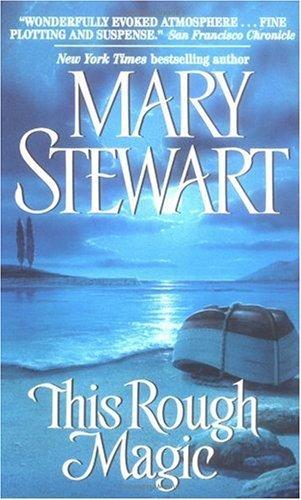
cover of This Rough Magic

Lucy Waring is an aspiring actress on the London stage, whose latest play has just folded. So, she comes to the Greek isle of Corfu for an idyllic holiday with her sister, who happens to be married to a wealthy Roman lawyer, and owns some property on the island. But, of course, this is Mary Stewart, so the idyllic vacation is quickly swallowed up by mystery and adventure. It is almost inevitable that our intelligent and brave heroine will meet two men, both handsome, and that one will be a villain, and the other will become a villain. Can you guess which?

The book's title, of course, is from The Tempest, near the end of the play when Prospero is calling an end to his own magic-making:

But this rough magic
I here abjure, and, when I have required
Some heavenly music, which even now I do,
To work mine end upon their senses that
This airy charm is for, I'll break my staff,
Bury it certain fathoms in the earth,
And deeper than did ever plummet sound
I'll drown my book.
There are plenty of references to Shakespeare's play throughout the text. Each chapter begins with an appropriate line or two as epigraph. One of the characters staying on the island is a famous actor, Julian Gale, now living in seclusion. The last role he played was Prospero, and he believes Corfu is the "real" island of the Tempest. There is even a certain conflation with Prospero and the patron saint of the island, St. Spiridion. Many of the boys on the island are named after this saint, and the shortened version of the name, Spiro, sounds even more like Prospero. There is a rather delightful moment when a character thinks that her boyfriend has found proof that Prospero really was on the island, because they have found something that looks like a book hidden underwater, but it is actually proof of the misdeeds of the book's villain. I was a little disappointed that there was no real conclusion to this idea of Corfu being Prospero's isle, no huge connection to the world of the tempest or to the "rough magic" of the title. Stewart does bring those words in near the end, as if to justify the title:
"You've seen the other face of the enchanted isle tonight, haven't you, my poor child? It's a rough sort of magic for such as we are-a mere musician, and a couple of players."

There is also a dolphin in the book, who is mostly present to service the plot, but he gives a few moments of delight. When Lucy first sees him, she notices that someone is shooting at the dolphin with a silencer, and after scaring the dolphin away, she charges up to yell at the only person she can see nearby (who, of course, turns out to be innocent-- although Lucy stubbornly refuses to believe this for some time). Later on, the dolphin strands himself on the beach at night, and Lucy, with a little bit of help, manages to get him back into the water before he dehydrates and dies. Still later, the dolphin returns the favor, and in his turn saves Lucy. It seems a little bit unrealistic, and romantic-- but perhaps also a bit like a friendly spirit such as Ariel, helping out those who are shipwrecked on Prospero's isle.

I was a bit surprised to read on Amazon that several reviewers counted This Rough Magic as one of their favorite Mary Stewart novels, along with Nine Coaches Waiting. Perhaps it is only because I have read enough of Mary Stewart, but I found the plot rather predictable. I guessed fairly early on that the man Lucy was initially most resistant to and suspicious of would be the one she would eventually fall in love with; I suspected the villain's actions had something to do with the political turmoil in Albania, when it was mentioned, although I'm not familiar enough with this kind of illegal maneuvering to guess what the specific crime might be. I was also a little troubled by the portrayal of the natives; Stewart's portrayal of the Greeks seemed a bit racist. She stereotypes them all as delighting to serve, and when it is a matter of one man's word against another, the Greek police are inclined to believe an educated European man rather than a Corfiote boy. This Rough Magic is certainly well-written and entertaining, but I don't feel that it is on quite the same level as Stewart's best work (including the superb and rightly praised Nine Coaches Waiting).

Title:This Rough Magic
Author:Mary Stewart
Date published:1964
Genre:Mystery / Romance
Number of pages:254

Read more...

Google Search

Google