Book/page totals

Top 10 Lists

Showing posts with label historical fiction. Show all posts

On this page:

Thursday, September 15, 2011

read full post >

cover of 'Mark of the Horse Lord'

Red Phaedrus the gladiator was born a slave and unacknowledged bastard son of a Roman merchant in the household, son of a northern slave woman; when his owner died he was sold, and then sold again to be a gladiator. Phaedrus survives four years as a gladiator (no small feat), and when Governor Sylvanus Varus celebrates his appointment in Corstopitum with an elaborate four days of games, Phaedrus draws the lot of dueling to the death with his one friend among the group. He nearly loses, but when he survives he wins his freedom-- which, it turns out, he doesn't really know what to do with. Fortunately (or, perhaps unfortunately), his red hair and northern face catches the eye of a merchant who has a particular use for him.

Read more...

Monday, April 28, 2008

read full post >

A young girl named Rachel is growing up in Hawai'i, in a time when leprosy is seen as a horrible and dangerous disease. Such that if someone shows signs of it they are taken to a special hospital and if they are not cured, they are sent to Kalaupapa, an island for those with leprosy. She spends time at the hospital and ends up being sent to the island .. meaning that she will only see her family if they can pay for a trip to the island which isn't easy on their small salaries. But instead of going away to die, she finds out that life is indeed possible. he is a trouble maker for the nuns who take care of the young girls with leprosy, finding ways to get around rules and push boundaries and enjoy life.

Before reading this book I didn't know that leprosy was such a problem at the turn of the twentieth century. I knew that it has been seen as a horrible disease for a long time and that many people (from Biblical times) have been made outcasts because of it. But the idea of people being exiled and separated from family was hard to read about. Especially because this is a novel based on history .. these are events that did take place, and Hawaiians were separated from family members in harsh ways. Good to know a bit more about history .. but also to see the hope and vivacity that Rachel shows, as a young girl faced with such pain. Hope in the midst of suffering .. that's something of which we can always be reminded.

Title:Moloka'i
Author: Alan Brennert
Date published:2003
Genre: historical fiction
Number of pages: 384
Notes: brought by sue

Read more...

Monday, April 14, 2008

read full post >

How to write one's thoughts from a book that is almost 1500 pages? And a book that took one almost five months to read? This book is regarded as a classic, and I found that to be true. The stories of five main families are followed for a number of years, through two huge wars and major changes in Russia. In addition to these main threads (which are surprisingly consistent and relatively easy to follow), there are thoughts on the wars and why they happened, commentary about why certain people are leaders and why others do not lead but simply seek power. Tolstoy's philosophy and view of his own people, history, and God become clear in various statements and reflections throughout the work.

Tolstoy manages to include thoughts from just about every subject: geography, history, philosophy, relationships, religion, politics, government, marriage, happiness... quite amazing. (Although if you have 1400+ pages, I suppose it's a bit easier to wield such a wide brush.) And even more amazing is that all these various topics come together to form one coherent masterpiece. The first few hundred pages were confusing, because most of the important, reappearing characters (somewhere between 20 and 35) have at least a couple names. First and last names and nicknames and titles. Very confusing if you aren't yet used to it, and trying to figure out who is related to whom. The list of "chief families" was very helpful. The last 50 pages were also challenging to read, because they are all about philosophy of war - why it happens, what it means, who has power, what power is .. not quite what I expected at the end of this epic. An overall enjoyable book, worth the effort to read it and remember who is who. I think it's even possible that I'll read it again. someday .. in a few years... :)

As for characters I'd like to remember: Natasha Rostov, who transforms from a young child into a beautiful woman, has a deep impact on numerous men, namely Prince Andrei and Pierre. She cares well for her family, has deep passions, sings beautifully, and is able to love others well when she turns her focus outward. Pierre Bezukhov, who is thrust into wealth unprepared early in life. This brings about many changes, and eventually sends him searching for the meaning in life. He and his wife have a rocky relationship, and he becomes a mason, seeking for truth. He eventually finds truth and hope when he becomes a prisoner of war and is forced to live with so little, after having everything he wanted. He discovers that man can choose to be happy in any circumstances and comes back a much wiser man. Princess Marya Bolkonskaya, who grows up with a father who can do nothing but criticize. She loves him and treats him well, in spite of his rudeness to her. She turns to God for solace, and even though she is physically plain, her eventual husband sees her as beautiful because inside she is deep and has known real suffering. Count Nikolai Rostov, brother to Natasha. He joins the army and spends much of his time fighting, and being with his men, and learning that the real power is not in those men who discuss decisions, but in those who actually act at the right moments. He grows up being able to do just about anything that he wants, but becomes much more responsible and able to think for himself instead of just following those around him. He even learns how to work the land, and at the end of the book works well with the peasants he is in charge of, being a good master who actually works with them and values them. Prince Andrei Bolkonskaya, who is raised with Princess Marya but doesn't have nearly the same experience. He knows he cannot please his father, and goes through various stages. He is in the army and gets shot, and when he returns wants nothing more than to spend his days on his land, making the place more beautiful and caring well for his peasants. Marries young, and has a child, but his wife dies in childbirth. He falls in love again, with natasha, but an unfortunate plan to elope by her (because of another man with evil intentions) stops their marriage. He goes to war again and is badly injured, and ends up being cared for by Natasha and his sister .. who grow to love each other through the experience together. This is one (of many) characters who dies, but he has the power to bring others together and to speak truth in a way that can be understood and believed.

Title:War and Peace
Author: Leo Tolstoy
Date published: 1869 (trans. 1968)
Genre: Historical Fiction
Number of pages: 1455
Notes: present from parents

Read more...

Saturday, November 17, 2007

read full post >

Written with two presents .. a boy, Johnny, growing up with his best friend, Owen Meany .. and Johnny as a teacher much later in life. The two times easily fade one into another, with events that strongly affected the near present slowly being revealed. Johnny was born to a wealthy family in small town, to a mother who won't reveal the father. She remarries a wonderful man, Dan Needham, who treats Johnny as a real person, and not just a nuisance. Johnny and his friend, Owen, travel through life together.. With Owen spending much time with Johnny and his mother, helping Johnny with his schoolwork, and sharing his strong opinions. They affect each other (as best friends typically do), with Owen helping to shape Johnny's future in a strong way.

Owen is a memorable character. He is short and has a voice that belongs only to him. It's sort of a shout, with no ability to speak quietly. Irving employs an enjoyable device, in that whenever Owen speaks (or writes) it is written in capitol letters, which continually conveys to the reader the power of his words and ideas. Whenever he talks people are forced to listen, and he is given to making pronouncements (which fit with his loud & obnoxious voice). Even though he is small, he has a strong presence, and is respected by many. When he is a young teenage, he has a vision of his tombstone -- and believes that he knows when he will die. Nobody believes him, but he continues to have dreams that make it more and more clear. People (namely Johnny & his cousin, Hester) try to stop him, but it cannot be done. How amazing, to be so sure of what one is called to and do be. Some people would try to run away, to stop it from happening, but Owen runs toward it despite what others want. And prepares those he loves for their futures .. helping them know how they are gifted and what they are called to do.

Title:A Prayer for Owen Meany
Author: John Irving
Date published:1989
Genre: Historical Fiction
Number of pages: 543

Read more...

Tuesday, October 16, 2007

read full post >

This is fiction, but written as a biography of a Japenese woman (Sayuri), who as a young child (Chiyo) was sent to the city for training to become a geisha. One of the first descriptions in the book is of her eyes .. they are grey, almost without color. Which is taken to mean that her personality is like that of water, which is flexible and able to adjust to anything. (Her father is like wood .. slow and steady and unchangeable). Which turns out to be very important for her survival, that she can adjust and make do and find ways to move around obstacles -- as well as her eyes, which are memorable and beautiful and attract attention. On her lowest day, she sits down to cry and a nice man comes to her and talks to her (which is basically unheard of in this society, and even gives her his handkerchief. He becomes a symbol to her of hope, and as things begin to happen well for her (there is a shift in many things which happens fairly quickly), she always has a dream that she will see this man and be able to thank him. In fact, he becomes her ideal in every way. She runs into him early on in her career, but circumstances are such that she cannot pay him much attention, and this causes her fairly constant worry and wonder and hope and doubt.

The world that this young girl is thrown into is harsh. She is the lowest person in the household that she is part of and must listen to and obey orders from all those above her (4 main people, plus other servants). Everything familiar is taken away from her .. parents and even her sister, and she is left to fend for herself and find new reasons to live and dreams to keep. Geisha have to be very good at what they do .. entertaining men. They are somewhat related to prostitutes, but they have to learn many more things and are a valued part of their society. They must learn dancing, singing, instruments, the tea ceremony, how to dress properly, how to wear their makeup, and how to be in conversation with men in such a way they are entertained -- knowing what can entice and just how far to push things. The lessons and way they are prepared for their life includes strict punishment, strict rules, an apprenticeship to an older geisha, and a learning how to compartmentalize life in such a way that they can survive what they do each day and evening. Sayuri does remarkably well .. at first she cannot adjust and almost is sent away to a hopeless life (in many ways), but through a few circumstances (namely the Chairman and Mameha, a successful geisha who took her under her wing), she becomes successful and eventually leads a life that she enjoys.

I wasn't sure what to expect from this book that so many people have read and that became a movie, but it was well worth my time. A good story, with any number of phrases and ideas that I sat and savored. Also managed to get a few stares and odd looks as people read the title, but that's alright .. a good book is worth a bit of trouble. As with another book I read recently, I learned about culture and values as well as enjoying the story, causing me to wonder about the values and traditions of my own culture. Some are worth keeping, and others .. could use a bit of challenging.

Title:Memoirs of a Geisha
Author: Arthur Golden
Date published:1997
Genre: Historical Fiction
Number of pages: 493
Notes: Read in a few days (traveling to Turkey!)

Read more...

Saturday, July 14, 2007

read full post >

cover of Snow Falling on Cedars

A book about an island and the people who live there. Who have lived there. Who were all affected by World War Two. Because some of the islanders are American and some are Japanese. And no matter what relationships they might have had before the war .. they were all dramatically changed because of it. Someone dies, and it is believed to be a homicide instead of an accident. A Japanese man is charged and all the history between their two families is brought to the surface, in such a way that the truth is eventually discovered, as well as reasons a murder would be believed by so many.

Guterson does a wonderful job of weaving past with present. Chapters flow in and out of each other, as well as relationships both in past and present. Kabuo Miyamoto is charged with the murder and has been in jail since he was charged until the trial, some few months later. The complex relationships between Americans and Japanese americans are gently laid open in such as way that this trial becomes a microchasm of much more. Those who perhaps have lost hope or purpose for one reason or another find something which helps them to begin hoping again. There are some details and passages the book could have done without, but overall it is well done and worth the read.

Title:Snow Falling on Cedars
Author: David Guterson
Date published:1995
Genre: Historical Fiction
Number of pages: 460

Read more...

Sunday, April 29, 2007

read full post >

cover of Doomsday Book

A story set in the future where they have the power to send people back to various points in history, using 'the net'. The net won't allow irregularities, so someone who was sick with a disease that the 'contemporaries' (aka those who lived in the past) wouldn't be able to travel to the past. And viruses etc. cannot come through the net either. Kivrin, a young college student, wants to return through the net as an historian to the middle ages (1320 or so). She takes the initiative and learns various languages so she should be able to communicate, grows long hair, learns practical skills like riding a horse and milking a cow, and does research so she'll be able to fit in (at least mostly!) with the contemps. She is sent back, and even as she is leaving things are going wrong in the present -- and within a few days a full-blown epidemic is happening. The two stories (past and present) mirror each other and reflect each other in beautiful ways.

Mr. Dunworthy is Kivrin's closest tutor. Others helped her to learn language or various skills, but Mr. Dunworthy is the one who made sure she knew what to learn, encouraged her to be wise in how she went about things, and became almost a father to her. Kivrin has a recorder imbedded in her wrists, so she can hold her hands like she is praying and record observations and thoughts without raising suspicion, and most of her words are directed to Mr. Dunworthy. When she is scared that things have gone dreadfully wrong and she may not be able to get back home it is Mr. Dunworthy that she hopes for - it is him that she trusts to keep the net open so she can return and to find her. At the same time, Mr. Dunworthy is doing everything he can to get the net open, to find out where and when she is exactly, to save her - but this is incredibly difficult with all the restrictions that have been put in place because of the epidemic. This also happens to be taking place around Christmas, so there are a couple different reflections from Mr. Dunworthy about God sending His Son to save humanity and parallels between Mr. Dunworthy and Kivrin. Without being heretical, Willis raises interesting questions.

Kivrin is sent back to 1320 but due to a variety of factors ends up in the wrong time. In 1348, when the black death hits the specific part of England where she is. Before she went she was immunized so isn't in danger of becoming infected, but everyone around her is in danger. She knows what it is and how it is transferred from person to person, so she frantically tries to care for those she has come to know and love in her short time with them -- but without medicine and knowledge that isn't available yet in the past she can only do so much. So she and father Roche (priest for the village) care for those who are sick and dying. Watch them die. Not what Kivrin signed up for -- but she cannot leave them (both because she doesn't know where the net is and because she cares for them too much), so she stays and helps bring hope to the village and family who took her in when she was sick (same virus that becomes an epidemic in her own time). Being present, since there isn't much else to do.

Colin is the great nephew of Mr. Dunworthy's good friend, Dr. Ahrens. Colin is coming up to spend the Christmas season with her, but because of the epidemic and the desire to keep it contained his train is sent back. As an adventurous and bright twelve-year old, he finds a way around it and comes searching for his great aunt. His energy and youth help bring hope into this story so full of sickness and suffering and death. He helps with anything that needs to be done (as long as it is somewhat fun) and keeps pushing Mr. Dunworthy and others to hope, to do what needs to be done even if it seems impossible. With so many serious topics and ideas in the book, it's important to be reminded of youth and possibility and adventure. That there is beauty and hope and things worth fighting for in life. Strength for today.

Title:Doomsday Book
Author: Connie Willis
Date published:1992
Genre: Historical Fiction
Number of pages: 578
Notes: Read in less than a week

Read more...

Wednesday, March 14, 2007

read full post >

With the final chapter titled, “The Great Plain Drinks the Blood of Christian Men and is Satisfied,” can anyone be in doubt of a happy ending? This book is an illuminating portrayal of the life, hardships, and sheer pluck of the early settlers of the Great Plains. Translated from the Norwegian, it is nevertheless a very American book – the events and experiences could have occurred in no other place but the unsettled Great Plains in a young United States. Norwegian pioneers immigrate to the US with the sole purpose of founding homesteads and new family histories – kingdoms, perhaps – in the vast, solitary, virgin soils of the Dakota Territory.

During the 1870s, many Mid-western states, like Kansas and Nebraska, had already made successful bids to enter the Union, while the Dakota Territory had held territory status only a few years and its prairies were still largely untouched. Per Hansa and his wife Beret, along with their four children, leave Norway by boat, expecting never to see their homeland or their families again, and travel via Atlantic Ocean, Canada, Great Lakes, and Chicago to arrive finally in Minnesota. There they buy a rickety wagon and a pair of oxen (horses would have been better but they are too expensive), and travel hundreds of miles with three other families to the Dakota territory, where they claim less than 200 acres as their own. Much hard work ensues.

As a record of the first determined human encounter with an ancient land, this book is fascinating. Rolvaag creates unforgettable images of a vast prairie with tall native grasses, without trees, a formidable silence pervading all. There were no birds. How does one steer the right course in such an ocean? And to witness first tilling of the deep prairie soil (Midwestern soils are among the richest in the world) is at once thrilling and heartbreaking.

Then, the book is a masterful chronicle of all the things that must be done, on a household level and a regional basis, to make the place fit for civilized habitation. So many things are needed, especially before the first crucial harvest: farming implements, flour, salt, clothing, seed, wood fuel, a house, a doctor! And they are obtained only with a difficult, multi-day journey to town and much expense.

Per Hansa and Beret are an interesting study. It is invigorating to see the profuse energy Per Hansa has for shaping his homestead: he bounds from height to height, in delights over the fertility of the soil, the unparalleled opportunity for influence over one’s own destiny, the good fortune of having good neighbors, the joys of good crops, healthy children, and earthly pleasures of soil, wind, rain, and sun. Beret, on the other hand, is frightened of the place, not only because of its extreme remoteness, but also of the demonic influences she perceives in the land. The presence of Sioux Indians in the area, the lack of churches and other “civilized” society, the savage pursuit of the necessities of life – all these she attributes to the work of Satan. This contrast plays out through the novel, reaching a climax and a charming resolution...until the conclusion sneaks up quietly, stealthily, and (let’s face it) sadly.

Title:Giants in the Earth
Author:O.E. Rolvaag
Date published:1927
Genre:Historical fiction
Number of pages:453
Notes:Translated from Norwegian

Read more...

Sunday, January 07, 2007

read full post >

It is obvious that Edith Pargeter was a passionate and meticulous scholar of Britain’s Middle Ages. This trilogy, comprised of The Heaven Tree, The Green Branch, and The Scarlet Seed, takes place in the early 1200s in England, Wales, and France; the scope and detail of Medieval society, customs, and political intrigues are truly impressive. Enveloped but not lost in this epic weave is the story of Harry Talvace, an unassuming but ambitious, principled young stonemason. Harry belongs to the landholding class, but he relinquishes his claim to the family wealth when he runs away as a teenager to save his foster brother from cruel punishment. The book follows his fortunes thereafter as he takes up a commission by the wealthy but jealous Lord Isambard to build a church on his estate.

The novel depicts the cruelty of the feudal society matter-of-factly, using it to flesh out the story without moralizing, which would only get in the way. I think that shows a wonderful purposeful focus.

The author herself wrote that she believed this trilogy to be her magnum opus: “the best piece of writing, the story best worth telling, the characters most formidably alive.” It is true that the writing is extremely well-crafted, but that virtue can also be counted as a drawback: the writing is almost too good – bordering on stilted and pompous. Get ready to look up “villein,” “crenallated,” and “tallage.” Her Brother Cadfael mysteries (penned under the name Ellis Peters), while not as grandiose, are more compelling and joyously natural.

Title:The Heaven Tree Trilogy
Author:Edith Pargeter
Date published:1960, 1962, 1963
Genre:Historical fiction
Number of pages:899

Read more...

Wednesday, October 11, 2006

read full post >

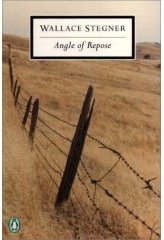
Angle of Repose is such a fruitful book that I have had to mull it over for several days after finishing the story. Being drawn into the life and mind of Susan Burling Ward gives me much to contemplate about human frailty, personal attraction, and the uniqueness of the American West in the 19th century. Stegner is a subtle and intelligent writer; what’s more, he treats his subjects with the dignity due to well-intentioned but flawed human beings.

Lyman Ward is a 58-year-old history professor (a favorite persona in Stegner’s novels) who’s retired to the family cottage to pour over his grandmother Susan’s papers and reconstruct her life - at least the most important part of her life, the 14 first years of her life with Oliver Ward. Susan was educated in genteel New York fashion in the 1860s and began a very successful lifelong career as an artist and writer in the 1870s. Oliver Ward was a mining engineer whose dedication and bad luck led him all over the West, following job after job. They were perhaps a bit mismatched, but their marriage thrived on mutual goodwill. Slowly, misfortune and their natural imperfections interfere. It is a fascinating study, admirably written.

Optimism carries the couple along jauntily for several years (and a few hundred pages). It is a pleasure to see their youthful inventiveness in inhospitable mining towns; their loving encouragement of the other’s vocation. However, towards the middle of the book, I found myself wondering, “is this ever going to end?” Susan and Oliver became mired in what I called the Boise Stagnation. They were waiting and waiting for a break in their luck, which came after 8 long years (and then only briefly). As their hope and patience wore thin, the pages seemed to drag on and on, and I was amazed that the author was so effective in conveying his characters’ torpor that even I, the reader, felt it.

There are plenty of things to think about here, and one thing I began to wonder about was avoiding adultery. No one wrongfully sleeps with anyone else in this story. However, Susan’s mind seemed to drift away from Oliver toward the possibility of Frank. It wasn’t that Frank was a superior man, but being exhausted in hope, she yearned for something new and fresh, unsullied yet by real circumstances. It seems that “possibilities” are hopes unfulfilled and inherently seductive. “Who hopes for what he already has?” The first step in adultery may be awakening to some lack in the current relationship and imagining something better with another, lesser known, person. The mere fact that the other person is little known and the outcome nebulous makes the extramarital relationship more interesting, more attractive, fuller of hope and positive possibility. Possibly this realization can help people to recognize when they are in danger of wandering away from their love.

Title:Angle of Repose
Author:Wallace Stegner
Date published:1971
Genre:Historical fiction
Number of pages:557

Read more...

Saturday, September 30, 2006

read full post >

cover of The Bronze Bow

This is a Newbery book, so obviously some people thought it worth reading. I'd agree with them. Historical fiction is not my favorite category, but this one snuck it's way in. Daniel is a boy who is successfully running away from his painful past, until two old characters turn up in one of his favorite places and he can't help but speak with them. This conversation leads his life in a whole new direction. These two are Joel and Malthace, brother and sister, who look alike and still have very unique personalities. They all go on this journey of life together, growing up and beginning to face life and death issues. Choosing who is worth following. Discovering what it means to lead well. Struggling with calling and passion and revenge.

All three (and many others) are strongly affected by Jesus. The story is placed during the time He was preaching and living in Capernaum. They have many opportunities to listen to Him speak, to see Him affect all those around Him, to see him heal. To listen to his words and see that they match his actions. Daniel's father was cruelly killed by the Romans, so at the age of eight he began to hate them. And this hate has only grown stronger with time. Daniel longs to follow this Jesus -- but Jesus is not calling anyone to fight and kill the Romans. They is a defining conversation where a weary Jesus takes time to listen to Daniel's story, and Jesus tells him the only thing stronger than hate is love. Daniel does not want to accept this but must struggle mightily to come to a final decision.

Samson is an amazing character. He speaks no words at all. He is taken from a slave trader, by the band Daniel is part of, at the beginning of the story. Samson is taken because he is huge and strong. He does things easily that four or five men would struggle to do, so his strength is unmatched. Daniel ends up taking him up to their hideout and freeing him from his chains (because he's the blacksmith), and earns Samson's devotion and love. They develop a sort of relationship. Whenever Daniel is gone from camp, Samson watches for him and misses him. Samson doesn't obey the leader of the band, but he's so strong that the leader can't do much about it. This human who is silent, doesn't show signs of understanding things, and often will not act of his own accord, saves Daniel and others from certain death. He chooses to give up his life willingly that they might live. (Reminds one of Jesus, eh?). When Daniel talks with Jesus and says he wants to revenge Samson's death, Jesus tells him that Samson did not give him revenge -- but love. That stops Daniel in his tracks. Everything which was so simple becomes much harder. When boundaries we've put in place are taken away from us, life gets much more complicated. But usually in a really good, growing, healthy way.

Title:The Bronze Bow
Author: Elizabeth George Speare
Date published:1961
Genre: young adult, historical fiction
Number of pages: 254
Notes: repeat reading

Read more...

Friday, September 22, 2006

read full post >

cover of The True Story of Hansel and Gretel

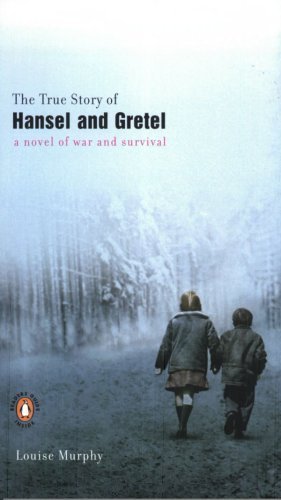
Two children are with their father and stepmother running from the Nazis. They figure the best hope is to leave the children to hide and maybe find a villager to take them, while the parents keep going. When the parents drop off the children, the stepmother yells that they must never say their names, and tells them their names are Hansel and Gretel. They all do get away from the Nazis, and then the reader follows both stories. The children find their way to a woman who lives outside the village, whose grandmother was a gypsy, and who decides to do what is right and what her grandmother would have done instead of living in fear. Largely a story of children who are children and yet are not children. Of what hope looks like in darkness. What one can withstand when one has others to stand with. What is worth fighting for.

Enjoy retelling of fairy tales -- but it's so easy to forget that the original fairy tales were not light stories, but had lots of darkness in them. Murphy probably falls into a similar category as Flannery O'Connor -- believing that to show hope and light, you must also show darkness and evil. And so many of the things that happened in world war two were evil, so when writing a book .. it must include evil too. Which is true of life. Without darkness and evil making themselves known, it is easy to miss God, good, beauty, light, truth. And murphy has the privilege of reckoning with God in the midst of such evil. Many characters comment on this, often about God packing up and leaving Poland when the war came. Or there being no God because of things they had seen. One comment which is still echoing around in my head comes from an old man who replies the following to such a comment. "God didn't come down and kill us. I don't see god shooting children and priests. None of us met God beating up Jews and shoving them into railroad cars. This is men doing the murdering. Talk to men about their evil, kill the evil men, but pray to God. You can't expect God to come down and do our living for us. We have to do that ourselves." (p207)

The sister is older and takes care of her brother. She worries about him and helps him to understand the important things he can do, should do, shouldn't do -- what it will take for the two of them to survive. Due to trauma, he must assume this role of caretaker for his older sister. Everything they know crumbles when the war ends, and he has to decide what to do and where to go. So he does, but it is wearing to have so little to hope for and also to be the leader. Another traumatic event brings her back into reality (not sure if this is really possible or how often it happens?) -- and she becomes the big sister again. Which gives her little brother rest. For the first time in weeks he actually sleeps soundly. We all have tasks and roles that we are given. Some of which are easy and familiar and fit our talents and personality -- but sometimes we are expected to things which we cannot do. Which, in our own strength, are truly impossible. But it's reassuring to know that God has more strength than we do. That in Him our inability and weakness become something worthwhile. Hard to accept and harder to live -- but there is hope to sleep soundly at night, because I am not in control and don't need to be.

Title:The True Story of Hansel and Gretel: a novel of war and survival
Author:Louise Murphy
Date published:2003
Genre:Historical Fiction
Number of pages:297
Notes: borrowed from amy

Read more...

Sunday, September 03, 2006

read full post >

This is the final book in the Kristin Lavransdatter triology, a chance to reflect on characters' lives. Kristin herself, while a sympathetic character, is not very likeable. Her actions are often inscrutable. During her girlhood all her family and neighbors admire her for her beauty and seeming goodness, yet again and again she fails to do what she ought and instead follows paths leading to sin and deception. It is as if she cannot resist her own desires; she must carry them out at all costs. Yet once obtained, they do not make her happy. She receives one disappointment after another from Erlend, her sons, and her family life. Filled with bitterness, she turns to God for healing, though she expresses anger with Him for allowing her to follow her own will into unhappiness and painful consequences.

Undset does not describe much about Erlend's thoughts or motives. Over several decades, he doesn't seem to mature at all, but remains as childish as ever. His basic childishness causes him to act in a very headstrong, imprudent way at crucial times, yet his love for Kristin is as pliable and forgiving as a child's, and he doesn't nurse grudges or hold on to bitterness. I found the struggle occurring in Simon Andresson to be the most intriguing part of the book. He was the intended husband of Kristin of Lavrans' choice. When he knew the Kristin loved Erlend, he released her from her betrothal but continues to love her. He tries to live a faithful and good life with his wife, but unhappily wishes that his marriage to Kristin could have taken place. He does not trouble Kristin with these longings, though he constantly dreams of telling her. Simon's honorable struggle demonstrates a self-discipline and courage that I admire.

Title:Kristin Lavransdatter III: The Cross
Author:Sigrid Undset
Date published:1922
Genre:Historical Fiction
Series:Kristin Lavransdatter
Number of pages:464

Read more...

read full post >

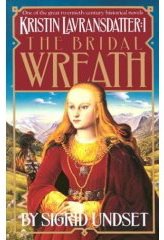
Kristin Lavransdatter is a young girl in 14th century Catholic Norway, the daughter of a well-to-do landholders. The trilogy offers a compelling and interesting, but not pleasurable, read. Kristin and her parents, her former betrothed, her sisters, and finally her husband and children suffer continual disappointments, usually caused by the fallen nature of the people they love most. Lavrans, Kristin's father, is upright and honorable, devoted to God and indulgent toward his eldest daughter. His love for Kristin then becomes a source of pain when he sees that she has willfully thrown away honor and prudence, and knowingly deceived him in her relentless pursuit of what she wants: marriage to Erlend Nikulausson. Kristin's story is continued in the The Mistress of Husaby and The Cross.

Title:The Bridal Wreath: Kristin Lavransdatter I
Author:Sigrid Undset
Date published:1920
Genre:Historical Fiction
Series:Kristin Lavransdatter
Number of pages:288

Read more...

read full post >

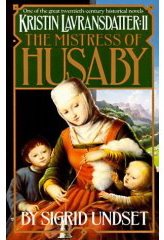
The translation of Kristin Lavransdatter makes a difference. I read the first two volumes published by Vintage, which translates the Norwegian using archaic Medieval English. As a result, the story reads much like a legend or an epic; however, nuances, realism, and comprehensability suffer. My library only had the Penguin-published third volume, which is translated by Tiina Nunnally using modern English. At first the language seemed rather flat, but I ended by liking it more, mostly because I didn't have to dig through obscure wording in order understand the thoughts and feelings of the characters. Undset often relies on implications to convey the importance of various speeches or actions, and even reading the modern translation, the reader can still miss out on momentous occasions: “What just happened?”

One thing that never fails to annoy me is a double standard applied to men and women regarding sexual purity. This is the case in the Kristin trilogy. In The Bridal Wreath, much fuss is made over a Kristin's maidenhood, and apparently it is fair game for general community discussion and conjecture. If it had been generally known at the time of her wedding that she had not remained chaste, she would have been universally condemned and her parents seen as dishonored fools. However, several men in the book, including Erlend and her former betrothed Simon, engage in multiple extramarital affairs and father illegitimate children, yet do not suffer any ill social consequences nor are even regarded as particularly unusual. If sexual purity is important (and I agree with Sigrid Undset that it is) then it is equally so for men and women.

Title:The Mistress of Husaby: Kristin Lavransdatter II
Author:Sigrid Undset
Date published:1921
Genre:Historical Fiction
Series:Kristin Lavransdatter
Number of pages:384

Read more...

Saturday, December 03, 2005

read full post >

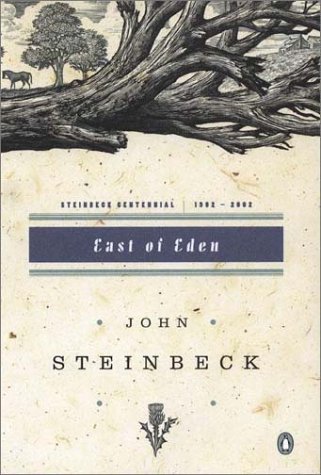
cover of East of Eden

This book definitely fits into the epic category. A novel which takes place over many years and covers the full life span of one individual and all the people he interacts with along the way – but that central individual is not really the center of the action. Adam trask has a twin, named Charles (C & A), and they are always fighting for their father's love. Adam has it and doesn't really want it, and Charles desperately wants it but doesn't really have it. Much later on, Adam has two twins – Caleb and Aron (C & A again), who repeat that same struggle. There are characters in the book which are all shades of good and evil. Some have all of one and can't imagine the other, while others are mixtures and can't figure out how to live well in either category.

This a a good story, and keeps one interested. Not only do you read about the lives of the characters, but also the lives of America before and during World War I. There are chapters interspersed where Steinbeck poetically describes the state of the nation or of California. I enjoyed this book, and also enjoy that Steinbeck can't seem to get away from Biblical references in his books (I've only read two, but that is very true of both.)

Title:East of Eden
Author: John Steinbeck
Date published:1952
Genre:Historical Fiction
Number of pages: 602
Notes: Borrowed from Miriam

Read more...

Monday, November 21, 2005

read full post >

cover of Secret Life of Bees

A truly wonderful book. Lily Owens grows up with the horrible knowledge that it is her fault her mother is no longer with her. Her father is bitter and abuses her (because she always reminds him of his wife, and he has no other way to deal with his pain). They have a housemaid, Rosaleen, who is black, which is important because the book takes place in South Carolina during the time the Civil Rights Act is enacted. Some unexpected events happen, and the two of them run away to a town whose name was written on the back of a picture from Lily's mother. The picture is of a black Madonna. Throughout the story there are images of womanhood and femininity and what it means to love and receive love.

Lily and Rosaleen end up 'coincidentally' with three sisters (August, May, and June) who keep bees, make all sorts of honey and wax products, and who live life fully - in some ways. May, the youngest sister feels life intensely – almost like she cannot separate the pain of the world from herself. To deal with the immensity of pain her sisters come up with the idea of a wailing wall in which she can stick notes that she writes about the pain. That idea is beautiful to me – that sometimes we have problems too big for us, and we can just put them in the wall or give them to God and He'll take care of them (since He already is...).

Truth is interspersed throughout the novel – not a preachy sort of truth, but ideas you read and go 'hmm' because they resonate in your soul. Truth can be simple, obvious, or profound - and sometimes all three at once. Running away is not the answer, but sometimes to stand against evil you have to run away to get strong enough.

Title:The Secret Life of Bees
Author: Sue Monk Kidd
Date published:2002
Genre: Historical Fiction
Number of pages: 302
Notes: Recommended by Mel

Read more...

Tuesday, November 08, 2005

read full post >

cover of Out of the Dust

This is a story written entirely in poems, about a young girl named Billie Jo who lives in the Dust Bowl of Oklahoma. The poems are written simply and straightforwardly – but still with considerable beauty in the images and words. A young girl who's life is changed for the worse by events beyond her control – but she still finds joy in simple pleasures and in being aware of the world around her. Life is not easy, but it is still worth living. She delights in playing the piano and themes related to that play throughout the book. This is a story written with careful attention to form and words, about a girl who takes delight in the arts and finding beauty in the world around her -- a story of hope in the midst..

Title:Out of the Dust
Author: Karen Hesse
Date published:1997
Genre: Historical Fiction, Poetry
Number of pages: 227
Notes: Borrowed from Miriam

Read more...

Wednesday, November 02, 2005

read full post >

Spinelli is an author I respect, and this book is done well and worth reading. It is written from the perspective of a young boy who lives in Warsaw during World War II. He steals food, runs, and then eats - that is the chain of events that he is used to following and doesn't always know what to do when something unexpected changes the usual plan. An older boy asks his name, and this little boy says 'stopthief' because that's all anyone ever calls him.

An older boy named Uri finds him and takes care of him and tries to keep him safe. Uri decides to call him Misha and makes up Misha's life story. Misha is little and fast, and surviving comes naturally to him – stealing bread and other food from people and stores when necessary. Spinelli tells the story of before, during and after the war through the eyes of a child who does not understand and has never had anyone to explain things to him well. So Misha sees acts of violence and degredation and doesn't know why they are significant or evil – but the reader knows. Misha ends up being moved into the ghetto with his gang of boys (all stealers and later smugglers), and becoming part of a Jewish family. This gives Spinelli opportunity to tell about what conditions were like in Warsaw and in the ghetto – not like a textbook, or with guilt behind it, but as a child would have seen it and become adjusted to certain realities. The brashness of Misha surprises all those around him, but he is never hurt too badly. War happens around him and finally affects all of those closest to him (with the boy who took care of him being gone from the ghetto often and becoming the enemy.) The end speeds through his life quickly – not all the ends are neatly taken care of. In fact, few are. But it is a book about war and the craziness of life which affects every aspect. This is a wonderful book -- hard to read in places because it is about war. It is well written – in terms of action, characters and bringing the past to life.

Title:Milkweed
Author:Jerry Spinelli
Date published:2003
Genre:Historical Fiction, Young Adult
Number of pages:208
Notes:recommended age is 9-12, but that seems too young to me

Read more...

Google Search

Google