Book/page totals

Top 10 Lists

Showing posts with label popular science. Show all posts

Tuesday, April 28, 2009

read full post >

cover of Oliver Sack's 'Musicophilia'

A fascinating compendium of a variety of case studies and stories relating music and the brain--

  • perfect pitch and why we don't all have it (and how some people associate tones with colors)
  • musical hallucinations (losing hearing & hallucinating songs from years before)
  • "amusia" - an inability to perceive one of the many components of music, the absence of which makes it impossible to appreciate music (there are so many things going on when we listen to music that we tend to just take for granted! rhythm, timbre, pitch, harmony)
  • musical savantism
  • people with severe amnesia or aphasia where music can be a tool to recover some of that lost function
  • even brain damage that frees up musical creativity
The stories are fascinating and interesting for what they say about the complexity of music, as well as the brain and what it means to be human. I was a little disappointed that Sacks didn't make a stronger argument or concluding summary at the end about what all of these stories and details means, what it all adds up to; he basically concludes that all human cultures have some form of music and that some relation to music is intrinsically part of being human. Perhaps this was cut from the audiobook, but it seems unlikely they would cut something as crucial as that, which would tie things together a bit more, and try to make sense of the whole picture.

In any case, there are any number of fascinating stories here, and listening to them reminded me how we all have those "touches of madness," little bits or traits of these much stranger and more extreme cases that we start to notice in ourselves after reading or hearing about them. For instance, it never occurred to me that we have "auditory imagery," and that some people have much better musical imaginations than others-- to the point that some people can look at a musical score and hear the whole orchestra in their head. Another familiar experience is the auditory "afterimage", or the "earworm," the song that gets stuck in your head. Or the notion that there is latent musical ability in many of us, but it is inhibited because so much of our brain is taken up with sight and visual processing.

The fact that our culture is so saturated with music and noise all the time, and that so many of us pipe it directly into our ears makes me wonder what we are doing to ourselves, what long-term effects there will be, on our brains and our hearing and our sensitivity to music.

Listened to the audiobook.

Title:Musicophilia: Tales of Music and the Brain
Author:Oliver Sacks
Date published:2007
Genre:Nonfiction / Science
Number of pages:400
Notes:listened to audiobook

Read more...

Monday, May 28, 2007

read full post >

cover of Darkover Landfall

A colony spaceship from Earth runs into trouble and crash-lands on an unknown planet. The people are torn between doing their best to settle and survive and trying to get their spaceship fixed so they can go on to their original destination-- a colony planet already checked out by Earth explorers, with a mining outpost and communication links back to Earth. A small team goes on an expedition to a nearby mountain in attempt to get a sense of the size of the planet and use the stars to determine their location in space, but the world begins to affect them-- especially once they encounter a strange pollen with a powerful, hallucinogenic effect. One person also has a mysterious encounter with a telepathic alien; to this alien race, humans minds are like a door barely ajar which is only slightly more open when under the influence of the pollen, but the aliens sense that humans may be dangerous and keep their distance. Ultimately, this book is a tale of survival and adaptation to a completely new environment.

Most of the book follows geologist Rafe MacAran. He's the one who leads the expedition to the nearby mountains, and he quickly falls in love with this undiscovered planet. There's a lot of conflict between the crew of the spaceship (who didn't plan to be colonists) and the others; the spacefarers are afraid that by reverting to lower levels of technology they will become savages, so they do everything in their power to fix the spaceship, and when that fails they begin trying to encode ever last bit of knowledge they can into a computer, to preserve it for later generations. Eventually, they recognize what Rafe figured out more quickly-- it is better to adapt to this new world and let their descendants develop technologies apropriate to this different world.

There are some interesting social/cultural points in the midst of this. One of the colonists is a "Reformed Catholic" priest, and he has to deal with whether or not a religion based on events that happened on a different planet is relevant here (and his own faith is shaken by the horrific things he did under the effects of the hallucinogic pollen. Also interesting is the women who struggle with not wanting to have children-- for their colony to survive and prosper, they need as many children as possible from all the fertile women, but many of those women have been psychologically ingrained with no desire for children, because they grew up on an over-populated planet and chose careers (like crewing a spaceship) where that makes sense.

I appreciated the fact that Bradley avoids easy answers. This is most apparent in what looks like an obvious romantic pairing early on-- in fact, it does not result in quite the usual story-book ending. I think the same holds true for the other issues in the book, too.

Title:Darkover Landfall
Author:Marion Zimmer Bradley
Date published:1972
Genre:Science Fiction
Series:Darkover
Number of pages:160

Read more...

Thursday, May 24, 2007

read full post >

Set in a the western U.S. in a world where the Axis won World War II. The book follows a handful of different characters (all loosely connected to at least one or two of the others) struggle to survive in this crazy world. One key element is a recently published book, The Grasshopper Lies Heavy, written by the titular man in the high castle-- it tells of a world where the Allies won the war. This is a strange, foreign world (even though it is set in familiar cities)-- and a believable one.

One thing that makes the book so believable is the clear Asian culture-- not just in the Japanese characters, but in the Americans who have been living in the Japanese-controlled Pacific States. It is present in their clipped language and way of thinking, and also in the ever-present oracle, the I Ching that they all consult to try to make sense of what is happening.

This is a dark world. The Nazis have destroyed all of Africa; they have space travel and certain other technologies, but it's pretty clear that their advances are very limited and directed to specific ends. It's later revealed that they are now plotting to destroy Japan. The bleakness of this world is particularly brought home by the reaction of one character. During the course of the book, the current German Füaut;hrer dies and everyone is concerned to see who will be the next leader. The Japanese officials meet to be briefed on the possible & likely candidates. Tagomi is physically sick because he sees that there is true evil in the world, and it turns his worldview upside-down. Later on, Tagomi is forced to kill to defend himself and two others-- and this completely looses him from his moorings. At one point, when he is trying very hard to recover himself, he gets a kind of vision-- of our world, a world where there are now Japanese pedecabs in San Francisco but instead there are buses and taxis and a big freeway being built.

There are handful of characters, and they are all distinctly and carefully portrayed, and all compelling in their own ways. Robert Childan, the salesman of American antiques and historical treasures (like a Mickey Mouse watch) that the Japanese are buying up like crazy, who wants to be Japanese and longs for the delicate, beautiful Japanese women he can never have. The Jewish man, Frank Frink, who is fired and decides, with the encouragement and help of a co-worker, to start to create new American art. Frank's estranged wife Julia in Denver, who is being used by a Nazi operative as a way to get to the author of that subversive book, The Grasshopper Lies Heavy.

This is a very moving, thought-provoking book-- although it's hard to know how to make sense of it, particularly the ending. Julia finally meets the author, Hawthorne (who does not live in an enclosed, highly guarded castle at all), and asks him how he wrote the book. Eventually, he admits that he did it with the help of the Oracle, and when she consults the Oracle to ask why, the answer she gets is that it is all true-- that the Axis did not win the war.

Writing a book about, among other things, a subversive alternate-history book, makes you wonder about the purpose of the original alternate-history book-- is it to point out other possibilities, make us see things in our culture and our history that we can't see without this contrast? I'm not sure. I don't have any answers yet, but I think it bears thinking about.

Title:The Man in the High Castle
Author:Philip K. Dick
Date published:1962
Genre:Science Fiction, Alternate History
Number of pages:259
Notes:Hugo Award for best novel in 1962

Read more...

Saturday, February 18, 2006

read full post >

cover of The Tipping Point

This is the second book I've read by Gladwell, and thoroughly enjoyed both. His writing is clear, making subjects that could be very confusing understandable to the common human. This particular book is about epidemics of any variety -- diseases, trends, success stories. Gladwell describes three main factors -- the law of the few, the stickiness factor, and the power of context. Some ideas are intuitive and others don't make any sense on their own. In the afterword (which was added in the second edition), Gladwell shares some of the stories he's heard as a result of this book. It is exciting to see that by being wise and careful in how we go about things, the effects can be greater.

The first factor is called the law of the few, which is the idea that some people have power in the specific senses that allow them to influence the masses. These three types of people are connectors, who know people from all walks of life and maintain these relationships well; mavens, who gather information and want to share it, such as knowing what car is the best deal and why; and salesmen, who can convince anyone their message is useful and helpful. These sorts of people all have power in different senses which can help social epidemics to 'tip.'

The second factor is called the stickiness factor, which means that for something to 'tip' it must be memorable. Sometimes this can just be a certain image, or directions to a location. It doesn't make intuitive sense that adding or taking away one detail could affect how well the message is remembered. The third factor is the power of context, which means that our environments do have a greater amount of control than we expect. For instance, they decided to deal with the graffiti on the subway cars and the farebeaters who jumped over the turnstiles, and greatly decreased the crime because the environment made people feel safer and less likely to act criminally because they didn't have examples in front of their faces.

Gladwell is definitely a translator. By this I mean that he is able to take research from specialized fields and combine them to prove his thesis. Not only that, but he does so in a manner that makes sense in daily life by taking examples from things most Americans know like Sesame Street and smoking. His books read fairly quickly and some important ideas stick with you (stickiness factor!), as well as a new way of understanding this world we get to live in.

Title:The Tipping Point: How Little things Can Make a Big Difference
Author:Malcolm Gladwell
Date published:2000
Genre:Popular Science
Number of pages:280

Read more...

Monday, December 12, 2005

read full post >

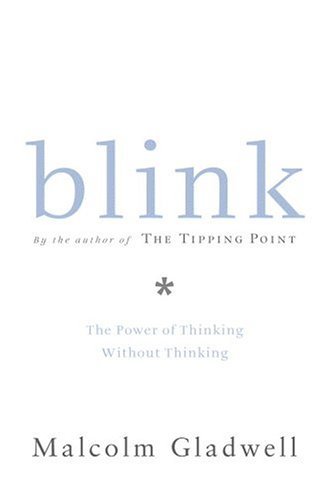
Because this is such a popular book, I was on the waiting list in the library system for about month. And in this particular library system there were possibly 80 copies of the book.. Even though it's popular, is is worth reading. Gladwell writes well and comprehensibly, introducing scientific information and ideas in ways that are understandable for the average Joe Schmoe. Ideas are made tangible through many studies and stories. The basic idea is that humans often know things without being able to explain why.

Experts can train themselves so they have a better understanding of how to classify their knowledge and how to explain what they know and why. But those of us who aren't experts in a field, if given the opportunity to explain our reasons, would confuse everyone involved and probably change our opinions. One good way of understanding this is the human face – we can understand emotion without identifying it. For example, the face can't hide thoughts – if i am lying to you, there will be a hint of that shown on my face at one point, even if just for a second or less.

Another concept is thin-slicing -- being able to take a little piece of conversation or interaction and predict. John Gottman has studied couples for a long time and came up with 20 or so emotions and ways of interacting, like stonewalling, contempt, criticism... He has studied and become an expert at how negative and positive emotions look and sound, and now can listen to a couple for fifteen minutes or less at another dinner table and predict with high probability of being right whether they will stay together. If you know what to look for, it is present in all the interactions of a couple – or in the way doctors treat their patients, or in just a few questions to determine if someone is truly in danger of a heart attack.

Knowing when to trust one's instinct and when not to is also important – because if we have associations with certain types of people or certain environments, that will color our thinking too. This is a very interesting read – I would like to put into practice some of the tips and ways of thinking (or not thinking) about life.

Title:Blink: The Power of Thinking without Thinking
Author: Malcom Gladwell
Date published:2005
Genre: nonfiction, popular science
Number of pages: 254
Notes: Very popular book, but worthwhile anyway..!

Read more...

Google Search

Google