Book/page totals

Top 10 Lists

Showing posts with label alan jacobs. Show all posts

Thursday, August 23, 2007

read full post >

cover of The Narnian

A biography of C. S. Lewis that approaches the man through his writing, particularly his fiction. Jacobs says at the outset that he is not going to include every detail of Lewis' life because he is interested in "the life of a mind, the story of an imagination"; through this book he is trying to answer the question, "what sort of person wrote the Chronicles of Narnia?"

It was surprising to me how little I actually knew about Lewis' life. For a man who is so well-known, and whose writings are so familiar and often-quoted, I think we don't know all that much about him (what kind of childhood he had, his relationship with his father and brother, his education, his experience in the war). Wherever possible, Jacobs relates Lewis' experiences to those of his fictional character-- so, for instance, in the hardships of Lewis' schooling, there are resonances with what we know of Edmund's and Eustace's schools. Also, I found that having Lewis' writing placed in the context of his life (what he wrote when, who influenced various books) was very illuminating.

This book is very readable and enjoyable. I found myself amazed at the amount of research Jacobs must have done-- trawling through the masses of papers we have from Lewis' life (it is wonderful that we have so much of it, but I find the idea of it a little overwhelming) and his voluminous writing to find the perfect quotes from or about him to describe a particular episode or part of his life or characteristic.

I'm glad I read this book. Now when people quote Lewis or illustrate a point from his life, I have an idea of the big picture (and often they're oversimplifying-- although I don't know where to start to try to tell them that).

Title:The Narnian: The Life and Imagination of C. S. Lewis
Author:Alan Jacobs
Date published:2005
Genre:Biography
Number of pages:342

Read more...

Tuesday, October 31, 2006

read full post >

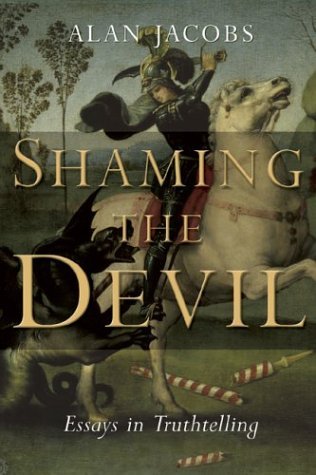
cover of Shaming the Devil

Another collection of essays, this one loosely grouped by the idea of telling and seeking the truth. The first section of essays focuses on those who have devoted their lives to the pursuit of truth, the second section on thinkers who engage with important questions but don't necessarily always arrive at truth, and the last section considers the idea of "computer control." This book doesn't have any of the personal essays which I found so amusing and moving in Jacob's A Visit to Vanity Fair, and sometimes the connection with truthtelling seemed a little more tenuous than others, but the essays are always interesting and thought-provoking.

Among of the exemplars of the first section, I was most impressed with Jacob's portrayal of Auden, who rejected one of his earlier, and very popular, poems as "a resonant lie," and determines instead to seek truth in his writing. Jacobs has convinced me (yet again) that I need to read more Auden. Also interesting are the portrayals of Camus (more distinct from the other existentialists than I expected) and Solzhenitsyn, who saw himself called upon to bear witness to the terrible things he, for some reason, survived (what sacrifices should be made or demanded from others for the sake of great art?).

Among the "explorations," or those who fall short of truth telling and seeking, are Rousseau (who considered himself the "only honest man" and used this as an excuse for all kinds of incivility), Iris Murdoch (who writes of religious matters, but substitutes the Good for God), Wole Soyinka (whose brilliant writing has been forced by the political situation in his homeland into more polemical and less literary modes), and the fantasy author Philip Pullman of the His Dark Materials series.

I found Jacob's comparison of Rousseau with Voltaire quite enlightening-- particularly when he elaborates on why Rousseau's vision of humanity is the one that won out-- because it is so much more appealing. Rather than requiring hard work and discipline to fight corruption and return to innocence, one need only follow one's own heart to know what is right-- and any of failures are someone else's fault, because they have corrupted that original innocence.

The last section, on "computer control," is quite different from the essays-- and perhaps more interesting to me (although I was surprised at how engaged I was with the essays throughout) because of my own interests in technology. Jacobs chronicles his own engagement with computers, including his attempt to install and use the operating system Linux on his own. His attempts are quite interesting and sometimes comical, but he makes the somewhat surprising (and the very interesting) argument that the more smoothly a computer user's experience goes, the less they are in control-- because, if things go smoothly, it is the computer (or the logic embedded in the software by programmers) that is in control. Jacobs makes the counter-intuitive claim that resistance-- which a user encounters when the computer doesn't exactly do what they want-- is important, and even a virtue. One other detail I found interesting was the idea that the overriding metaphors we use for our computer interfaces (that of a desk, with files and folders) is not the only, and perhaps not the best, metaphor-- because (like any metaphor), it has limitations.

Title:Shaming the Devil: Essays in Truthtelling
Author:Alan Jacobs
Date published:2004
Genre:Essays
Number of pages:231

Read more...

Saturday, September 30, 2006

read full post >

cover of A Visit to Vanity Fair

A collection of thoughtful essays-- sometimes humorous, frequently insightful. Some essays are inspired by particular books and others by personal experience (such as a young son eating paper torn from a Bible), but Jacobs always moves from these starting points towards deeper and more significant issues so that a review of a historical study of children's Bibles addresses our modern perceptions of children's spirituality, and whether editors of children's Bibles are justified in editing out violent and racy stories (other than the violence of the cross, of course, which is generally portrayed in some fashion). The essays range from personal experiences of fear and death to musings on such personages as C. S. Lewis, Bob Dylan, and Harry Potter, among other topics. Throughout, the essays are entertaining, readable, and thought-provoking.

A few favorites that particularly stood out, for some reason or another:

In "Dowsing in Scripture," when his two-year-old son eats paper from the Bible, Jacobs muses on the common, deprecated habit of opening the Bible at random as a kind of prophecy-- and finds himself unable to resist attempting to interpret his own son's act of eating scripture, with resonances of the prophets who were fed scrolls.

"In on the Kill" addresses the preponderance of violence in animal and nature shows and points out our society's preoccupation with, and entertainment by, death-- and even suggests that by watching we participate in this. In "Friendship and its Discontents," a review of an anthology of writing about friendship becomes an occasion to delve into what does and does not constitute true friendship, along with the question of whether friends must share spiritual beliefs.

"Lewis at 100" addresses the evangelical appropriation of C. S. Lewis as almost a saint, and the oddities that this has brought with it (such as a refusal by some to believe that Lewis consummated his marriage with Joy Gresham, as if Lewis must be 'pure' according to evangelical standards-- even though he was also known as a drinker and smoker, which such people happily ignore). One interesting point: Lewis did not think he was, or intend to be, original. He merely tried to articulate Christian views in a way that people of his time period could understand, and he did not expect his work to last. Jacob raises the question, why have there not been other writers and thinkers who might supersede Lewis by articulating these same points in a new way, for a new age?

"Harry Potter's Magic" is an insightful response to the mixed reception of the popular books in evangelical circles. Jacobs describes Rowling as a "world-maker" akin to Tolkien, and goes on to address ideas of magic in comparison to technology and science. He also makes a point that I have often thought myself-- many evangelicals condemn as "dangerous" the magical elements in books such as this, all the while holding the contradictory belief that magic isn't real. Jacobs also clearly points out the powerful moral dimension to the Harry Potter books-- the dangers of dark magic, the consequences for actions, and the power of the choices we make (such as Harry's desire not to be put in Slytherin's house) forming we who become.

The last section, "Lives of the Essayists," is a humorous look at a book Jacob's says will never be written, because it is more along the lines of "Lives of the Dentists" than the more dramatic-sounding "Lives of the Poets," or novelists, or painters. This gives him an opportunity to touch on some of the more interesting and famous essayists (some of whom did have very strange and dramatic life experiences), and even on the place of the essay itself as a genre, however poorly respected in some circles.

Title:A Visit to Vanity Fair: Moral Essays on the Present Age
Author:Alan Jacobs
Date published:2001
Genre:Essays
Number of pages:173
Notes:Christmas gift from Mom

Read more...

Google Search

Google