Book/page totals

Top 10 Lists

Showing posts with label fairy tale. Show all posts

On this page:

Friday, July 26, 2013

read full post >

A delightful fairy tale retelling that takes the familiar story of the twelve dancing princesses and fleshes it out-- adding completely plausible reasons for just about every aspect of the story: why the princesses dance every night, whey they can't tell anyone, and even why there are twelve of them. It even adds to the mundane aspects of what life must be like if you had to go dance every night-- what if you get sick (as the oldest, Rose, does) but still had to go dance every night? And with twelve sisters, the youngest are quite young - one dancing since she could walk, and hates balls because she has had to dance every night.

Read more...

Thursday, May 21, 2009

read full post >

cover of 'The Complete Fairy Tales of the Brothers Grimm'

The things you can learn from fairy tales! For instance, in reading these stories I discovered:

  • Poor but beautiful peasant maidens who wish to marry well should get themselves cursed by an evil witch, and then they are bound to end up married to a king or a prince (although there may be some discomfort along the way)
  • Young kings shouldn't go hunting or wandering in forests, as they are bound to run across a witch and bad things will happen to them as a result
  • If a gnome, an animal, or a saint talks to you in the woods, it is best to be kind and generous to them
  • Naive, fearless simpletons will either end up rich, married to princesses and heirs to kingdoms; or they will trade away their wealth for something worthless
  • Saints and miracles intermix freely with magic
  • Things are more likely to end well for you if you are the youngest sibling of three

It was a lot of fun to read these stories. Some were mostly-familiar versions of well-known tales, others were unfamiliar stories with echoes of the more familiar fairy tales, and others were just strange. In some cases, reading the stories again gave me a new perspective on them. For instance, there is the story of the old fisherman who catches a fish, and when the fish tells him that he is an ensorceled prince, the old fisherman releases him and goes on his way. But his wife wants something, and there begins a succession of ever greater houses and palaces and positions of power until the wife finally wants to be like God, and the old fisherman and his wife end up in their hovel again. I had always thought this meant they had met the limits of the powerful prince-fish's patience, but re-reading it this time I saw an alternate interpretation-- perhaps the fish actually gave them what they had asked for; it's just that they-- and we-- understand so little of what it means to live like God.

I borrowed this book from Abiel a few years ago (actually swapped it for one of mine), and she moved away before we managed to trade books back! I enjoyed reading the stories over several months, just a few stories at a time so I could take them in slowly.

Title:The Complete Fairy Tales of the Brothers Grimmm, Volume I
Author:Jack Zipes (translator)
Date published:1987
Genre:Fairy Tale
Number of pages:416
Notes:loan from Abiel; read over many months

Read more...

Friday, October 17, 2008

read full post >

cover of Little, Big

A multi-generational tale of a family that is somehow connected to the world of Fairy. There's a family tree chart at the beginning, and I found myself referring to it frequently because I couldn't keep track of all the people. The book starts in the middle of the family's story (Daily Alice meeting and marrying Smoky and rescuing him from his anonymity), but then jumps backwards a few generations (Violet Bramble leaves England and her fairies behind, only to meet John Drinkwater and learn that the world of Fairy is somehow also close to the crazy multi-style, multi-fronted house he built), and then moves forward and follows some of their children. It's a strange book and I couldn't tell if I liked it even near the end-- the family all know (to varying degrees) that they are somehow "part of a Tale," and I found myself waiting for something to make sense of everything. The ending is pretty brilliant, and really works-- it's the kind of revelation that transforms the characters and the story, makes sense of some of the strangeness and raises a whole batch of new questions. The title comes from (I think) the notion of some of the family that the world of Fairy grows larger the further you go into it-- only the smaller parts of it overlap with our world, so we tend to only see little fairy beings.

Part of the reason I wasn't sure I liked the book, and didn't really enjoy it so much while I was reading it, was that the characters are all so unhappy and, to some extent, difficult to like or identify with. One young man in the family meets an odd bird-person and is granted the gift of being irresistible to women; what he doesn't learn until later that this is really a curse that makes it impossible to resist any woman-- he is consumed with love by each of the many women he is spending all his time and vital energies chasing around the country to be with. Another young couple in the city have a very strange relationship that seems unhealthy-- but when you know the end of their story it makes a great deal of sense, somehow. Another disconcerting thing I found, at least early on my reading, was that although the book is written in a style that reminded me of George MacDonald, there is quite a bit more nudity and sex than I would ever expect to find in a MacDonald story (not much by modern standards, I think it was that the style caught me off-guard).

Other strange and interesting characters-- a dead and ancient king brought back from the dead to become President and tyrant; a woman who is effectively a wizard, but her power stems from her mastery of the Art of Memory, her ability to make sense of things and let the things she knows infuse each other with meaning so her understanding grows and changes. A changeling child, stolen from her mother and brought up by the fairies apparently only with one rather small task.

There were hints of the ending of the story, and the ones I caught (or know now I failed to catch) were in the names. Auberon seemed like a family name, and I didn't really think about it (why it sounded vaguely familiar, how it could be pronounced). I was intrigued by the mention of a family nickname for the younger Auberon's lover, his "dark girl" Sylvie-- she mentions in passing that her family sometimes called her Tita, or Titania. But even with those clues, I'm not sure I could have guessed (still not sure I understand) the way the story ends. Some of the other parts of the story make me think I'm not quite as familiar with the characters and stories of Fairy as I ought to be, and maybe if I were these things would make more sense.

In a way, this book reminded me of The House of the Spirits and 100 Years of Solitude-- a multi-generational family with hints (and more than hints) of the supernatural, magical experiences woven into the every-day. It was the little moments like this that I loved, where you don't know quite whether or not to believe-- one of the cousins who can't sleep sees the Sandman in the room of the children, but is told he won't get any sleep. Or, the Christmas where they write letters to Santa and burn them in the fireplace (as per their tradition), and Santa shakes his head over what some of them ask for because he knows what it will cost in unhappiness, but the requests are, in a sense, fulfilled.

I hadn't heard of this book or John Crowley until I saw the title listed on Alan Jacob's syllabus for a "Modern Mythology" course somewhere online (that was over a year ago, and now I can't find it). It does seem like a book that would be interesting to discuss, and one I wouldn't mind having other people help me make sense of.

Title:Little, Big, or, The Fairies' Parliament
Author:John Crowley
Date published:1981
Genre:Contemporary Fantasy / Fairy Tale
Number of pages:538
Notes:recommended by Alan Jacobs (sort of)

Read more...

Wednesday, April 18, 2007

read full post >

cover of Fable

An interesting story with all kinds of fairy tale characters. The premise is that years ago their homeland was invaded by an emperor who was taking over all the magical kingdoms, and those who survived escaped into our world-- and now they live in New York with their own secret "Fabletown," which they keep hidden from the regular people ("mundys", as they call them, for mundane). Rose Red is missing, with blood spattered all over the walls of her apartment, so the Fabletown policeman -- Bigby Wolf (known as the Big Bad Wolf to you and me)-- investigates the case, along with Rose's estranged sister, Snow White.

It's an interesting twist on the fairy tale idea, and it's fun to see all kinds of different characters consorting together-- Old King Cole is the unofficial mayor-for-life of Fabletown, Jack (of beanstalk fame) is Rose Red's boyfriend, Bluebeard gives fencing lessons to Cinderella, and one of the three pigs stays at the Big Bad Wolf's house when he escapes from the Fable farm to come to the city. In some cases, the way they "updated" the characters and stories made them seem a little too sullied and modern to me-- Snow White was abused by the dwarves, Beast is only human when Beauty is in love with him and their marriage is on the rocks, etc.

Bigby looks human, but at one point reverts to a huge wolfish form-- and I wondered about that. It's not explained during the course of the main story, but there's a brief prose story at the end that describes the invasion of the Fables' home kingdom and the part that Bigby played (harassing the armies, freeing Fables and helping them escape-- although mostly for his own reasons), and the time he first met Snow White (he has a bit of a crush on her). And, eventually, the story reveals that his human form is kind of an inversion of the werewolf curse that lets him live with the human Fables in New York.

An interesting enough story (the resolution to Rose Red's disappearance was fairly clever) and enjoyable artwork. I wouldn't buy this book, but I'd probably read subsequent volumes if I see them at the library.

Title:Fable: Legends in Exile
Author:Bill Willingham
Date published:2003
Genre:Graphic Novel
Number of pages:128

Read more...

Tuesday, February 13, 2007

read full post >

The fairy tale of Robin Hood, made into a long wonderful story. McKinley has done this often and well .. taking vague tales and making them believable and with depth. Robin accidentally kills a man and goes into hiding, and with the help (and persuasion) of two good friends takes others with him. They become a banner for Saxons who are frustrated and angry with the Normans who unfairly tax them and take control of more than belongs to them. Robin is more than flesh-and-blood to those who keep surviving under Norman rule -- he is the embodiment of a legend -- he symbolizes their hope.

All the regular characters are here .. Robin Hood, Little John, Friar Tuck, Maid Marian, Much, the Sheriff of Nottingham, Will Scarlet. Characters as unique as one could hope for .. each with quirks, fears, dreams, humor. The band in the woods is made believable by the way they care for each other, the ways they interact, the mundane problems they have to deal with (food, rain, shelter, hiding, uncomfortable trees). An intruiging idea .. something that to us is only a tale becoming living people. How quickly normal people can become larger-than-life. I wonder if we need that to survive. Humans need stories .. but do we also need stories that are 'impossible' .. heroes who survive more often than they should, relationships that are saved and not broken as they so often are in our world, people who need hope and to whom it is given. Things that perhaps are not .. but perhaps should be? or could be? or may yet become?

Title:The Outlaws of Sherwood
Author: Robin McKinley
Date published:1988
Genre: fantasy, fairy tale
Number of pages: 275
Notes: repeat reading

Read more...

Monday, October 09, 2006

read full post >

cover of Wicked

I really enjoyed the musical and own the cd, so thought I would read the book too. But .. I didn't like Maguire's other book which I read last year. And didn't really like this one either. Long and felt windy without reason. (Both windy like a road and windy like too many words!) The concept is fun, to retell a well known story from the opposite side -- but not particularly well done. This is a case where the musical is much better than the book. Too political and too psychological (sort of ) to hold my attention. Got to a point where I kept reading simply to finish. And was still disappointed by the end which had little closure or explanation for the need for this book to be so long.

Elphaba is the woman who eventually becomes the Wicked Witch of the West. Maguire shows this to be not by choice, but because of a large number of circumstances and events which were largely beyond her control. Being born green, parents who didn't know how to love her, always standing out, not having a friend until college, living in a land which was politically divided. With all these factors, how could she help but fight back in the ways available to her? The story is somewhat interesting, but Maguire takes sizable chunks of the book to relate his own views about politics and where the dangers come from and who should have rights. (Not saying they are his own, but they certianly come through in the commentary that is shared about Oz.)

One idea which was particularly interesting was that of a soul. Elphaba keeps insisting that she does not have a soul. (The reader isn't even given clear reasons as to why..) But this comes into play in some of her actions. she mentions it -- 'If I had a soul...' or 'I'm glad I don't have a soul..' because many people who do have souls are not respectable for her. They are weak and choose poorly and have favorites -- which are always somebody besides her. Are some people born without a soul? Some people certainly have little ability to tell what is right or wrong -- but is that all a soul is good for? Those with views that differ greatly from society are not necessarily evil (although history can easily portray them that way ..) but I did enjoy wondering about what exactly a soul is. And what it might look like to 'prove' that someone was soul-full or soul-less..

Title:Wicked: The Life and Times of the Wicked Witch of the West
Author: Gregory Maguire
Date published:1995
Genre:fairy tale retelling
Number of pages: 406
Notes: from marion

Read more...

Friday, September 22, 2006

read full post >

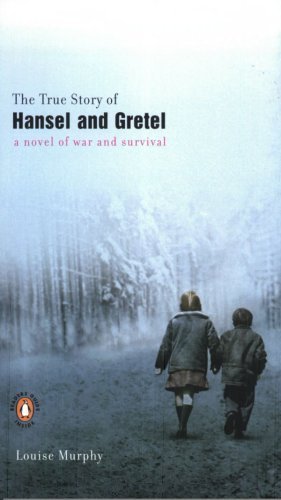
cover of The True Story of Hansel and Gretel

Two children are with their father and stepmother running from the Nazis. They figure the best hope is to leave the children to hide and maybe find a villager to take them, while the parents keep going. When the parents drop off the children, the stepmother yells that they must never say their names, and tells them their names are Hansel and Gretel. They all do get away from the Nazis, and then the reader follows both stories. The children find their way to a woman who lives outside the village, whose grandmother was a gypsy, and who decides to do what is right and what her grandmother would have done instead of living in fear. Largely a story of children who are children and yet are not children. Of what hope looks like in darkness. What one can withstand when one has others to stand with. What is worth fighting for.

Enjoy retelling of fairy tales -- but it's so easy to forget that the original fairy tales were not light stories, but had lots of darkness in them. Murphy probably falls into a similar category as Flannery O'Connor -- believing that to show hope and light, you must also show darkness and evil. And so many of the things that happened in world war two were evil, so when writing a book .. it must include evil too. Which is true of life. Without darkness and evil making themselves known, it is easy to miss God, good, beauty, light, truth. And murphy has the privilege of reckoning with God in the midst of such evil. Many characters comment on this, often about God packing up and leaving Poland when the war came. Or there being no God because of things they had seen. One comment which is still echoing around in my head comes from an old man who replies the following to such a comment. "God didn't come down and kill us. I don't see god shooting children and priests. None of us met God beating up Jews and shoving them into railroad cars. This is men doing the murdering. Talk to men about their evil, kill the evil men, but pray to God. You can't expect God to come down and do our living for us. We have to do that ourselves." (p207)

The sister is older and takes care of her brother. She worries about him and helps him to understand the important things he can do, should do, shouldn't do -- what it will take for the two of them to survive. Due to trauma, he must assume this role of caretaker for his older sister. Everything they know crumbles when the war ends, and he has to decide what to do and where to go. So he does, but it is wearing to have so little to hope for and also to be the leader. Another traumatic event brings her back into reality (not sure if this is really possible or how often it happens?) -- and she becomes the big sister again. Which gives her little brother rest. For the first time in weeks he actually sleeps soundly. We all have tasks and roles that we are given. Some of which are easy and familiar and fit our talents and personality -- but sometimes we are expected to things which we cannot do. Which, in our own strength, are truly impossible. But it's reassuring to know that God has more strength than we do. That in Him our inability and weakness become something worthwhile. Hard to accept and harder to live -- but there is hope to sleep soundly at night, because I am not in control and don't need to be.

Title:The True Story of Hansel and Gretel: a novel of war and survival
Author:Louise Murphy
Date published:2003
Genre:Historical Fiction
Number of pages:297
Notes: borrowed from amy

Read more...

Tuesday, August 22, 2006

read full post >

cover of Harrowing the Dragon

Another magical book from McKillip-- this time, a collection of her short stories. I was pretty excited to see a new book from McKillip when I first discovered this book; I have to admit, I was a little disappointed when I finally got a copy from the library and found out it was a collection of short stories. I think sometimes I don't enjoy short stories as well because there is no continuing engagement with the book: each section you have to start over again with new characters and places, and often in a book like this I enjoy some stories more than others, and usually find a few to dislike. That was not the case here-- they are self-contained, but still delightful.

There are many wonderful stories here, so I'll try to limit myself to a few of my favorites.

In the title story, "The Harrowing of the Dragon of Hoarsbreath," two young people meet up with the ice dragon who keeps the cold of a unique arctic-like mining community-- and in the process of "harrowing" the dragon, or driving it away from the people, end up changing their home forever.

"A Matter of Music" is a wonderful story that, like McKillip's Song for the Basilisk, draws on the power of music-- in this case, a young female bard's music has the strength to reunite a prince with his estranged wife and to begin the difficult task of restoring a relationship between two warring peoples.

In "The Fellowship of the Dragon" several women go on a quest at the behest of their Queen & friend-- they cross over into the kind of place "where anything can happen," and one by one they are separated. When the last one (the narrator) finally comes to the Queen's bard she was sent to rescue, she discovers she gets along with the dragon better, so the two of them go off to try to find and recover her friends.

"Lady of the Skulls" is strange and almost fable-like; a kind of morality tale about relationships and true value. Several men come to a tower in the middle of the desert filled with untold wealth and tended by one woman. If they can correctly choose the one thing that is most valuable in the tower, then all of it will be theirs; but if not, they must die (and many have tried and failed, hence the skulls). Only one young man among the group has the keen insight to discern the true value the tower holds.

"The Lion and the Lark" is a wonderful fairy tale that starts out like Beauty & the Beast, but goes much further. "Ash, Wood, Fire" tells of young girl who works as a fire tender in a medieval kitchen. In "Transmutations," a young woman works for a philosopher in order to transform her poetry into something golden-- but when she sees the perfection and stillness to which transmutation aspires, she decides she prefers the noisy, imperfect, everyday world. "Star-Crossed" is a wonderful story about "what came after" Shakespeare's Romeo & Juliet (the story is so familiar, and we're so used to watching it all unfold that we forget-- all those who knew the true story died), as a city watchman struggles to uncover the reasons for the many bloody bodies in Juliet's tomb. Similarly, "Toad" takes on the fairy tale of the Princess & the toad, told from the toad's perspective-- but the story hints at something else: how fairy tales and stories can change your life, fascinate you and make you grow up suddenly when you weren't expecting it.

There are many more-- a few in more contemporary settings, most in the fantastic worlds like most of McKillip's books. Overall, these stories are well worth anyone's time.

Title:Harrowing the Dragon
Author:Patricia McKillip
Date published:2005
Genre:Fantasy, Short Stories
Number of pages:310

Read more...

Saturday, January 07, 2006

read full post >

cover of In the Forests of Serre

Patricia McKillip's books are magical and wondrous, and among her many fine works, this one stands out. It is a fairy tale, but one written for and about complex, adult characters with both troubles and joy. How many fairy tales do you know of where the prince is a widower, driven nearly mad by the loss of his wife and newborn child? The story is spun into motion by Brume, the oldest and most feared witch in Serre, who lives in her house made of bones, and along with the mysterious and beautiful firebird, she is at the heart of the magic in Serre which propels the story and makes healing possible.

Where do you hide your heart? What does it look like, and what is it worth to you? This book repeatedly brings up the idea of the heart, in many different ways. Prince Ronan, when he is bargaining with Brume for his life, decides to give her his heart in payment-- he is so wounded by his grief that he thinks he would rather live without it. When Princess Sidonie learns this, she secretly steals away to deal with the fearsome Brume-- because, she says, while Ronan may be able to live without his heart, she cannot. These issues of the heart also touch on the wizard Gyre, who escorted and protected Sidonie on her trip from Dacia into Serre-- because years ago he had found and stolen the heart of a fearsome monster. And of course, there is the beautiful firebird, whose song and lovely form ensorcel people so, because they look and sound like the desires of your heart.

Part of the story is told through the experiences of the scribe Euan, in Sidonie's home kingdom of Dacia. Euan is hired by the wizard Unciel, who is recovering from a difficult battle which nearly destroyed him, and which, for a time, he refuses to talk about. This is, of course, the monster whose heart Gyre stole-- Unciel defeated the monster only by becoming the monster, which nearly destroyed him; the magic of Serre eventually allows a possibility for Unciel to heal from this ordeal of self-destruction. Euan is an interesting character, and the first time I read the book I wondered why McKillip wasted time on him; he is not merely a scribe, but also a dreamer and a lover of language and story, and I see now that his presence in the book allows McKillip to write more about the power of words and tales. And this is more important, because of the kind of land that Serre is.

You never know, in Serre, when and where a tale will become true.

This is a book worth reading and re-reading, worth thinking and dreaming about. It is beautiful and mesmerizing and powerful-- especially the strange connection between the heartbreakingly beautiful firebird and the hideous and terrible Brume, something which is all the more mysterious and magical because it is never fully articulated.

Title:In the Forests of Serre
Author:Patricia McKillip
Date published:2003
Genre:Fantasy
Number of pages:295
Notes:Second reading. Christmas present from Sapphire.

Read more...

Saturday, December 10, 2005

read full post >

cover of In the Forests of Serre

The first book I have ever read by McKillip. It will definitely not be my last. Would like to read this book again - slowly - to savor and catch more of the underlying meaning and ideas that are beautifully hidden. McKillip creates a fantasy world where magic is part of the weave of society and the environment. A princes (Sidonie) is sent to marry a prince (Ronan) in another kingdom (Serre), where odd things are known to happen almost commonly. Ronan interacts with Brume the witch, who sends him on a quest to find the firebird who is beautiful, gold, bird, woman, and so captivating that all those who hear its beautiful song lose their hearts.

McKillip uses common magic characters like witch, ogre, talking animals, things that appear one way but are another – but uses them to describe people as well, and not just those who are truly magic. For instance, one man is an ogre because of his spitefulness and anger, which is an interesting crossing of lines. Many people have some form of power or magic, and it is used well and poorly and to affect others for good or evil. Things only possible in a fantasy world happen beautifully and characters that seem disconnected suddenly find themselves needing and affecting each other. McKillip's work is both refreshing and captivating, like the song of the firebird.

Title:In The Forests of Serre
Author: Patricia McKillip
Date published:2003
Genre:Fantasy
Number of pages: 295
Notes: Recommended by Lark

Read more...

Tuesday, July 05, 2005

read full post >

cover of Rose Daughter

Robin McKinley's later version of the Beauty & the Beast tale bears some marked changes from McKinley's earlier version of the tale-- this one, in some ways, reads more like a fable because of the names (like Lionheart and Jeweltongue, Beauty's sisters, or Mr. Horsewise). Perhaps the most significant thing, though, is the way that McKinley modifies and adapts the familiar fairy tale and turns it into a new story.

The character of Beauty in Rose Daughter is rather a departure from most of the other women in McKinley's books. It's almost as if the main character of McKinley's Beauty had been split into three characters-- the bold, horse-loving Lionheart (who even masquerades as a boy), the scholarly and witty Jeweltongue, and Beauty herself-- a kind, practical girl who loves to garden. She really loves all living things, as is made clear when we see her making friends by caring for unwanted animals and finding them homes. Beauty is also a much more reserved and less public person than her more flamboyant sisters. I also love the detail of the roses-- what would dead roses look like, to someone who loves plants but has never seen roses? All thorns and black and ugly-- but Beauty can tell they were important to whoever set up the garden, so she decides to wait one season to find out if they are worth all the trouble and the pain, and she loves them more than any other plant when they finally do bloom.

One interesting difference from the traditional version in this tale is the reason for Beast's form. He was a sorcerer-philosopher seeking knowledge who went too far-- but he was not evil or power-hungry in his search, so in restraining him the guardians of that knowledge accidentally touch him and give him something like their own form. This Beast is a rather different character from the spoiled young prince who is the first of his proud family to slip and be hit by an anicent curse.

The biggest point of difference in all of McKinley's Beauty & the Beast retellings is the ending. [Note that you may not want to read this if you have not yet read Rose Daughter or Sunshine and don't want to know how they end.] The ending of Beauty is right out of the fairy tale, although maybe a little grander and populated with the specific personages from Beauty's world. When you look at that ending in comparison with Rose Daughter, there is a bit of an inconsistency-- even in the first book, Beauty's family seems happier living a simple country life. Gervain can try on the fancy clothes from Beast and look like a Lord, but he's actually happier being a blacksmith. I sense this much more strongly in Rose Daughter-- the whole family is happier in their tiny country cottage than they were in their huge city mansion; they realize the duplicity of their city friends (most obvious in the two cancelled engagements of the older sisters). The father finally recovers from his wife's death and starts writing poetry. It would make much less sense for this family-- Beauty especially-- to go back to city life. However, as in the first version, this book still ends with a triple wedding.

It seems that sometimes writers must tell the same story repeatedly, and that they must first tell it one way before they can tell it another. I think this may be the case for McKinley-- it is only in her second re-telling that she is able to let her Beast remain a beast, and to let her characters stay in the simple lives they have come to love. And this is where I see the biggest connection to Sunshine: there, the beast is truly a monster inimical to humans. What happens on a smaller scale there happens here-- the girl saves the monster, the monster protects the girl. Allowing the beast to remain a beast at the end of Rose Daughter seems to open the door for Constantine in Sunshine-- he is an ancient monster, who is allowed to stay what he is. Also, the relationship between Con and Sunshine is different-- there are hints of attraction (and maybe more than hints), but it is against their very natures (and what would a marriage between Beauty and her untransfigured Beast look like, anyway?).

In her afterword, McKinley comments on this act of supposedly repeating herself, and what it means to her as a writer:

I read somewhere, a long time ago, a French writer, I think, saying that each writer only has one story to tell; it's whether or not they find interesting ways to retell it that is important. The idea has stuck with me because I suspect it's true. Maybe I shouldn't be surprised that my favourite fairy tale came back to me, dressed in a new story, after twenty more years in the back of my mind and the bottom of my heart-- and the odd major life crisis to break it loose and urge it into my consciousness.
Maybe it'll come to me again in another twenty years.

Title:Rose Daughter
Author:Robin McKinley
Date published:1998
Genre:Fantasy
Number of pages:202
Notes:Second reading.

Read more...

Monday, July 04, 2005

read full post >

cover of Beauty

This book, as the title suggests, is a novelization of a beloved fairy tale. McKinley doesn't offer any major twists or revisions-- she just fleshes out the characters, makes them real and believable, and gives them human motivations. Some friends have expressed the feeling that the ending is a little bit "over the top", but I was young when I first read it, and loved it pretty much from start to finish, so I find it hard to dislike the fabulous ending even the tiniest bit.

The character of Beauty in this book bears a remarkable resemblance to many of the other women in McKinley's writing (most of whom she actually precedes)-- she's a tall (at times ungainly or awkward), stubborn, tomboy of a girl who loves horses and books (both of which are important in her relationship to Beast), is terrible at sewing and other more traditionally feminine pursuits, but inexplicably loves roses (it is called for in the plot, after all). It doesn't seem like all those characteristics should all belong to one person, but when I'm reading the book, I believe it-- and it also seems that Beauty's very uniqueness is what makes her capable of loving and saving her Beast.

I wanted to re-read McKinley's two explicits versions of the Beauty & the Beast story after reading Sunshine again, because I think there is a continuity between them. It would be reductive to say that Sunshine is merely another Beauty & the Beast story (does a story just need a woman and some kind of monster to qualify? What about Aerin fighting the dragon Maur in McKinley's Hero and the Crown, does that count?), because it is certainly much more than that. Whatever the case may be, I sense some connections between Sunshine and McKinley's two Beauty & the Beast stories, Beauty and Rose Daughter.

The character of Sunshine definitely has some of this Beauty's stubbornness, and it is one of her strengths. Beauty is written in first person, and re-reading it this time, I found some hints of a voice a little like Sunshine's-- but McKinley's more mature work has a greater depth, and seems much freer.

This book also contains one of my favorite lines about story-telling, when Beauty returns home for a visit and begins to try to tell her family about the kind Beast she has come to know.

Pictures of the garden, the castle, the incredible library, and the Beast himself crowded into my mind. "I don't know where to begin."
"Begin in the middle and work outwards," said Hope. "Don't be stuffy."
"All right," I said. So I told them...

Title:Beauty: A Retelling of the Story of Beauty & the Beast
Author:Robin McKinley
Date published:1993
Genre:Fantasy
Number of pages:247
Notes:This is a repeat reading.

Read more...

Sunday, June 26, 2005

read full post >

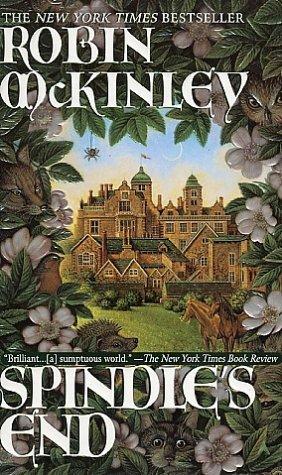
cover of Spindle's End

Another delightful fairy tale re-telling from Robin McKinley, this time (if you couldn't guess from the title), we get her version of Sleeping Beauty-- although there isn't so much slumbering in this story. McKinley creates a new country so saturated with magic that it settles around like dust and has the potential to invade such ordinary, every-day tasks as boiling water or slicing bread. This also allows McKinley to set up a dichotomy between the more academic and intellectual wizards, in contrast with the wilder, and ultimately more powerful magic of the fairies, both good and evil.

As with so many of McKinley's heroines, the girl who should be a slumbering princess is instead a tomboy who talks to animals, hangs around the smith's yard helping him shoe horses, and learns to be a horse doctor. Rosie detests the silly fairy-gifts she was given by her fairy godmothers at her christening (things like ridiculously long eye-lashes, curly blond hair, and the like), and has a stubbornness familiar to those who have encountered some of the other women in McKinley's books.

Because we all know the fairy tale, I'm not giving anything away when I say that the evil fairy Pernicia is defeated in the end. But the way that Rosie wins out is largly due to the strength of her own individuality, and also due to the loyalty of her many friends, both human and animal. Pernicia's strength is clear, and it is very obvious that things could have easily gone another way. This is one of the more creative retellings of a fairy tale I've read; the ending is fresh, and the characters (especially characters who never come into the traditional version of the tale) are delightful and lovable.

Title:Spindle's End
Author:Robin McKinley
Date published:2000
Genre:Fantasy
Number of pages:354
Notes:Second or third reading, at least.

Read more...

Monday, May 30, 2005

read full post >

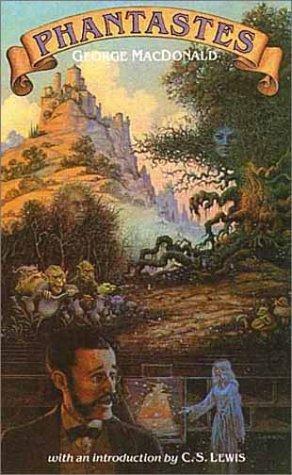
cover of Phantastes

Told from the point of view of Anodos, a young man who has just inherited his father's house and possessions-- and who discovers that his grandmother was actually a fairy. At first he doesn't believe her, but expresses a desire to go to Fairy Land. The next morning when he wakes up, his bedroom gradually transforms into a forest glade in Fairy Land. The rest of the story is made up of his travels through Fairy Land, and the people and creatures he meets.

Phantastes is one of those books that I've heard about for a long time-- supposedly it inspired people like C. S. Lewis and Tolkien, and helped them believe that it was possible to write Christian fantasy and original fairy tales. Lewis says in his introduction that the imaginative world of MacDonald's works is "the divine, magical, terrifying and ecstatic reality in which we all live", and suggests that Phantastes sort of baptized his imagination, long before he became a Christian. So, I had some pretty high expectations, and as a result of that, I was a little disappointed. This book feels more like a series of short stories, which all happen to feature the same character, the narrator. It didn't feel like there was a great deal of progression, and it certainly didn't feel like a novel, as MacDonald's Lillith does.

Many of the episodes are obviously allegorical, and of course Anodos' whole journey is supposed to be some kind of spiritual progression. In one village, Anodos finds that all of the people look attractive until you get within a certain distance of them. One time, Anodos is protected by the lady of the Beech tree from the evil Ash tree. Another episode seems like a somewhat disturbing allegory of female sexuality; Anodos meets a young girl who is almost a woman, with a little crystal globe which is "at once her plaything and her greatest treasure"-- she doesn't want to him touch it, but when he does, the globe vibrates and makes beautiful music. Eventually the globe becomes irresistible to Anodos, and he wants it so badly that he fights the girl, and breaks it. Later on, Anodos meets her again, and she says losing the crystal globe was a blessing in disguise, because without it to make music for her, she learned to sing. At some point, Anodos finds a beautiful white lady asleep within a block of clear marble, so he sings her to wakefulness and freedom, and spends much of the rest of the story searching for her. Another time, Anodos opens a door he has been warned not to-- and his shadow finds him, and trails along with him for the rest of his travels through Fairy Land.

MacDonald's style is not always my favorite-- the story is interrupted with "songs" that the narrator translates and records for us (often noting that the words were different, but it was "something like this", or that "I could not understand, but which left in me a feeling like this"). The quality of this work seemed a little uneven; some of the stories are much more engaging and compelling than others. Anodos' journey didn't seem quite as life-changing as it ought to have been, although perhaps I have missed details or not understood aspects of MacDonald's story. Phantastes is definitely worth reading at least once, if only for the better stories and the influence it has had on other writers. It is a book I will probably come back to in a few years, and maybe I will understand it better then.

Title:Phantastes
Author:George MacDonald
Date published:1858
Genre:Fantasy
Number of pages:185

Read more...

Google Search

Google