Book/page totals

Top 10 Lists

Showing posts with label short story. Show all posts

Thursday, February 01, 2007

read full post >

cover of The Adventures of Sherlock Holmes

Sherlock Holmes is one of those iconic characters that everyone is familiar with-- but perhaps not so many know him very well. I thought I had read some Sherlock Holmes before, but all of these stories were new to me-- and the description of Holmes' character and personage was a little different than I expected. I suspect my mental image of Holmes has been more formed by TV versions of his character than by the original stories. In spite of my mild surprise at finding a different man than I expected, I found both the stories and the character quite engaging and interesting.

I've discovered about myself that, while I enjoy mystery stories (whether in book or video form), I dislike the death and gore that is so often associated with them (particularly in so many TV series these days)-- so the fact that Holmes' cases in this book are much more varied was a pleasant surprise. A few have to do with death, but in many other cases Holmes stops a crime before it happens, or by solving the mystery of one death prevents another. In at least one case, there was no actual crime committed-- although still a terrible, unkind act. After I finished the book, it occurred to me that at least three of the different stories (out of twelve total) had to do with fathers or step-fathers who, by death, imprisonment, or more subtle means, were doing their best to keep their daughters fortunes under their own control. They are all different cases and interesting on their own-- but the parallel struck me as interesting; perhaps because it is so much less likely to happen in our society now.

I love that Holmes cares so little for rank. He works for the high and noble, Kings and Lords, but is just as willing to work for the poor commoners-- he cares more about whether or not the case is interesting and challenging than anything else. A while back I read that the character of Gregory House on the TV show "House, M.D." was based partly on Sherlock Holmes (which I found both intriguing and explanatory as to why I liked the show so well). When I read these stories and found Holmes so much concerned that his case be "interesting" or unique (rather than any kind of payoff or importance in the eyes of the world), it resonated with the character of House. Watson also notes Holmes' arrogance and (probably pretty just) assessment of his own brilliance and skill-- sometimes even showing off what he can deduce about people's profession or means of travel by the tiny indicators on their clothing and the like-- an arrogance that is also discernible in House.

This collection includes an afterword from Fred Strebeigh excerpted from "The Greatest Detective Who Never Lived" on Holmes fans, especially American ones. What struck me as most interesting (and a little bizarre) is the insistence that Holmes be treated as and spoken about as a real, and not a fictional, person.

Title:The Adventures of Sherlock Holmes (Readers Digest edition)
Author:Sir Arthur Conan Doyle
Date published:1987
Genre:Mystery Short Stories
Series:Sherlock Holmes
Number of pages:270

Read more...

Monday, September 18, 2006

read full post >

cover of Lord Peter

Read in less than a week. Lord Peter is quite an enjoyable character. Certainly a lord with noble bearing -- but also a man who can be down to earth and enjoys using his logic, which is better than that of most men. He and his butler, Bunter, make quite the pair. One who can figure out any mystery that is set before him, and one that can do almost any practical (or impractical) task that is set before him. The butler reminds me of Jeeves, as they have many of the same qualities, as presumably did most spectacular butlers during this time period. Sayers does not make every mystery end in finding and condemning the criminal, which is quite nice -- sometimes difficult decisions must be made that will affect many. And sometimes the truth is quite unbelievable.

A couple different places in the stories, Wimsey is asked how he does it. His answer is that he observes and his brain goes on making connections and asking questions of what he saw. That things are slightly out of place - something is not right. He doesn't worry about it, but simply goes on observing and comes back to it when his brain has already figured out the answers. For instance, a pearl necklace is stolen and it must be in one of two rooms. Everyone does a thorough search and it cannot be found anywhere. Wimsey does his own search with the master of the house and finds a pin. He doesn't actually see the pearls but he sees a reflection in the floor of things that look remarkably like pearls -- and that's enough to go on. He knows where they are and how to reveal who stole them in the first place. I like the idea that our brains work overtime. It's true!! But -- perhaps mine works on different things or notices different details. And I'm very glad that some people have brains that actually work rather like Wimsey's and put them to good use to find criminals, discover cures, seek possibilities.

Title:The Complete Lord Peter Wimsey Stories
Author: Dorothy L. Sayers
Date published:1972
Genre:Mystery Short Stories
Series: Lord Peter
Number of pages: 481
Notes:Borrowed from mom

Read more...

Thursday, May 11, 2006

read full post >

cover of Tomorrow Happens

A collection of essays and short stories asking questions about the future. About our world -- where we have come from, where we are going, how we are going to get there. These are good questions, asked in interesting ways, which makes them all the more palatable instead of frightening. Recently at church, we've been talking about the end times, and that the world is getting worse in many ways, so we need to be ready for the end. Which was an intriguing contrast to this book with ideas stretching far into the future. A strong tension -- but both have things to teach us today.

One idea that asks more thought is that of human purpose. Say that we do succeed in making the world a better place, a place that most, if not all, individuals have a chance to live and also to enjoy life. If there was then a generation that has everything they need and everything they want, what would they do with their time? Seems like there are a lot of people who are striving for the next best material thing to own or control. But what if they got all they wanted? How much more valuable to have a purpose, a calling, a vision -- than to have things, money, power.

Another piece is historical fiction (heavy on the fiction part), which asks the question of what one individual can affect. This idea keeps coming back to me in one form or another. My favorite ways of thinking about it is 'good ripples' and 'bad ripples' (thanks to Joan of Arcadia). Humans to have deep affects on others, regardless of their power. So often we get trapped by the idea that to have an impact we need to be powerful, have a strong influence, or control something. But sometimes all we need to do is be consistent in our choices and attitudes. Choosing well at most opportunities (good to strive for all, but that doesn't seem possible...) gives those around us hope of a different reality. I may not have brilliant ideas, but I can take what I believe and actually try to live it out. Asking questions that don't have easy answers seem like a good way to keep myself humble -- seeing myself clearly, being willing to learn from others, being excited when others are challenged to become more like Christ through me.

An essay titled 'The Self-Preventing Prophecy' also caught my attention. What an interesting idea that one way to help our world is to share stories of what could be. For example, Orwell's 1984 helped society to fear such intrusive objects and power, so that it hasn't happened. Other movies and books about our environment and what it is in danger of becoming have given environmentalists and others cause to care, and to act. There are places throughout the world that nature is being cared for well, and one could argue that this has something to do with the fear of what could be shown in stories. Often individuals become what they hear about themselves. If kids are constantly told by their parents, siblings, teachers, friends that they are dumb, they live down to that expectation and do poorly in school. But every once in a while, an individual (or society, or world) comes along that has enough courage and strength to fight that expectation and do the opposite. May we be such a society, and such a world -- that we are able to live into the good ideals and prove wrong the pessimistic prophecies.

Title:Tomorrow Happens
Author:David Brin
Date published:2003
Genre: Science Fiction - Essays & Short Stories
Number of pages: 219

Read more...

Friday, December 30, 2005

read full post >

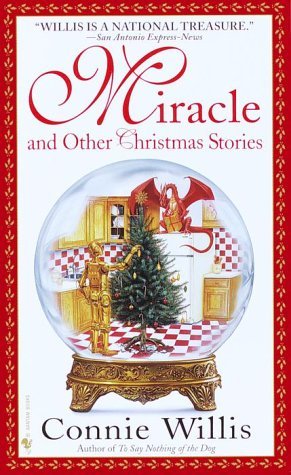
cover of Miracle

A collection of delightful Christmas stories from the talented Connie Willis-- some of them are heartwarming, others are creepy or a bit disturbing, but all of them will entertain you-- and the best will you leave you wondering just a bit. Willis is a big fan of Christmas, and has a great deal of respect for all the drama and power of the original Christmas story, and the stories collected here are unique and strange and wonderful.

A few of my favorite stories in this collection: the titular "Miracle", which plays out like some of Willis' other screwball romantic comedies; the wonderful story "Inn", where one choir member is the only person not too busy with Christmas to notice a strange homeless couple in the snow outside the church, and discovers that the young couple is really Joseph and a very pregnant Mary, lost (in time as well as space) on their way to Bethlehem; "Cat's Paw" presents a fascinating Christmas mystery; "Newsletter" is a humorous parody of the Christmas letters so many people send, and includes a possible invasion by aliens who are making people behave nicer than usual; and the last story, "Epiphany", is a wonderful story of three unlikely modern wise men-- a Presbyterian pastor, his atheist friend, and a former English teacher-- who are inspired to "go west", despite their own doubts and fears for their own sanity, in search of Christ, who has returned, but not in the way most would expect.

Willis also provides, as a "gift" to the reader, some recommendations-- twelve things to read, and twelve to watch. Some I'm familiar with, and some I will have to check out sometime soon. Her stories seem are gift enough, but I find it delightful that Willis wants to share with her readers some of her own favorites, and recognizes how wonderful it is to discover new authors, and how we frequently do that through the work of authors we already love.

Title:Miracle and Other Christmas Stories
Author:Connie Willis
Date published:1999
Genre:Short Story
Number of pages:298
Notes:Second reading.

Read more...

Saturday, November 12, 2005

read full post >

cover of My Man Jeeves

Jeeves and Wooster and P. G. Wodehouse are all familiar names, but before now I've never taken the time to read any of Wodehouse's work, or any of the actual stories about Jeeves. This book is really a collection of short stories, and I was a bit surprised and confused when I discovered, half-way through, that not all of them are about Jeeves. Half of the eight stories in this collection are actually narrated by Reggie Philips-- a rather similar kind of character and narrator to Wooster, a chap who tries to help his friends out of jams, but without the assistance of Jeeves. The stories are all quite entertaining, and the tone is light and fun.

Some of the circumstances in these stories are pretty hilarious-- the kind of things you might expect to encounter in a sitcom today. In one case, Reggie is trying to help a friend who's girl has ended their engagement; he decides it would be a good idea to kidnap a child who he thinks is the girl's nephew so his friend can return the child-- but of course, the child is no relation to her and Reggie is stuck taking care of the kid for a few days. Of course, in all of the stories things usually come out right in the end-- although usually in spite of Reggie's help.

Wooster, Jeeves' employer, is the narrator of the Jeeves' stories, and he is usually as clueless as Reggie-- although generally without the bad ideas of how to help people; he relies on Jeeves for all of his ideas. Wooster usually has no idea how to resolve things, and when things go wrong, he tends to despair; but Jeeves always manages to fix things up (and always without any real help from Wooster).

Entertaining, light reading, and worth your time. I plan to read more Jeeves stories and more P. G. Wodehouse.

Title:My Man Jeeves
Author:P. G. Wodehouse
Date published:1931 (original publication; electronic edition 2005)
Genre:Short Stories
Series:Jeeves
Number of pages:139
Notes:Read electronic edition freely available from Project Gutenberg.

Read more...

Google Search

Google