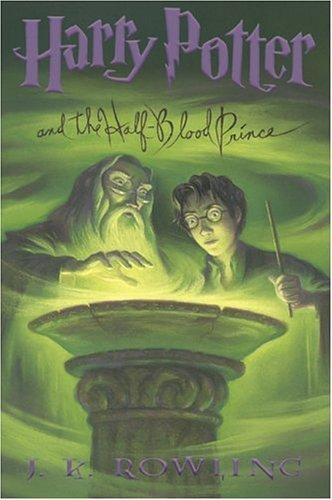
I haven't felt very "into" Harry Potter in a while-- I think that maybe after I finished reading the last book, I felt like I was done; I found it to be a satisfying conclusion to a good series. When "The Deathly Hallows Part 1" movie came out last fall, I wasn't excited about it and I didn't actually end up seeing it until just a few weeks ago. But I guess the enthusiasm of other Harry Potter fans and seeing a few of the later movies again was contagious and got me back into it. So, I decided to re-read the last two books in the series, leading up to seeing the last movie, and I'm glad that I did. This is the book where we, with Harry, learn who Voldemort really is, and how the boy Tom Riddle became the fearsome Lord Voldemort. And we also get to see a bit more human and vulnerable Dumbledore.
Read more...On this page:
- (Lark - Friday, July 15, 2011)
- (sapphire - Friday, August 10, 2007)
- (Lark - Sunday, July 22, 2007)
- (Lark - Monday, July 09, 2007)
- (Lark - Sunday, July 01, 2007)
- (Lark - Sunday, June 24, 2007)
- (Lark - Sunday, June 17, 2007)
- (Lark - Monday, June 11, 2007)
- (Lark - Saturday, June 09, 2007)
- (Lark - Monday, July 18, 2005)
- (Lark - Sunday, June 12, 2005)
Friday, July 15, 2011
Friday, August 10, 2007
The last in this enjoyable series, and well worth the wait. Harry and his two dear friends are on a quest to find and ruin the rest of the horuxes, so that Voldemort can finally be defeated. And for much of the book, they are on their own .. without adults to help them or trust, without comfortable places to stay, without Dumbledore to guide them, without many things. But they have enough to get by on .. even enough to do well with. As they spend a lot of time together with building tension, their attitudes and tempers aren't always the best .. but together they have power. And of course, it comes to a final battle between the two destined to fight to the death. Some beautiful moments happen .. especially since the battle is not just two people, but two armies .. and one army is full of all those characters (and their relatives!) we have come to know and love in the previous six years of Harry Potter's life.
Dumbledore gives one gift to each of the three .. Harry, Hermione, and Ron: to Ron, the deluminator which can put out any light (and also do one other vital thing); to Hermione, a book of wizard fairy tales which she must translate and learn from; and to Harry, the first snitch he ever caught. These three gifts don't seem to make sense. They are simple things that don't seem to have any special powers .. but each does, and plays a vital role at one point or another. That seems to fit well with life too .. as humans, we are given talents or abilities that sometimes don't seem to make sense or be very useful. But they are! At their own time and for their own reasons, even if they are not the reasons we would expect.
The epilogue has gotten a lot of flack, I've heard. Because it's about normal life .. nothing spectacular. But after being chased by Voldemort for seven years (or his whole life), it makes sense that for Harry and for his friends, having 'normal lives' is just the right ending. The whole series has been very much about relationships, about friendship, about mentors who lead well, about the importance of family, about fighting for good no matter what. And the epilogue comes back to these key themes. Savoring relationships that have lasted many years, looking with hope toward the future, enjoying today and what life has given. This is a series well worth reading (and re-reading), and book that finishes the story well. Thanks, J.K. Rowling.
| Title: | Harry Potter and the Deathly Hallows |
|---|---|
| Author: | J.K. Rowling |
| Date published: | 2007 |
| Genre: | Young Adult, Fantasy |
| Series: | Harry Potter |
| Number of pages: | 784 |
| Notes: | A gift from Aunt Carla! |
sapphire
on
Friday, August 10, 2007
add a comment
Sunday, July 22, 2007
Wow. Finished. That was a great adventure.
As I was waiting for the book and wondering how Rowling would resolve any number of things, I decided it was a matter of trust-- and, based on the care and skill of the first six books, I decided I could trust Rowling to end it well-- and I was not disappointed. I won't go into too many specific details here, because I don't want to mar the experience for those who may not have immediate access to the book. It's a different book, since Harry isn't at Hogwarts this year; it starts with intensity and action right away, and hardly lets up; there is a real feeling of war and oppression-- people in hiding, family members being taken, etc. As in the last one, the stakes are real and there are consequences, including death (I cried at several different points in the book). There are also lots of wonderful resonances with moments from the other books (especially the first), and this book completes and fulfills the series.
Some highlights... finally getting Snape's side of his story; learning more about Dumbledore's past and his family; the role that Kreacher the house-elf plays, and the valiant Dobby; heroic Neville; finally having everything explained; a new (but unsurprising) perspective on Voldemort's soul; Harry coming fully into his own, and the extraordinary power of his love (as Dumbledore tried to tell him repeatedly); the aftermath.
I feel like I should say something about the titles, but don't know what to say without revealing too much. The Deathly Hallows are three magical items (out of a fairy tale) that, when united, make a person the master of Death. They form an interesting parallel to Voldemort's dreadful horcruxes, being both quite different and troubling similar.
Read in about 24 hours.
| Title: | Harry Potter and the Deathly Hallows |
|---|---|
| Author: | J. K. Rowling |
| Date published: | 2007 |
| Genre: | Young Adult Fantasy |
| Series: | Harry Potter |
| Number of pages: | 759 |
Lark
on
Sunday, July 22, 2007
add a comment
Monday, July 09, 2007
In Harry's sixth year at Hogwarts, he begins taking special lessons from Dumbledore-- you could call them "Voldemortology," since Dumbledore is sharing all the painstaking research that he has done in collecting memories and tracking Voldemort's movements. All this is done to give Harry as much help as possible for when he eventually must face Voldemort. Harry also gets an old potions book owned by someone who called themselves "the Half-Blood Prince," and who left all kinds of interesting notes in the margin-- adjustments to the directions for potions that make Harry look brilliant (and Hermione very frustrated), spells in the margins, and the like. All year long, Harry suspects that Malfoy is up to something, but no one quite believes him. Harry's instincts are usually pretty good, and in this case (unfortunately) it turns out he's right.
It's interesting how much Harry trusts the scribblings of the Half-Blood Prince (in spite of previous experience with dangerous books). He randomly tries out on Ron a spell scribbled in the margins of the book, which, as Hermione points out, is really pretty stupid. Later on he uses a spell that the prince had labeled "for enemies"; the spell is horrible, dark magic and Harry feels betrayed. Near the end of the book you find out (don't read if you don't want to know!) that Snape was the Half-Blood Prince-- which gives a real sense of how brilliant Snape must have been, to fix potions directions and invent his own spells (however terrible).
Dumbledore seems a lot weaker in this one. His hand is blackened and shriveled, a memento from destroying one of Voldemort's horcruxes. Especially at the end, it seems like he makes some poor decisions-- but we don't have the whole picture, so perhaps (hopefully) there's something we don't know. As with Snape-- Dumbledore had some reason for trusting him (and I think it is more than what Harry says), but it hasn't been revealed to us yet.
The horcruxes are, of course, the crux of how Harry must deal with Voldemort. In his fear to death, Voldemort split up his soul into seven parts and stored those parts in various objects. Reading this again, I had a real sense of pity for Voldemort-- so afraid of death that he has maimed himself repeatedly to protect against it. Perhaps it's no wonder that he no longer looks or seems human, since he's only got a seventh of a soul. And, of course, that there could be a power in a soul that was whole and pure.
The ending... is crazy (and comes with a heartbreaking loss). It really leaves you wanting to know what Rowling isn't telling us, which side Snape is playing for, and how Harry will do without Dumbledore's direct guidance (I suspect he will still have Dumbledore's guidance indirectly, in some form or other). Fortunately, I guess, I don't have to wait so very long to find out.
I feel like I've timed my reading all wrong! Now I have to wait an agonizing week and a half before I get to find out what all this means. (How did I wait after I read this last time? I guess I kind of forgot about it.)
Finished in about four days.
| Title: | Harry Potter and the Half Blood Prince |
|---|---|
| Author: | J. K. Rowling |
| Date published: | 2005 |
| Genre: | Young Adult Fantasy |
| Series: | Harry Potter |
| Number of pages: | 652 |
| Notes: | second reading |
Lark
on
Monday, July 09, 2007
add a comment
Sunday, July 01, 2007
Angry Harry. For various reasons, Harry spends the bulk of this book, his fifth year at Hogwarts, being very irritable and the slightest provocation will start him raging and shouting. Hermione and Ron seem to take turns patiently reminding him that they're on his side and would he please stop taking it out on them. And Harry has some pretty good reasons for being so on edge, the biggest of which is that Voldemort is back, and Harry's scar is twinging all the time (and flares up and really hurts whenever Voldemort is particularly angry or happy). The Ministry of Magic is trying to suppress rumors of Voldemort's return, using the newspapers to make Harry out to be an attention-seeking liar, and even interfering at Hogwarts in the form of the despicable Dolores Umbridge. There are also some interesting ideas about how seeing death alters your perception.
One of the things haunting Harry is Cedric's death at the end of the last book. While there has been plenty of death and loss in Harry's life, he's never exactly witnessed it first-hand, and in this world that changes your perception. The most obvious way we see this is the Thestrals-- beasts which have invisibly pulled the carriages from the train to Hogwarts every year, only now Harry can see them (along with the delightful character of Luna Lovegood). Later on, when they are in the Hall of Mysteries, there is an arch with a veil-- and only Harry and Luna can hear voices whispering behind the veil, calling to them. There are some pretty interesting ideas about death here, and I guess we will get to learn more about Rowling's ideas of death in the last book.
One of the really great things in this book is the Defense Association (aka Dumbledore's Army). Umbridge steps in as the ministry-appointed Defense against the Dark Arts teacher, and decides to give them a "purely theoretical" course-- designed to keep them from practicing any practical magic that might be used against the ministry. At Hermione's instigation and encouragement, they start an underground group led and taught by Harry to learn Defense spells. It's clear that Harry really enjoys teaching this stuff, and is a good teacher (the other students are able to conjure Patronuses, which Lupin wasn't sure Harry would be able to do in book 3). It made me think that if Harry survives his final encounter with Voldemort, he should eventually come back to Hogwarts and teach.
The DA is the source of the group that eventually goes with Harry to the Ministry of Magic and ends up facing off against the Death Eaters (along with some help from Dumbledore's Order of the Phoenix). Seeing Harry and his classmates practicing and learning made me see that the DA is sort of the next generation of the Order of the Phoenix.
Finished in about five days.
| Title: | Harry Potter and the Order of the Phoenix |
|---|---|
| Author: | J. K. Rowling |
| Date published: | 2003 |
| Genre: | Young Adult Fantasy |
| Series: | Harry Potter |
| Number of pages: | 870 |
| Notes: | repeat reading |
Lark
on
Sunday, July 01, 2007
add a comment
Sunday, June 24, 2007
Harry's fourth year at Hogwarts and the revival of the Triwizard Tournament. The names of the school champions are magically selected by the fiery goblet of the title, and, of course, somehow Harry ends up getting selected-- even though he's younger than the age limit, and the three champions have already been selected. As Harry muddles through his tournament tasks as best he can (and with lots of help from friends), unaware that there is a traitor at Hogwarts, although he is suspicious that Voldemort is getting stronger and strange things are happening at the Ministry of Magic. Re-reading the book and knowing who the impostor is the whole way through makes it quite interesting-- it almost strains credulity that someone could keep up that guise for so long, but not quite. And the resemblance between extremes of good and evil is even clearer.
If you haven't read this book yet (or at least seen the movie), perhaps you shouldn't keep reading, because I'm going to write about what interested me most: the idea of this traitor keeping up appearances and pretending to be someone else for an entire school year. Perhaps Crouch's job was simplified by the fact that Moody was such a shifty, jumpy, suspicious man anyway. The moments that rang most true for me were when Crouch said or did something Moody would have done, although for different reasons. It made me think about those similarities (even if only on the surface) between good and evil, which are pointed out explicitly in Crouch Sr., who became so harsh in his treatment of Voldemort's followers that he approached the cruelty and abuse of power of Voldemort himself. At one point, the faux Moody says something like "there's nothing I hate more than a Death Eater that went free"-- not because they weren't punished for their deeds, but because they weren't loyal to their master.
I also wondered about Crouch using the unforgivable curses on his students. He claims he has permission from Dumbledore to teach them the worst that they can expect, and to learn how to resist it-- and, whether he means to or not, he really does Harry a favor by teaching him to resist the Imperius. It's within the realm of believability that Moody would do this, but when I think of Crouch doing it, I can't help but imagine he got a sick satisfaction from torturing the students he was supposed to be teaching and protecting.
It's fun to see Harry making his ways through the challenging tasks of the tournament. He has help from friends (and one enemy), but that has always been the case, especially with Ron and Hermione. He even does the incredible, and stands up to Voldemort in the flesh-- although, again, he has help. One of the things that makes Cedric's death even more heartbreaking (on top of Voldemort's callous disposal of that for which he has no use) is Harry's sense that it is his fault-- he was trying to do something decent and generous in sharing the victory with Cedric, and instead Cedric was killed.
Read in about four days.
| Title: | Harry Potter and the Goblet of Fire |
|---|---|
| Author: | J. K. Rowling |
| Date published: | 2000 |
| Genre: | Children's Fantasy |
| Series: | Harry Potter |
| Number of pages: | 734 |
| Notes: | second reading |
Lark
on
Sunday, June 24, 2007
add a comment
Sunday, June 17, 2007
I feel sorry for the people who only watch the Harry Potter movies and don't read the books-- they are missing so much. I remember coming out of the third movie disappointed with the things that had been oversimplified (probably to fit it into two hours), and which added so much more depth-- and reading it again, I feel that again. In this book, you learn a great deal about Harry's dad and his friends, and the lengths they went to for each other, most specifically in learning to become animagi to be with their friend Lupin, and this comes together perfectly in the shape of Harry's Patronus (which is not the amorphous white shield portrayed in the movie). He finally sees the shape of it clearly near the end, when he fights off a swarm of dementors, and it is a great stag-- which was his father's animagi form and the reason his nickname was Prongs.
The Dementors are a powerful, dark creature in Harry's world. Perhaps it reveals a little something more about the wizarding world, that they tolerate these dreadful creatures, allowing them to torment those imprisoned at Azkaban, because it is a way to immobilize powerful wizards and make the rest of the wizarding world feel safe. Dumbledore makes it pretty clear how he feels about the dementors, and Lupin challenges Harry about the fact that anyone could deserve a dementor's soul-sucking "kiss."
Lupin is a great character-- the best Defense Against the Dark Arts that Harry has had, but, unfortunately for everyone, a werewolf. It was interesting to me how much Harry respects Lupin-- he values Lupin's opinion, and there are a couple of times when he's breaking the rules or doing something he shouldn't that he senses Lupin would disapprove, and this bothers him.
Re-reading the books, I'm more aware of how tightly-plotted they are. I've noticed before that Rowling is always careful to introduce magical ideas (such as animagi, or certain charms or potions) before they become central points in the plot. Time-travel is difficult to do, but Rowling is very careful and makes it work perfectly. Perhaps it's slightly easier that she makes it work so there is no alternate version of events (the time-travel always happened), but it is still perfectly done.
Not so relevant to the book, but-- the other thing that really bothered me with the movie-version of this book is that they made Lupin transform into some grotesque man-wolf, rather than an actual wolf, which makes the whole animagi thing (which they also mostly left out) completely illogical. Just dumb.
Read in less than two days (over the weekend).
Edited to add: I remarked something when I read the book that I forgot to include here. Harry spares Peter's life, asking Sirius and Lupin not to kill him (which they were ready to do)-- he does this more for their sake than for Peter, but Dumbledore later commends him for it. Dumbledore says that it's what his father would have done, but also that he may be glad of it later-- which reminded me of the pivotal role Gollum played in the Lord of the Rings, and the ramifications of the decisions of both Gandalf and Frodo to spare him.
| Title: | Harry Potter and the Prisoner of Azkaban |
|---|---|
| Author: | J. K. Rowling |
| Date published: | 1999 |
| Genre: | Children's Fantasy |
| Series: | Harry Potter |
| Number of pages: | 435 |
| Notes: | repeat reading |
Lark
on
Sunday, June 17, 2007
add a comment
Monday, June 11, 2007
Harry returns for his second year at Hogwarts, and we are introduced to the delightful character of Dobby the house-elf. At Hogwarts, the heir of Slytherin has opened the Chamber of Secrets and unleashed whatever monster Slytherin left there-- and Harry has to deal not only with the suspicions of the other students, but his own doubts about himself, since the Sorting Hat considered putting him in Slytherin house. Ultimately, he proves himself loyal to Dumbledore and a true Gryffindor when he faces Voldemort in a different, younger incarnation.
Eventually Dumbledore explains to Harry that, when Voldemort tried to kill Harry and failed, some of his power was transferred to Harry-- like the rare gift of parseltongue that makes everyone suspect Harry is Slytherin's heir. This is pretty interesting when you know the prophecy that is revealed later in the series-- by trying to take out a threat, Voldemort creates an even greater threat.
A couple of things that seemed annoyingly convenient to the plot, when I knew where it was heading: Harry, Ron, and Hermione are in frequent contact with Moaning Myrtle, yet they never think to ask her how or when she died? And Hermione is too clever not to figure out what the monster is before everyone else-- but of course she doesn't voice her suspicions until she can confirm it in the library, and then she's turned to stone until the whole thing is over. Ginny's behavior, on the other hand, did not bother me, because it seemed about the way someone like that would behave in such a situation.
Read in two days.
| Title: | Harry Potter and the Chamber of Secrets |
|---|---|
| Author: | J. K. Rowling |
| Date published: | |
| Genre: | Children's Fantasy |
| Series: | Harry Potter |
| Number of pages: | 341 |
| Notes: | repeat reading |
Lark
on
Monday, June 11, 2007
add a comment
Saturday, June 09, 2007
G and I have been planning to re-read all the Harry Potter books in time for the last one coming out in July. I was hoping to give him more of a head start (he's only in book 3), but I realized there isn't all that much time before July 21st to read 6 books and I'm not sure how many pages. It's fun to revisit our first trip into Rowling's magical world-- but thinking of it with the ending in mind makes it more interesting, too. And I still find myself touched by what saves Harry, when it is fully explained at the end of the book-- the sacrificial love of his mother is such a powerful counter-curse that it saves Harry's life as a child, destroys Voldemort's power, and leaves its mark in his skin so that eleven years later Voldemort's minion physically can't bear to touch Harry. That's powerful imagery, and surprisingly Christian for all those who clamor against these books as dangerous.
Because I'm reading with ideas about the last book in mind, and I've recently heard that the bookmakers in London have given up taking bets on Harry's demise (everyone was betting he dies in the last book), it's hard not to notice comments about death. For instance, the centaurs that Harry meets in the Forbidden Forest seem to know something about his death-- one centaur decides to make a stand against evil (even if it means being an ally of humans) and helps Harry, but it makes you wonder if they just weren't quite right about the timing of when Harry would meet his fate. Dumbledore also has a great line (all the more poignant because we know about Dumbledore's fate in book six) when he's explaining to Harry how Nicholas Flamel could willingly destroy the source of his immortality: "After all, to the well-organized mind, death is but the next great adventure."
Rowling's writing isn't what we think of as great literature, but there's something about her narrative tone that is very engaging-- a humorous, personable voice that is easy to listen to, and has interesting things to share. And in Harry's discovery of who he is and the world he belongs to, it seems there is something every child longs to discover-- there is magic in the world, and they are extraordinarily special.
Read in under 24 hours.
| Title: | Harry Potter and the Sorcerer's Stone |
|---|---|
| Author: | J. K. Rowling |
| Date published: | 1997 |
| Genre: | Children's Fantasy |
| Series: | Harry Potter |
| Number of pages: | 309 |
| Notes: | repeat reading |
Lark
on
Saturday, June 09, 2007
3
comments
Monday, July 18, 2005
I know Harry Potter & the Half-Blood Prince is one of the "most talked about" books online now (at least according to Technorati), so it's hard to know what to write. I will say I was a bit surprised by the interest & reactions of friends who haven't read any of the Harry Potter books and have only seen the movies-- one heard all the brouhaha in the news about someone dying and had to know who it was that died; the other's first question was whether or not this book was better than all the others (a question I find extremely difficult to answer), and wanted to be reassured that his favorite characters hadn't been killed. As well-done and enjoyable as the Harry Potter movies have been, I find the books so much more pleasurable. You get so many more hours of entertainment (even if I do tend to cram it into just a couple of days, at least on the first reading); you get to know the characters better, and you get more details than you do in the movies. It's amazing how many people and how much time & money it takes to create a two hour movie... I suppose it takes many hours of J. K. Rowling's work, and the help of editors and publishers, but that seems different, somehow.
I didn't start The Half-Blood Prince right away (that is to say-- not on Saturday, when our Amazon pre-order arrived). I wanted to let G read it first, and usually once I start a book like this I have trouble putting it down, so I tried to show some self-restraint. (A couple of summers ago when The Order of the Phoenix first came out, I waited until we were on vacation, and then I read the whole thing in just a day or two.) But on Sunday, G told me I could go ahead and start reading (I thought it very generous of him to share), and of course I ended up spending most of Monday reading it (figured I might as well finish it and get it out of the way, so it wouldn't be distracting me from everything else I should be doing). I was lost in the world of the book, so I remember distinctly that when I finally closed the book and looked up, and rejoined the world of normal reality, it was exactly 2:30 in the afternoon.
I think I came across on J. K. Rowling's website a hint in answer to a question about how the Order of the Phoenix communicate-- she said they only used their wands, and that we'd seen them do it before (I don't remember when, but will have to look for it next time)-- it seems pretty clever to use the Patronus as a method of communication, and it has a built-in kind of identification. I wonder if Harry & his friends will be able to use that, too, now that Harry knows about it. I like how Rowling sometimes will take some magic we are familiar with and use it again, or in a slightly different way.
I was hit pretty hard by the ending... I think I was crying for the last several chapters. But I like the fact that Rowling makes the stakes real-- this is a real war, and there are real casualties, major players that we and the characters in the book care very much about. I was also fascinated, almost the whole way through, to see the ambiguity about Snape's position. Right from the beginning of the book, we don't have enough information to know who he is lying to and who he is deceiving. I think Dumbledore must have had a pretty good reason indeed to trust Snape (more than what Harry comes up with), and I partly wonder if maybe Dumbledore had Snape swear an unbreakable vow to protect and/or help Harry (since Rowling has previously introduced a particular kind of magic once, and then brought it back in a larger role later). I will be very interested to see how Rowling deals with Snape and Snape's relationship with Harry in the last book (among other things, of course)-- but I will try to be patient.
| Title: | Harry Potter and the Half Blood Prince |
|---|---|
| Author: | J. K. Rowling |
| Date published: | 2005 |
| Genre: | Fantasy |
| Series: | Harry Potter |
| Number of pages: | 652 |
Lark
on
Monday, July 18, 2005
add a comment
Sunday, June 12, 2005
G & I wanted to prepare ourselves for the release of Harry Potter book 6, and when G found an unabridged book-on-tape edition of book 5 at the library right before a long road trip, it seemed like perfect timing. Normally, I don't do books on tape very often (if at all); G does more since he has a long commute to work right now. At first it took me a while to warm up to the reader's voice, but he did such a great job with all the different character's voices that it was delightful to listen to. It was also fun to enjoy the book together and talk about what we remembered and didn't remember, or speculate about things. As long as our road trip was, The Order of the Phoenix was longer-- we didn't have time to finish the book on the road. But that worked out fine for me: G listened to the rest on his work commute for the next few days, and I just read the last few chapters in our copy of the book.
Reading this book made me want to go back and read all the other Harry Potter books, too (the practical part of me realizes both that I don't have time for that right now, and that there are lots of other books I want to read-- maybe I will re-read them all before book seven comes out). Sometimes I think that Rowling's writing is not so fabulous (on the level of wording or style), but somehow the characters she creates are so memorable and likable-- which is a far more powerful literary gift than perfect style.
One of the interesting things about this book is the different kinds of evil Rowling presents. Umbridge is clearly an awful woman, and she is evil-- she uses dark means to what she considers to be "good" ends, and she is very interested in power and control (without even the wisdom or the skill to be able to manage them well-- it's made quite clear she's not nearly as talented in magic-practicing as the other Hogwarts teachers, as exhibited by her inability to clean up the portable swamp Fred & George created in a hallway). Umbridge is clearly evil-- she is both like and un-like Voldemort. And, just as in the real world, Harry has to learn that not all evil people are in league with each other. There are plenty of evil people even in supposedly good institutions.
| Title: | Harry Potter and the Order of the Phoenix |
|---|---|
| Author: | J. K. Rowling |
| Date published: | 2003 |
| Genre: | Fantasy / Young Adult |
| Series: | Harry Potter |
| Number of pages: | 870 |
| Notes: | Second "reading". |
Lark
on
Sunday, June 12, 2005
add a comment