Book/page totals

Top 10 Lists

Showing posts with label cynthia felice. Show all posts

Saturday, February 23, 2008

read full post >

cover of Promised Land

I've read this book so many times, and I know it's not great literature, but it's such a delightful, entertaining, pleasant book that I often find myself reading it again. I guess it is my reading equivalent of comfort food (I read it in a single night once). I needed something to lighten the bleak, heaviness of Watchmen, and this is what I thought of and grabbed off the shelf. It's an entertaining story, again the "married first, fall in love second" that there are so many versions of, but with the trappings of a rough colony planet and the humorous escapades of an outsider, a "been-to" coming back from off-world and unfamiliar with the local ways.

I think the reason this book, and these kinds of stories, are so compelling is because it's a picture of unconditional love. A former pastor once said that we know perfect love not because we are capable of giving it or because we have received it, but because we know how we want to be loved. And near the end of the story, when you finally get all the details and find out how blindly and completely Sonny loves Delanna, it's a taste of that. He puts up with all the crazy things she does and the hurtful things she says, and he has no expectations from her; as soon as he sees how beautiful and educated she is he knows she doesn't belong on his primitive planet, but he still wants to show her the land and the beautiful flowers she used to love as a child. Sonny is generally so careful and thoughtful about things, but eventually we find out that he took off across the shifting, unsafe landscape in a broken solar the moment he heard Delanna was coming. He even tries to accommodate her leaving and getting money to go off planet, even though he knows it will force him and his brothers to abandon their land for ten years and go work in the mines to get by, but he never treats he never seems to think of himself when Delanna is involved.

The one thing that bugs me about this book (and I think it bothers me more every time I read it) is the last few lines. There are other things that are slightly out of character earlier in the book (like Delanna beginning to interpret and speak for the laconic Sonny when she's hardly seen him for a few hours), but for some reason I can put up with that. But at the end Sonny and Delanna suddenly forget that they are already married by the laws of the land (when they have argued about it and danced around it and avoided it for months by this time), and the only reason I can figure this happens is so the authors can get in what they think is a clever last line, but I find it disappointing and unsatisfying.

Title:Promised Land
Author:Connie Willis & Cynthia Felice
Date published:1997
Genre:Science Fiction / Romance
Number of pages:368
Notes:repeat reading

Read more...

Tuesday, January 31, 2006

read full post >

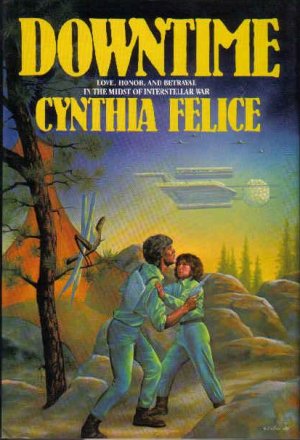
cover of Downtime

This novel is set in an interplanetary society on the brink of a galactic war over the precious Elixir, which extends the life of those who drink it (it reminded me a bit of the spice in Dune. Most of the action takes place on the downtime outpost planet Mutare-- "downtime" because of the apparently relativistic time effects in this planetary system: time on Mutare and other downtime planets passes more slowly relative to the time of the Hub and the central worlds. The two main characters, Calla and Jason, were lovers years ago; Jason joined the rangers and came to Mutare, and Calla stayed with the Praetorian Raiders. Because of the downtime effect, only ten years have passed for Jason, while it has been thirty years for Calla. Calla has been chosen to protect their society from a suspected traitor because of her genetic singularity: she is immune to the Elixir, and therefore cannot be bribed by it.

I know of Cynthia Felice only through her collaborations with Connie Willis, and after reading Light Raid, I decided I should check out some of her work. Downtime was the only book by Felice that I could find in the libraries I have access to, and I had trouble finding much information on her, or even a cover image for the book, online. I enjoyed the book, and the end certainly reeled me in and made me keep reading, even though I correctly guessed some of the outcomes.

One thing that bothered me in this book was the use of technical terms. Felice seems to throw you right into the middle of this society without any definitions or terminology, and you have to pick things up as you go-- which is mostly do-able (and certainly preferable to reading a slow, boring introduction to the society structures and technologies). It's easy enough to figure out that the decimvirate is a council of ten, and from the references in the text I eventually understood that the stellerator was some kind of vest worn to protect humans from the cosmic radiation on Mutare. It's clear that this society has highly advanced genetic sciences, and also that they are heavy into protocol-- each person must wear a "nomenclator" that transmits their name, rank, accomplishments, etc. to those they approach. One of the odder things was the use of "jelly beans" to store and transport information. The one time Felice does go into detail is about the production of Elixir, and then it was far more detail than I really wanted-- although I understood the point she was trying to make, which is that making the Elixir is a very difficult, complicated process which can easily be disrupted.

An interesting subplot revolves around the strange danae, a species indigenous to Mutare; they are hunted for the valuable fragrant crystal contained in their bodies, but Jason, who is the Ranger-Governor of Mutare, does his best to limit this hunting, becuase he suspects that the danae may be sentient. Because of the themes of environmentalism and caring for other creatures, I was strongly reminded of Anne McCaffrey's The Coelura. The danae are actually pretty interesting; they communicate mostly by Psi, and the nymphs must go into a cocoon phase before they will emerge as a full-fledged danae. The interesting bit about this last part, as Jason eventually discovers, is that when a nymph cocoons with a dying danae, the new danae shares the memories of the old one.

One peculiar thing that I might not have noticed if I hadn't been reading the book of Esther the same day I finished this book... Calla has a gallows built on Mutare, so that when she eventually chases the traitor back to Mutare, he will know that she had planned it all along. This is suspiciously reminiscent of the gallows that Haman built for Mordecai, although here it plays out slightly differently, and Calla is certainly not a despicable character like Haman.

An entertaining read. In spite of the strange technology, there is plenty here to fascinate. I found the parts of the story set on Mutare, and the concern with a traitor in their midst, more compelling than the space battles. I was intrigued by the politics of this war more than I expected to be, and enjoyed Calla's surprising plan-- because she is immune to Elixir, she is one of the only ones who can think clearly and respond decisively in the face of this threat.

Title:Downtime
Author:Cynthia Felice
Date published:1985
Genre:Science Fiction
Number of pages:246

Read more...

Tuesday, September 20, 2005

read full post >

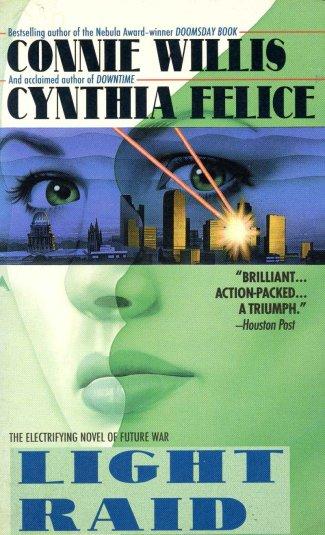
cover of Light Raid

I picked up this book to read just for some fun, light reading-- because I enjoy Connie Willis' work, and her other collaboration with Cynthia Felice that I have read (Promised Land) is an entertaining, quick read-- but it turns out, in a way, that it is [slightly] relevant to our current events, with hurricane Katrina. The main character, Ariadne, is a teenager who has been evacuated to Victoria because of the dangers of war between Quebec and the Western States-- and when I read about her fears and frustrations with being evacuated, I thought about all the people displaced by hurricane Katrina. The title comes from the main form of attack used: laser beams from satellites, which cut through anything and reduce houses to rubble (presumably based on the term "air raid", but upgraded for the future). Of course, most of the cultural relevance quickly disappears as the (of course) clever and beautiful Ariadne escapes evac and treks back home, out of concern for her parents' safety, and the novel quickly turns into something of a cloak-and-dagger story: where Ariadne is continually uncertain who she can trust, including her parents and the dashingly handsome ladies' man, Prince Miles Essex, and his "nice-looking" assistant Joss Liddell, who seems to be something more than a servant.

There's a delightful sort of Dickensian character in the early part of the book. Mrs. Ponsonsby has taken in to her home many of the poor children orphaned or evacuated because of the war. But, of course, this is only because of the money the Red Cross will pay her for taking care of the children, and she is delighted to have Ariadne (however briefly), who is old enough to take care of the babies. I don't know if it was the name or the behavior or both, but it seemed like the kind of character Dickens might create (particularly if he were writing speculative cloak-and-dagger war fiction).

One thing that bothered me a bit about this book was the slang-- some of it took me a while to figure out (they start you right in with "diping" as a verb-- to put a diaper on a baby), and some seemed a bit silly, such as "batellite", for a battle satelllite (those that cause the light raids, of course). In general, I think slang usually makes a fictional place feel more realistic and lived in-- but, when it is jarring, or just sounds like something people wouldn't actually say, it is distracting.

Also interesting was the use of Greek names. Ariadne's full name is Hellene Ariadne, her father is named Dares, and her mother is Medea. They work for a company called Hydra corp, and the powerful, intuitive supercomputer that runs behind everything at the company is called Minerva. The book suggests (although I think it never explicitly says) that the societal structure is based around companies that operate more like families, and this particular one is Hellenic.

I enjoyed reading Light Raid quite a bit. There are enough twists and turns to keep things unpredictable (although the romance is rather predictable). This is a better book than Promised Land, and makes me think that I really ought to check out some of Cynthia Felice's work sometime.

Title:Light Raid
Author:Connie Willis & Cynthia Felice
Date published:1989
Genre:Science Fiction
Number of pages:263

Read more...

Sunday, March 06, 2005

read full post >

cover of Promised Land

Promised Land is a variation on the standard plot of two people being forced to marry for some reason, and then gradually falling in love afterwards (usually because the man's unswerving and abiding love eventually wins the woman over). Just recently I've seen this plot in the TV movie "The Magic of Ordinary Days" and also in "Love Comes Softly" (based on Jeanette Oke's book of the same title). There are some fun quirks to Willis' and Felice's version of this familiar story, but I wonder if there is a draw to this basic plot itself? My pastor, in a recent series on love, claimed that none of us is capable of loving perfectly and unconditionally-- but in spite of our inability to love, we still all want to be loved perfectly, and we recognize real love when we see it. My suspicion is that this is the reason we are drawn to this familiar plot-- because, as unrealistic as it is, this story presents something that may be as close as humanly possible to the kind of love that all of us are longing for.

Despite the fact that the main plot of this book is familiar and predictable, I still enjoy it quite a bit-- as evidenced by the fact that I've read it three times now. It is a quick read, easy to breeze through and enjoy. The promised land of the title is a lanzye, or farm, named Millesflores on the colony planet Keramos, and this setting allows for some exotic scenery and fanciful creatures. In this case, the marriage is caused by planet laws relating to inheritance, and designed to keep lanzye's from being split up. The off-planet educated Delanna comes back to the back-water planet her mother hated and did her best to get her daughter away from-- and (of course) Delanna comes to see the beauty of the land and the people on this undeveloped planet. There are some points where the character development or dialogue isn't quite believable (including a line at the very end of the book-- it seems a detail the characters would be unlikely to forget). This is a bit disappointing (at times I found myself wondering which parts were written by which author-- I mean no offence to Felice, but I'm unfamiliar with her work and know a bit of Willis' brilliance); I suppose, as a reader, you put up with these inconsistencies because you know where the story is heading.

Title:Promised Land
Author:Connie Willis and Cynthia Felice
Date published:1997
Genre:Science Fiction
Number of pages:368
Notes:Third reading

Read more...

Google Search

Google