Book/page totals

Top 10 Lists

Showing posts with label nonfiction. Show all posts

On this page:

Sunday, August 16, 2009

read full post >

Bryson is an author who is knowledgeable and entertaining at the same time – a combination not to be taken for granted! As stated in the title this book gives a general overview of the history of the world, scientifically speaking, and includes glimpses into a wide variety of subjects – chemistry, physics, geography, lots of -ologies, but in a way that they are comprehensible. Bryson talked with a large number of specialists, visited them, learned from them, asked lots of questions. And we get his summaries.

One of the best parts of the book is the stories about various characters. Many of them incredibly strange. Brilliant – but strange. One Oxford professor that I remember reading about was extremely absent-minded. Upon returning home one evening, his wife told him to go upstairs and change for their dinner party that evening. He got undressed, but then couldn't remember what he was doing, so he changed into pajamas and got into bed. His wife was duly exasperated when she found him shortly thereafter. Or the chemist who insisted on tasting all of his experiments, something which clearly aided his death in arriving sooner. Or the fact that if a meteor were to actually hit earth, it wouldn't be visible to the naked eye until one second before it hit earth, and the impact could easily damage a whole continent and most likely throw the whole ecosystem wildly off-kilter. In the process of reading this book, two facts became more clear to me:

1) we often take for granted things for which the margin of error (or possibility) is actually incredibly narrow.

2) there must indeed be a Creator!

Title:A Short History of Nearly Everything
Author: Bill Bryson
Date published:2003
Genre: Nonfiction
Number of pages: 478
Notes: from c. knapp

Read more...

Monday, July 20, 2009

read full post >

cover of The Loved Dog

I was pleasantly surprised with how readable and interesting this book was. It starts off almost more like a memoir, as Geller tells some of her story and how she came to her view of how dogs should be trained. She has a great story of trying to use foreign toilet facilities in a strange land, and then compares this to dogs, who she says don't know what we want them to do and don't know how to ask us. She also describes her observation of wolves, who teach pups how to behave by playing games. Geller is apparently a dog coach to the stars, and at times it feels like she is name dropping, but she tells plenty of other stories about non-celebrity dogs and families when it suits the purpose of what she is trying to communicate. Geller claims that most of what passes for dog training these days is actually abusive, and she has some horror stories of dogs with broken feet and crippled legs that bear witness to this.

The training ideas are easy to follow along with and Geller generally provides reasons why you should do things a certain way. I found new ideas and insights that were helpful to me with my dog, who is mostly pretty well trained (and some thoughts about why he has trouble with a couple of commands he doesn't always do so well). The idea of different levels of treats to help reward different kinds of behavior is helpful, and even the notion that dogs need structure but also like a surprise now and then. I found Geller's opinion on training dogs to heel interesting and sort of emblematic of the rest of her thinking-- she says it goes back to a time when dogs were soldiers, and had to be on the opposite side of where the rifle was carried, but that dogs aren't soldiers anymore and we don't need to treat them like they are.

Geller is clearly very passionate about her work and dogs, as evidenced by the organizations and campaigns she describes in the back of the book: Stop Puppy Mills, Another Chance for Love, and Pets for Life.

Title:The Loved Dog
Author:Tamar Geller with Andrea Cagan
Date published:2007
Genre:Nonfiction, Dog Training
Number of pages:227
Notes:gift from Ardis

Read more...

Monday, July 13, 2009

read full post >

cover of 'Friday Night Lights

This may be the best nonfiction book I've ever read. Maybe that's not saying much, since I don't read all that much nonfiction, but I found it engrossing and well-written. The well-known book that's been turned into a movie and a TV series follows the season of High School football for the Permian panthers in Odessa, Texas; but along the way, Bissinger not only brings the town and the people to life, he also gives fascinating insights to racism, classism, politics, the oil bust and boom, the history and culture of Odessa and neighboring rivals, as well as the fanatical, near-religious devotion to football.

Every now and then I found myself wondering about the narrator-- not because he is present or noticeable in the text, but precisely because he is so invisible and yet manages to capture so many details and moments in a way that seems so clear and insightful; even though it's never mentioned, I imagine the author doing his careful, meticulous research, following along all season long with the team, the coaches, the players and their families to capture so many of these crucial moments in the season, and to hear and understand their stories.

There are so many fascinating insights here that are just a part of the fabric of the story that Bissinger tells. For instance, desegregation of the schools in Odessa was delayed quite a bit, in part because no one wanted to mess up the football programs; and when they finally did desegregate, the district lines were gerrymandered so that Permian would get a greater share of the black athletes. When the star running back is severely injured, he becomes a nobody, and they don't even try to coach him back, they just replace him with somebody else; when he no longer gets the preferential treatment of a football player, he can't keep up with his classwork because he never was really taught.

The story of the many oil millionaires in nearby Midland Lee gives a personal glimpse into the oil industry, and the way that government policies had a tremendous impact on people's lives, and the striking difficulty of getting oil from Texas as compared to the Middle East. Men who happened to be in the right place at the right time were suddenly rich because of luck and politics, but because they thought it was their own business skill they all spent and invested like crazy, until suddenly the oil prices crashed and all these oil-millionaires went broke.

This edition of the book includes a look at where the players were ten years later, and it is fascinating, but mostly quite sad. For a school year or two, these young men were treated like heroes and gods, they could do no wrong and were allowed to get away with pretty much anything-- but as soon as they lost in the semi-finals and the season was over, that was gone and they were replaced by the next group of kids who had worked and dreamed of playing for Permian since they were children. Even the few who were able to play college football talk about how nothing was ever quite like playing for Permian.

Title:Friday Night Lights
Author:H. G. Bissinger
Date published:1990
Genre:Nonfiction
Number of pages: 367
Notes: borrowed from Sapphire

Read more...

Tuesday, April 28, 2009

read full post >

cover of Oliver Sack's 'Musicophilia'

A fascinating compendium of a variety of case studies and stories relating music and the brain--

  • perfect pitch and why we don't all have it (and how some people associate tones with colors)
  • musical hallucinations (losing hearing & hallucinating songs from years before)
  • "amusia" - an inability to perceive one of the many components of music, the absence of which makes it impossible to appreciate music (there are so many things going on when we listen to music that we tend to just take for granted! rhythm, timbre, pitch, harmony)
  • musical savantism
  • people with severe amnesia or aphasia where music can be a tool to recover some of that lost function
  • even brain damage that frees up musical creativity
The stories are fascinating and interesting for what they say about the complexity of music, as well as the brain and what it means to be human. I was a little disappointed that Sacks didn't make a stronger argument or concluding summary at the end about what all of these stories and details means, what it all adds up to; he basically concludes that all human cultures have some form of music and that some relation to music is intrinsically part of being human. Perhaps this was cut from the audiobook, but it seems unlikely they would cut something as crucial as that, which would tie things together a bit more, and try to make sense of the whole picture.

In any case, there are any number of fascinating stories here, and listening to them reminded me how we all have those "touches of madness," little bits or traits of these much stranger and more extreme cases that we start to notice in ourselves after reading or hearing about them. For instance, it never occurred to me that we have "auditory imagery," and that some people have much better musical imaginations than others-- to the point that some people can look at a musical score and hear the whole orchestra in their head. Another familiar experience is the auditory "afterimage", or the "earworm," the song that gets stuck in your head. Or the notion that there is latent musical ability in many of us, but it is inhibited because so much of our brain is taken up with sight and visual processing.

The fact that our culture is so saturated with music and noise all the time, and that so many of us pipe it directly into our ears makes me wonder what we are doing to ourselves, what long-term effects there will be, on our brains and our hearing and our sensitivity to music.

Listened to the audiobook.

Title:Musicophilia: Tales of Music and the Brain
Author:Oliver Sacks
Date published:2007
Genre:Nonfiction / Science
Number of pages:400
Notes:listened to audiobook

Read more...

Tuesday, August 19, 2008

read full post >

This is a book about five current missional groups: InnerChange, Servant Partners, Servants to Asia's Poor, Urban Neighbors of Hope, and Word Made Flesh. Bessenecker writes about the fact that historically, radical Christ-followers step away from the Church and to the the poor in order to call the Church back to the poor. These followers live simply, among those who are poor, making a difference in the small scale, suffering with and being present with their neighbors. He talks about how these people are radical not simply as an end, but in order to pursue Jesus. There are five different pursuits he focuses on: Jesus' descent into humanity, intimacy with Jesus, relational wealth, the Kingdom, and the edges.

Nice to read this book because I am part of one of the groups he discusses, and it's encouraging to know there are a number of us out there. And that this is not such a strange calling .. many throughout history have been similarly called to love those on the margins and to step down instead of reaching for those things the world values. Bessenecker makes these ideas accessible for the reader, without using fancy language or trying to prove his point strongly .. stories and examples from today are more than enough to do that.

Title:The New Friars
Author: Scott Bessenecker
Date published:2006
Genre: Spiritual, Nonfiction
Number of pages: 175
Notes: from t. lockie

Read more...

Friday, May 23, 2008

read full post >

Bryson is a wonderful writer, and this is quite the interesting topic. Particularly for someone who enjoys words and using them well. Bryson includes a number of comparisons between English and various languages .. for instance, how English only has the word 'you' while in most other languages there are at least three or four different varieties to choose from when addressing someone else. And he is careful to make sure these go both ways .. expressing how in some ways English is simpler than other languages, but also how confusing it can be with grammar and vocabulary and simple changes bringing large changes in meaning.

There are a nice divisions for chapters .. names, spelling, pronunciation, swearing, wordplay .. and others relating to both the history and future of words and language. Of course Bryson uses good vocabulary in this book (how else could one write a book about the English language?!), so it was good for my brain to read this book. Not only was I learning as I read (and also wanting to share random facts with friends who weren't always so interested..), but I was using my brain and being reminded of words I don't get a chance to use often. This is a book I am sure I will read again.

Title:The Mother Tongue: English and how it got that way
Author: Bill Bryson
Date published:1990
Genre: Nonfiction
Number of pages: 245
Notes: from danny & anita

Read more...

Wednesday, April 16, 2008

read full post >

Actually got to hear Dawn speak at Wheaton for special services one year, so that's fun. There are four sections - four main categories of how Dawn sees the Sabbath: ceasing, resting, embracing, and feasting. Many people know that to keep the Sabbath means to not work, but there is a fullness in the day that Dawn describes. Sabbath is meant to be a gift .. to the individual, to the family, to the Church, to the world. When people can rest, be refreshed, and be reminded of what truly matters and who we are in relation to God .. the world is a better place for it. And we are better people. If lived well, Sabbath can affect not simply one day a week -- but the entire way one views time, relationships, and the way one measures value.

Dawn describes Sabbath as .. ceasing to be controlled by the expectations of the world; ceasing to live in the belief that we actually have control over our lives; ceasing the monotony of day to day existence. Whe calls Christians to rest as well .. not simply to take a nap on Sunday, but to rest as whole people -- physically, intellectually, emotionally, socially. The third section focuses on embracing, because when we say 'no' to something (aka ceasing to worry and to accomplishing) we must say 'yes' to something else: aka God's upside-down values; time and people instead of space and all that must be done; being who God has called us to be instead of who others or the world expect us to be. Finally, Dawn challenges the reader to feast on the blessings of God, that this day might really be special. It might be listening to beautiful music, going for a long walk in nature, eating particularly enjoyable food, or taking the time to really spend the day with friends and enjoy each other. Dawn find theological, Biblical reasons for all her main points. This book was a challenge to me. I want to keep the Sabbath .. not simply to have a day off, but to have a day to focus on God and who He is, to live out my belief that He is in control and not me, to have a focus on the celebration of Sabbath instead of just seeing it as another day in the week.

Title:Keeping the Sabbath Wholly
Author: Marva Dawn
Date published:1989
Genre: Spiritual, Nonfiction
Number of pages: 213
Notes: borrowed from Diane

Read more...

Saturday, April 12, 2008

read full post >

A fairly simple story with some good truth. The author becomes friends with a woman who is much older than her, named Nancy. They are both writers and find out that they both love road trips. Through travels together they become much closer, and Nancy often speaks into Mary's life. As with all good relationships, they both challenge and change one another over time. Nancy has had a pretty exciting life, and she loves getting to know people, and is able to relate with just about anybody .. little kids at church, college students, the mailman. Nancy teaches Mary three important truths over time: get your eyes off yourself, keep a positive attitude, pour your life into others. All very good things to learn .. and to keep being reminded of. A quick, positive read.

Title:Over Salad & Hot Bread
Author: Mary Jenson
Date published:2006
Genre: Nonfiction, Spiritual
Number of pages: 159
Notes: gift from Church of the Resurrection

Read more...

Thursday, April 03, 2008

read full post >

Read in a few days and enjoyed Bryson's writing style. It is narrative, with him and his friend Katz walking the Appalachian Trail (parts of it, at least), but there is a nice mix of information as well. History about the areas they walk through and how the trail came into being, stories about things that have happened along the trail, facts about how the animal population has drastically changed in the last century, reflections and what it can mean to 'live without' and then to return to 'civilization.'

Bryson decides to walk the trail, and hopes that someone will walk with him, but nobody replies. Shortly before he is planning to start the first long leg, an old friend calls him up and asks if he can still come. They outfit themselves with all the necessary (and a bit of unnecessary as well :) gear, and prepare to start. Neither of them are particularly prepared for what is to come, though. Katz enjoys donuts and pancakes and big meals .. and walking everyday, all day is very hard work that neither of them are prepared for. But they get used to it, and at least Bryson even enjoys the process. They see some beautiful places, and some not so beautiful places; they meet some particularly memorable characters along the way; become rather good at setting up camp and living on snickers & raisins; and come back to 'the real world' with new eyes. An enjoyable read from a humorous author.

Title:A Walk in the Woods: Rediscovering America on the Appalachian Trail
Author: Bill Bryson
Date published:1998
Genre: Nonfiction, Nature
Number of pages: 274
Notes: borrowed from Diane

Read more...

Thursday, January 24, 2008

read full post >

Quite a book. L'Engle is an articulate woman who believes in Jesus, who is an artist, who is an intellectual, who is widely read, and who is still humble. A wonderful and challenging book. L'Engle, who is both an artist and a Christian, was asked to lecture about what it means to be a Christian artist. Thoughts from that lecture went into this book, as well as many others. If I was a person who highlights in books, probably 1/3 of this book would be bright yellow .. but I'm not. So I'll just plan to read it again in the near future. L'Engle connects a variety of images and ideas -- theology, advanced mathematics, stories of herself and her family, classic literature, various branches of science -- to ponder and reflect on what the differences and distinctions are between Christian artists and secular artists, between artists and Christians, between sinners and saints and those in-between.

I'd like to think that my perspective is similar to L'Engle's, although she is much more articulate than I am. From her writing, I suspect that I want to grow up to be like her. As someone who is unafraid to face challenges and the unknown. As someone who takes time each day to BE without needing to do and to be busy all the time. As someone who can see what is usual and old in such a way that others can see the newness and beauty of it. As someone who doesn't have to write (or dance or draw) about things which are Christian because her character simply reflects it. All that said, how refreshing it is to read a solid book by a solid person .. as opposed to a good book by a person whose life I wouldn't want to imitate. Haven't yet read anything by L'Engle that I didn't enjoy and wouldn't mind reading again.

Title:Walking on Water: Reflections on Faith and Art
Author: Madeleine L'Engle
Date published:1980
Genre: Nonfiction, Creativity
Number of pages: 227
Notes: Borrowed from Lisa E.

Read more...

Friday, September 28, 2007

read full post >

cover of The Irresistible Revolution

This man came to speak at my college while I was a student there, and incited a number of dialogues and questions. He's good at that, I think .. stirring up the way people are living in such a way that they have to ask questions and wonder and perhaps even change the way they are living. Which seems to me to be a very good thing. Claiborne's main premise is that many Christians don't actually live as followers of Christ. We may go to church and do good things periodically, but we don't actually do the things that we read about in the Bible. If Christ's words (and other words and ideas in the Bible too, of course) were taken seriously, our lives would have to change radically.

Claiborne's main ideas are conveyed through stories, most of which he has lived through himself. He spent some time in India working with Mother Teresa and getting to know some lepers. He has experienced a variety of churches and ways of doing Christianity. He lives in Philadelphia with a number of other Christ-followers, seeking to live out what it means to be a community and care for their community. He makes many of his own clothes (if not all?), doesn't settle for easy answers, and likes playing with the kids on his street. Claiborne has things to say, and is worth listening to .. not simply because they are good things, but because he is seeking to live what he talks about. To be a radical for Jesus not because it's cool or because he has to, but because it is simply what all those who follow Christ are called to.

Title:The Irresistible Revolution: Living as an Ordinary Radical
Author: Shane Claiborne
Date published:2006
Genre: Spiritual, Nonfiction
Number of pages: 358
Notes: borrowed from Diane

Read more...

Saturday, June 16, 2007

read full post >

This woman is one I had as a professor a couple times during my time at Wheaton College, and I have deep respect for her. Each of her books that I've read have been both enjoyable and challenging. This book speaks about what it might mean to be content in our day and age. Two of the phrases she uses repeatedly are 'mellowness of heart' and 'walking gently'. We are given an example of walking gently in the way McMinn writes, speaking truth in ways that can be heard without condemnation. The end of each chapter has a series of questions, which comes from the Quaker background in which she was raised, reminding the reader that if something is read it can easily be forgotten .. but if it is pondered and applied to my life the ideas will stay present much longer.

On the surface, many of the pieces of advice and ideas that McMinn shares are easy to do: finding my limits and keeping them; taking time to savor and enjoy this moment; taking care to value and work to create community; remembering. But as with so much of life, those things which are simple are not necessarily easy. McMinn comes to this topic with an acknowledgment that she still has much to learn, and is on the journey as her readers may be. At least a couple of times the idea of mentors is raised, perhaps not people who are formal mentors, but those who are older than us who live well and in doing so call us to walk as they do. This idea, of looking for traits you value in others and then imitating them, is echoed throughout creation, (like baby ducks imprinting and following whomever is in the room with them when they first hatch,) and probably for very good reasons. Having examples of humans to follow and be encouraged by can give us the strength to choose well today, as we slowly learn how to walk gently.

Title:The Contented Soul: The Art of Savoring Life
Author: Lisa Graham McMinn
Date published:2006
Genre: Nonfiction, Spiritual
Number of pages: 174
Notes:

Read more...

Thursday, June 07, 2007

read full post >

This is written by another member of InnerChange, and was enjoyable to read. Hayden has been in Cambodia for a couple of years now, and has enough of the language that he could go and spend a month in a small village. This was a time of learning both culture and language, and understanding the history and place where his neighbors (in Phnom Penh) come from. The images and questions and ideas that Hayden shares gave a good glimpse of Cambodia.

One thing I appreciated is his honesty about some of the adjustments that were hard to make. The topics of bugs and food come up once in a while, but not overwhelmingly so. Things in this village move slowly, so Hayden has lots of downtime which he wasn't prepared for and isn't always sure what to do with. But that is something there can be lots of in villages .. time to sit and talk, to watch tv, to slowly make food, to watch neighbors walk by. Also, Hayden had a camera to document his time, and got to use it himself as well as let the neighborhood kids use it and enjoy it. He let them use it, but then also took the time to develop the photos and give them out so the kids (and their families) could see actual results and not just a picture on the back of the camera. In this journal, Hayden does a good job of making note of things that happened without making lots of judgments or comparisons, which feels healthy and wise.

Title:Cambodian Journal: 28 days
Author: Hayden Sewall
Date published:2006
Genre: Nonfiction
Number of pages: 159
Notes: Written by a fellow InnerChanger

Read more...

Wednesday, February 28, 2007

read full post >

This is a book of informal essays that capture Miller’s reflections on God, Jesus, and the issues of living as a Christian in a fallen yet hopeful world. Miller dispenses with some of the more formal guidelines for good writing to establish a more conversational style. I appreciated his approach because it led to an authentic, often humorous tone, though sometimes it became a bit too casual. But the ideas and their thoughtful expression were what were most important in this book, not necessarily the quality of the prose. I was attracted to this book not so much because Donald Miller answered my questions about why the church and fellow Christians are often so disappointing to me, but because he let me know that I am not alone in my diappointments. And he did this from a standpoint of strong Christian faith and hope for God’s work in the church.

My favorite chapter title is "Church: How I go without getting angry." It resonated in my mind because for the last 2 years I have dreaded going to church, and I often come home thinking, "Can I continue to attend without being angry?" In this chapter the author talks about aspects of most churches that bother him: people who try to "sell Jesus as a product," the blind acceptance that Republicans are God’s party, and the war-talk against "liberals and homosexuals" and America-haters. These traits irk me about my current church and many Christians I know. And, since I can, I will list a few more:

-Gender stereotyping and the resulting limitation of ministry: men all love red meat, fishing, and sports; women love crafts, children, and pink, ruffly comfort.
-Self-absorbed giving and spending: it seems church budgets often go toward building even nicer sanctuaries, "life centers," offices, and private schools. Why don’t more funds flow out from the church in love toward missions and poverty-relief and health and clean water for people in need?
-Provincial, materialistic, complacent worldview: Christian faith seems to be domesticated within a wealthy, comfortable, suburban lifestyle that isn’t conducive to spiritual discipline, sacrificing any comfort for the good of others, or loving people who are different or poor or sick or needy. A preoccupation with shopping and consuming is embraced as spiritually-neutral or even beneficial to Christians.
-Utter disregard for preserving God’s marvelous creation: for most Christians, stewardship of resources, natural areas, and the earth’s ecological systems is completely unrelated to participating in Christ’s kingdom and loving others as we have been loved by God.

If a believer doesn’t buy into these parallel Christian assumptions, often that person feels left out of the faith; instead of being welcomed into the family of God, he can stand out as an outsider or foreigner. What's more, I believe earnest seekers and even long-time believers can be alienated from the church because of such cultural issues. Miller’s solution in this book, one that I’m not satisfied with, is to find a church where you fit in. He describes his own church, where he finally found like-minded Christians. I am extremely sympathetic to his decision and am tempted to do the same myself. There is a church I really like – but it’s in Seattle, 40 miles away. It seems like a cop-out, somehow, yet one more example of how the marketplace drives spirituality: I can choose the congregation that fits my needs. Does God want that? I don’t know. For now I’m staying at the church where I grit my teeth during the service and praying that God will help me to keep growing.

One of the most insightful ideas I gleaned from Blue Like Jazz was that our fallen natures can be characterized as an all-consuming addiction to self. Miller says that the world is depraved, but that "the problem is not out there; the problem is in the needy beast of a thing that lives in my chest." We should be more concerned with cleaning out our own sin closets than that of our neighbors as we follow Christ. That coincides strongly with the passage I read this morning from Elton Trueblood, that Christians should rightly view their own sin:

heed the words found in The Imitation of Christ, “Be not angry that you cannot make others as you wish them to be, since you cannot make yourself as you wish to be.” The essence of pietism, by contrast, is the limitation of primary interest to personal salvation. Even today, by the highways, we can see signs paid for by somebody, which urge us to “get right with God.” The evil of this well-intentioned effort lies not in what it says, but in what it so evidently omits. The assumption is that salvation is nothing more than a private transaction between the individual and God and that it can become an accomplished, dated event.

The truth is that we are continually in need of God’s forgiveness and redemption; too often we behave as if we’re planted firmly on God’s side and criticize those on the other side of the fence, neglecting to tend to our own festering sin and complacence. (So I should take back all that stuff I said about church earlier?)

There is also an excellent chapter about how to better love other people, as well as many moving stories, funny anecdotes, and thoughtful reflections on Christ’s work in our human lives. It’s a book I could discuss at length with friends; a book whose ideas will come back to me for several years; a book about what I most care about.

Title:Blue Like Jazz
Author:Donald Miller
Date published:2003
Genre:Spiritual Non-fiction
Number of pages:242

Read more...

Saturday, February 17, 2007

read full post >

This is an anthropological book, written by an English woman about the English. I enjoyed it very much. Haven't read anything like it before, and don't think it's going to become my new favorite kind of book, but it was worth my time. Kate Fox takes a step back from her own culture, to try and explain it to outsiders. Most of us (all of us?) grow up inside at least one culture, and know how to act, what to say, how to dress, what to value .. even if we couldn't explain it to anybody else. Having someone take the time to share a bit about Englishness was a gift. And after reading the bulk of it, I found myself reading an Agatha Christie novel and realizing 'oh! this character is just being English.' And, as I have opportunity to interact with the English, hopefully I'll be able to understand them better and be able to interact in ways that are valuing to both of us as individuals as well as our separate cultures.

The last chapter is a summary, where she wraps up all she has learned into a few short words. These words cannot express everything, but they do a good job of summarizing. (As they are supposed to!) The core of Englishness she calls social dis-ease (being uncomfortable with others unless they are very well known). There are 3 reflexes (which are learned so deeply they often cannot be stopped): humour, moderation, and hypocrisy. 3 outlooks: empiricism, eeyorishness, and class-consciousness. 3 values: fair play, courtesy, and modesty. All of these characteristics became clear as Fox did much research, including participant-observation research. This kind of research means watching queues to see what happens when someone tries to jump to the front. It means purposely bumping into people on the sidewalk to see if they respond "sorry" which they almost always do. It means asking lots of questions and pushing social boundaries to see if they are really there and how others react when they are pushed (or shattered, as the case may be).

One of my favorite parts of the book was the underlying humour, which one would expect from a truly English author. Since the English usually extend courtesy by not prying into others' business, it was funny to read about Fox working up the nerve to push a boundary everyone knows should never even be looked at (like how much home renovations cost). As she discovered/observed certain characteristics, she duly noted them in herself. Reading a book like this written by someone who is so aware both of her own culture, and her individual reactions, was a treat. I consider myself somewhat self-aware, but in terms of cultural awareness .. I have a long way to go. (If I were english, a statement like that would mean "I'm brilliantly aware, but wouldn't admit it for the world.") But I'm not, so it means I really do have a long way to go. See? I did learn something!

Title:Watching the English - The Hidden Rules of English Behaviour
Author: Kate Fox
Date published:2004
Genre:Nonfiction, Anthropology
Number of pages: 416
Notes:found in a Romanian bookstore!

Read more...

Tuesday, November 21, 2006

read full post >

cover of The Cloister Walk

I savored this book for at least a month. Reading a chapter before bed sometimes, or a couple chapters during a slow morning. Then I got close to the end and read even more slowly because I didn't want to finish. In this book, readers are invited to join Norris during a year of her life. A year in which she spends much time at monasteries, with monks and nuns, doubting, returning to life in South Dakota, and reflecting on how liturgy, prayer, psalms, and metaphors can fit into regular life.

Norris has a wonderful way of writing, and of thinking -- she asks good questions and makes connections between people and ideas that feel true. Norris also writes humbly -- not as someone with all the answers, but someone who is seeking and who has been found and is in awe when she glimpses the Kingdom of God. In many chapters, monks (from a variety of centuries including the most recent) are set alongside regular society. What does it mean for Christians to set themselves apart from the world? What do their interactions look like when they come in contact with the world again? What does it mean to be celibate in a society where sexuality is exploited and over-emphasized? What does it mean to continue rhythms (daily, weekly, monthly, yearly, lifetime) and remember the past, when society so often longs to forget it and move on?

One set of ideas I really appreciated was those connecting artists with theology and prophecy. (By artists I mean all varieties.) Artists see the world differently, and artists who are Christian are called to share this different vision. It doesn't mean that artists are better -- but that artists often grasp different pieces of God's character and are able to make connections for others in ways that minister to the whole person. This is important to me because I consider myself an artist and sometimes find little encouragement in Christian circles. It's easy to get caught up in words and abstract ideas and forget about what it means to live practically as a Christ follower in this world. Artists and pastors and other truth-speakers have the opportunity to call us back to reality. To connect ideas with concretes and emotions and colors and the future. To take what has become mundane and remind us how amazing and incomprehensible truth actually is. I'm glad for the encouragement and understanding and exhortation Norris gives to herself and others in these pages.

Title:The Cloister Walk
Author: Kathleen Norris
Date published:1996
Genre: Religious, Nonfiction
Number of pages: 380
Notes: repeat reading

Read more...

Monday, July 03, 2006

read full post >

cover of An Anthropologist on Mars

The neurologist Oliver Sacks writes in depth about 7 different, strange cases. He writes much more in depth here than in The Man who Mistook his Wife for a Hat, going into greater detail, referencing other research and ideas that relate more generally to the specific case, using these strange conditions to increase and expand our understanding of what it means to be human. In this book, Sacks works to keep an awareness of the individuality and personhood of his patients, and he does that partly through narrative-- by sharing their stories. The book is fascinating and well-written. This is my second reading of this book (the first was several years ago), and I noticed how well-read Sacks is, and not just in the scientific literature of his field. He is familiar with a wide range of literary texts and authors, and he connects them clearly with the scientific cases he discusses.

Each of the seven chapters focuses on a specific case.

The Case of the Colorblind Painter. An adult man develops "achromatopsia" (complete inability to see color) and because he is a painter, he is able to communicate clearly what his colorless world is like. Sacks uses this case to explore theories of color and finds insight into how the brain generates color, which provides us visual stability in a world of shifting wavelengths.

The Last Hippie. A rebellious young man lived as a hippie and then joined a religious cult, where a tumor causing blindness and personality changes went undiagnosed because his demeanor seemed "spiritual." This man's condition is similar to that of lobotomized patients, and Sacks uses this story to go into the history of the lobotomy procedure.

A Surgeon's Life. Sacks spends some time with a surgeon who has Tourettes-- the disease of nervous tics, sudden movements and repeated tic-like words or phrases-- and sees that when he operates on a patient, his Tourettes goes away for the duration of the surgery. Sacks writes about the uninhibited movements of Tourettic people, which gives them incredibly faster reaction times than that of a "healthy" person.

To See and Not See. A man who lost his sight as a child has surgery to remove his cataracts, and must struggle to learn how to process the world by sight instead of touch. [This story was the basis for the movie "At First Sight."] Virgil's struggle to process visual input, and the contrasting ease with which he can identify objects by touch, provides Sacks the opportunity to explain how much of the brain is devoted to interpreting visual input. Seeing and recognizing things seems so natural and instantaneous to us, but this is because as children, a great deal of time and energy was spent training our brains how to process this information. Virgil's story is a sad one-- he never fully acclimates to vision (his restored eyesight is not very good), and his poor health complicates the problem. Sacks also addresses the problem of blindness as a part of Virgil's identity which was lost when he regained his sight.

The Landscape of His Dreams. An Italian man with photographic memory has a mysterious illness, and suddenly finds himself remembering and even re-experiencing Pontito, the small Italian village he grew up in (even in three dimensions, as if he had a model in his head)-- and he discovers he has the artistic skill to paint it with extraordinary accuracy, from any angle. The tradeoff with this extraordinary memory is that Franco is like a man possessed, he lives almost entirely in his past and in his imagined, remembered Pontito.

Prodigies. Sacks talks about savants and prodigies generally, and then gives more detail on a young autistic artist named Stephen who has an extraordinary gift for drawing, particularly architecture. Due to the assistance and kindness of other people, and fame in England due to a documentary, Stephen was able to travel and draw the famous buildings of foreign cities, and his art has been published in several books. Sacks has the opportunity to meet him and travel with him, and struggles to guess what is going on inside his head, and whether he feels any emotion or connection to his traveling companion, who has made his life possible.

An Anthropologist on Mars. Sacks spends some time with a "high functioning" autistic woman named Temple who is a very successful engineer, designing humane facilities for the holding and treatment of cattle and other livestock. Temple is a visual thinker, and easily understands cows, but can only infer the emotions and behaviors of other humans logically, without truly understanding it. Clearly a brilliant woman, Temple also lectures and writes about her autism (she was the first autistic person to publish an autobiography), sees it as part of her identity, and recognizes the strengths and abilities it has granted her, in spite of the aspects of human life she knows she is missing.

The title of the book comes from Temple's description of herself-- because humans and their emotions are, at times, so alien to her. But it applies equally well to Sacks, who investigates into these people with strange conditions that not only affect their abilities, but also their identities, and give us surprising insights into the depth and breadth of what it means to be human.

Title:An Anthropologist on Mars: Seven Paradoxical Tales
Author:Oliver Sacks
Date published:1995
Genre:Nonfiction
Number of pages:316
Notes:Second reading.

Read more...

Wednesday, March 15, 2006

read full post >

cover of The Christian Imagination

A collection of essays on literature, reading, writing, and creativity. I was surprised at how much I enjoyed the essays. It also includes short pieces by several of the authors whose work Sapphire and I read already-- such people as Annie Dillard, C. S. Lewis, George MacDonald, Madeleine L'Engle, J. R. R. Tolkien, G. K. Chesterton, and many others. The book was very thought-provoking, although it was sometimes more enlightening by the ways I reacted against the opinions in the book and the things I disagreed with.

Each section is comprised of two or three longer essays and sometimes one or two very short (2-3 pages) "viewpoints", usually excerpted from other works; certain sections also include an introduction or statement from the editor. Some of the sections also include "reflections" on the topic of the section, in the form of quotes from many different people on the topic at hand (for instance, on the joy of reading). Interspersed throughout the essays are also relevant quotations from a wide variety of sources. The sections are as follows: A Christian Philosophy of Literature; Imagination, Beauty, & Creativity; To Teach and Delight; The Christian Writer; The Christian Reader; State of the Art: Success and Failure in Current Christian Fiction and Poetry; Realism; Myth & Fantasy; Poetry; Narrative.

Lots of food for thought and for the imagination here. New authors that I'd like to read, familiar authors that I'd like to read more of. One thing I particularly liked & remember: I felt like I "fit" C. S. Lewis' description of the "good reader"-- among other things, good readers re-read books (because you get different things out of them at different times in your life).

Title:The Christian Imagination
Author:Leland Ryken (editor)
Date published:2002
Genre:Nonfiction
Number of pages:464
Notes:Christmas present from Mom a couple of years ago.

Read more...

read full post >

cover of A New Kind of Christian

Been wanting to read this for a while, and so it was nice to finally read it. McLaren takes ideas and some situations and characters from his own life, fictionalizes them, and then tells a story that is basically about ideas. Modern worldview is normal for us, and we need to realize that it is not the only right view, but simply the one that is most comfortable and known. Lots of challenging ideas (many of which I have already heard in some context or other) that were connected to each other so they make more sense.

Some interesting thoughts about what postmodern Christianity might look like -- more emphasis on story, liturgy, ritual, the arts, community, mission. One idea is that the postmodern church will look like a triangle, with points & energy going in three directions -- community, spirituality, and mission. That seems like a healthy church. Exciting to think about the ways I am already seeing this and ways I am participating in some communities where these are some of the values. Change is coming. And it will be exciting to see what God's going to do to intersect this new culture. He is present and working. Change may be hard, but it is necessary and will help us as individuals and communities to relate to God on a new, different level. Well worth reading, this book is.

Title:A New Kind of Christian
Author: Brian D. McLaren
Date published:2001
Genre:Spiritual Nonfiction??
Number of pages: 164
Notes: Got to hear the author speak earlier this year!

Read more...

Monday, December 12, 2005

read full post >

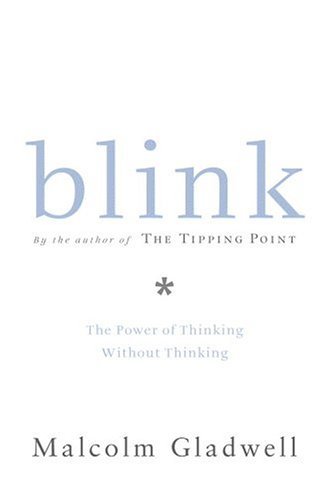
Because this is such a popular book, I was on the waiting list in the library system for about month. And in this particular library system there were possibly 80 copies of the book.. Even though it's popular, is is worth reading. Gladwell writes well and comprehensibly, introducing scientific information and ideas in ways that are understandable for the average Joe Schmoe. Ideas are made tangible through many studies and stories. The basic idea is that humans often know things without being able to explain why.

Experts can train themselves so they have a better understanding of how to classify their knowledge and how to explain what they know and why. But those of us who aren't experts in a field, if given the opportunity to explain our reasons, would confuse everyone involved and probably change our opinions. One good way of understanding this is the human face – we can understand emotion without identifying it. For example, the face can't hide thoughts – if i am lying to you, there will be a hint of that shown on my face at one point, even if just for a second or less.

Another concept is thin-slicing -- being able to take a little piece of conversation or interaction and predict. John Gottman has studied couples for a long time and came up with 20 or so emotions and ways of interacting, like stonewalling, contempt, criticism... He has studied and become an expert at how negative and positive emotions look and sound, and now can listen to a couple for fifteen minutes or less at another dinner table and predict with high probability of being right whether they will stay together. If you know what to look for, it is present in all the interactions of a couple – or in the way doctors treat their patients, or in just a few questions to determine if someone is truly in danger of a heart attack.

Knowing when to trust one's instinct and when not to is also important – because if we have associations with certain types of people or certain environments, that will color our thinking too. This is a very interesting read – I would like to put into practice some of the tips and ways of thinking (or not thinking) about life.

Title:Blink: The Power of Thinking without Thinking
Author: Malcom Gladwell
Date published:2005
Genre: nonfiction, popular science
Number of pages: 254
Notes: Very popular book, but worthwhile anyway..!

Read more...

Google Search

Google