Book/page totals

Top 10 Lists

Showing posts with label c s lewis. Show all posts

Sunday, March 29, 2009

read full post >

In college, I was told that this is a book that is generally understood better as one matures and ages. That is true for me. I still don't get it all, but I understood more of it this time! Orual is the oldest of three daughters of a king in a small land. She is not beautiful, and is not treated well by those around her, but nor does she treat them well. Their father provides them with a Greek tutor who becomes like a father to them, caring for them and teaching them in a way that is very different than the beliefs of their people. There are variety of themes that run throughout the book .. religion vs. reason .. faith vs. knowledge .. and love of self vs. love of other. The youngest daughter, Psyche, is given as a sacrifice to the gods to save the people, and Orual finds herself in a fight with the gods over this .. and fights until the end of her life.

Lewis repeatedly and variously asks questions about love. What is love? Is love that is selfish really love? As humans how much can we love? Can humans understand divine love? What does love demands of others? These are almost all asked through story and not simply words. They (and Lewis' answers) are seen in the lives of characters, for either good or ill. Orual tells her own story, and of course she tells it as she sees it, through her own eyes. The reader confronts his own selfishness, the way that emotions and actions which are not really love are treated and conveyed as love. Human love is so far from divine love .. and we have no way to make it perfect or right. At the end Orual confronts the gods and is left speechless. As it should be. Except for the gracious gift that God makes to give us one to speak for us, we have no defense. A book worth reading and re-reading, giving its truth space to work its way down into one's soul.

Title:Till We Have Faces: A Myth Retold
Author: C. S. Lewis
Date published:1956
Genre: Fiction
Number of pages: 313
Notes: Repeat reading

Read more...

Friday, May 16, 2008

read full post >

cover of Prince Caspian

I decided at the last minute that I wanted to re-read this book before I saw the new Narnia movie (I actually read the last ten pages in the movie theater), but I'm glad I did even though they changed so many things in the movie. It was delightful to catch the little bits that are directly from the book that I might not have noticed otherwise (like the Bulgy Bear sucking on his paws). Prince Caspian has never been my favorite of the Narnia books, but I think that must be simply because the others are so good and have so many interesting ideas in them, and not because this is a bad book. There simply isn't the scope for ideas that's provided by the many strange islands in The Voyage of the Dawn Treader, or the fascination of meeting Narnia for the first time, or glimpses of creation and heaven that we get in the other books. But this story does have much to say about faith.

Narnia is in trouble again when the Pevensies return. Where before Narnia was oppressed and enslaved by the White Witch, now Narnia is wild, asleep, and hidden-- oppressed by humans who fear the fantastic Narnian natives. The landscape has changed so much in the centuries since Peter, Susan, Edmund, and Lucy reigned over Narnia's golden age that a long section of the book is about them getting lost in the woods. Perhaps one of the changes they made in the movie are an extension of this-- in the book Peter is over-reliant on his sense of direction and knowledge of the land, where in the movie he is over-reliant on his skills as a military leader.

The ideas of faith mostly center around Lucy's interactions with Aslan. When they are all lost in the woods, she sees Aslan when no one else does, and they don't believe her. They made an interesting choice in the movie not to show Aslan when Lucy first glimpses him-- in the book it is easier to sympathize with and believe Lucy, but in the movie we are among those who don't get to see Aslan and don't know whether to trust Lucy. There is a great sequence in the book where Lucy is following Aslan and the others are following her without really seeing Aslan, although gradually they get glimpses of his shadow in the moonlight, and eventually they see him too. This is a great spiritual metaphor, because some people do seem to see God more easily than others, maybe because they are looking for him. But it also gives hope to those who don't see-- we can rely on those who have more faith until our own faith catches up.

It was hard to take the movie on its own terms because I kept thinking about what was different from the book. It makes sense that they would need to change and condense things to make this work as a movie, but some of the changes seemed like an excuse to have more battle scenes because I guess that is what movie-goers like (Lewis' description of the battles are always incredibly brief). It is also strange to listen to reviewers who don't like-- and don't seem to understand-- the Narnia movies. They think it is a poor attempt to duplicate the Lord of the Rings movies, and dismiss the talking animals as "cutesy." Whatever my quibbles with the changes they made to the story, my reaction to these kind of misunderstanding reviews makes me realize how much I value the movie-- perhaps because it allows me to enter into the wonderful world of Narnia and spend a couple of hours there.

Title:Prince Caspian
Author:C. S. Lewis
Date published:1951
Genre:Fantasy
Series:Chronicles of Narnia
Number of pages:216
Notes:repeat reading

Read more...

Sunday, November 11, 2007

read full post >

My first novel in Romanian!! Took me a number of months, but the last ten chapters were less than a week .. because I started reading for gist instead of looking up every vocab word that I didn't know. I've read this book before in English a number of times, so was able to catch much of the story (and pick up grammar and vocabulary along the way!). This time, I noticed that when Aslan talks to the coach driver he talks about being familiar. That Frank somehow already knows Aslan, which I had never picked up on before. Already Lewis is starting to put in place the ideas which will become much clearer in the following books.

Uncle Andrew always has seemed quite a peculiar character to me. He is very proud, arrogant, and egocentric. Everything that happens is somehow related to him or connected to him. Which is funny, but also sad, because there are really people like that. The most enjoyable thing that happens to him (for the reader, at least!) is when the newly created, talking animals find him. They aren't sure what he is or how to treat him. Because of his disbelief, they cannot understand each other, and while they are trying to figure out what he is, they decide he must be a tree and therefore must be planted. So they dig a hole and put his legs in (lucky for him they decided this way and not the other!). They they find out that he is alive and try to feed him .. all things that would be wonderful food for themselves, so worms from the birds, honey from the bear, grass from some.. most of which he is not too happy about. I guess the imagery of choosing to live in darkness and thus living in darkness (and not being able to understand these wonderful talking animals at all) is carried out in our own times, in many places and ways.

Title:Nepotul Magicianului (aka The Magician's Nephew)
Author: C. S. Lewis
Date published:1955
Genre: Children's, Fantasy
Series: Chronicles of Narnia
Number of pages: 186
Notes: Repeat reading

Read more...

Thursday, August 23, 2007

read full post >

cover of The Narnian

A biography of C. S. Lewis that approaches the man through his writing, particularly his fiction. Jacobs says at the outset that he is not going to include every detail of Lewis' life because he is interested in "the life of a mind, the story of an imagination"; through this book he is trying to answer the question, "what sort of person wrote the Chronicles of Narnia?"

It was surprising to me how little I actually knew about Lewis' life. For a man who is so well-known, and whose writings are so familiar and often-quoted, I think we don't know all that much about him (what kind of childhood he had, his relationship with his father and brother, his education, his experience in the war). Wherever possible, Jacobs relates Lewis' experiences to those of his fictional character-- so, for instance, in the hardships of Lewis' schooling, there are resonances with what we know of Edmund's and Eustace's schools. Also, I found that having Lewis' writing placed in the context of his life (what he wrote when, who influenced various books) was very illuminating.

This book is very readable and enjoyable. I found myself amazed at the amount of research Jacobs must have done-- trawling through the masses of papers we have from Lewis' life (it is wonderful that we have so much of it, but I find the idea of it a little overwhelming) and his voluminous writing to find the perfect quotes from or about him to describe a particular episode or part of his life or characteristic.

I'm glad I read this book. Now when people quote Lewis or illustrate a point from his life, I have an idea of the big picture (and often they're oversimplifying-- although I don't know where to start to try to tell them that).

Title:The Narnian: The Life and Imagination of C. S. Lewis
Author:Alan Jacobs
Date published:2005
Genre:Biography
Number of pages:342

Read more...

Thursday, September 21, 2006

read full post >

cover of The Great Divorce

Another Lewis classic. The story of a dream. A man who finds himself in a grey dreary town (between the sunset and full night), waiting for a bus. This bus will take them to the other place (heaven) for a visit. And if they'd like, they can stay. Our narrator interacts with many characters and also observes other interactions which give insight into this place and the people who exist there. Lewis makes it very clear this is not what heaven is really like, but simply some ideas to affect the way we live now.

One phrase which rings throughout the book is that hell and those who live there are 'so nearly nothing.' The people have become the worst parts of themselves and lost all good (or almost all in some cases). The narrator has a hard time understanding this, so his Teacher, or companion, in heaven tries to show that good must in the end overcome evil. That evil cannot be larger than good. That good is much better at being fully good than evil -- so heaven must be incomparably bigger. Nobody from heaven could go into hell even if they wanted to because it is too small. A tiny crack in the ground.

One idea that keeps returning to the forefront of my understanding of what it means to be a Christ-follower is that of naming. God names us -- He calls out the true person. By choosing to follow Him and be obedient to Him, I do not become less myself -- but somehow more myself. I become more solid, more real, deeper. Not because of anything that I am doing, but because God is all the time changing me to be more like Himself -- and more like the person He created me to be. For instance, one woman our narrator observes finds all her value in 'caring for' (aka controlling) someone else. She cannot believe that she or this person she wants to 'care for' have any value simply because of who they are or who they were made to be. she wants to earn her worth. It's not possible. One heaven dweller says 'everything is here for the asking and nothing can be bought.' (p28)

Lewis has such a way of putting large ideas into comprehensible ideas, that his works are entertaining to read but also dredge up questions long forgotten or never asked. It's easy to get caught up in the daily tasks of life and enjoying the present moment (or surviving it, perhaps). But life can be so much more than that - living today in light of what has happened and what is to come. Not just events of yesterday, but the Event -- God coming in the form of a man to save humanity and bring us back into right relationship with Him. When the fact of God's love is allowed to affect each day (and parts of each day, as it becomes more natural), the simple tasks of today are seen to have eternal affect. Which is intimidating and frustrating and exciting.

Title:The Great Divorce
Author:C.S. Lewis
Date published:1946
Genre:Fiction
Number of pages:146
Notes:repeat reading

Read more...

Monday, June 26, 2006

read full post >

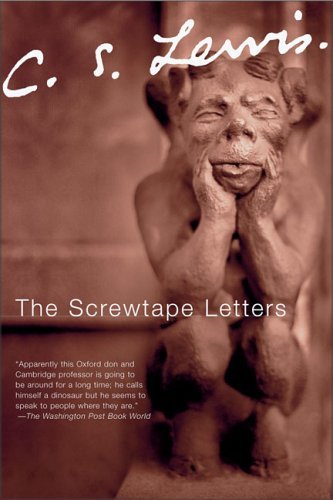
cover of The Screwtape Letters

This is the first time I actually finished this book. I've read the beginning before and got caught up in something else. Anyway, this is probably one of Lewis' most famous novels. The premise is that Screwtape has a young nephew, Wormwood, with whom he corresponds about life. And both of them happen to be in the service of 'Our Father Below'. Wormwood has a 'patient' who he is supposed to corrrupt and keep from joining the service of the 'Enemy' aka God. Lewis takes the opportunity to imagine what demons might reason about various things, to give a fresh perspective to the reader about sin and choices and what it means to serve God.

Wormwood and Screwtape have a few discussions about prayer. About what it means to corrupt prayer and make the prayers of this patient useless. Which raises plenty of good questions. If you are praying to someone who is not God, but simply your idea of God, does the real God still hear your prayers and answer them? Does praying simply mean thinking good thoughts? By praying, is it better to be vague and nebulous or to ask for specific things and bring up specific questions to God? Prayer is a vital part of knowing God, and so easy to get sidetracked from. Prayer can become a rote piece of the day instead of remembering that prayer is really a conversation that brings humans into the presence of the Most High God, which is not something to be taken lightly. Perhaps all the prayers that are said without real intent and focus behind them are not really said to God at all? And yet -- I know that grace is extended to each of us more often and in greater measures than we could ever deserve. So -- God must extend some grace to us in our prayers and hear us even when we are quite unsure of what we are praying or who we are praying to, as long as we are generally aimed toward Him and not from Him. Perhaps. Still in process on this...

Title:The Screwtape Letters
Author: C. S. Lewis
Date published:1941
Genre: Religious Fiction
Number of pages: 134

Read more...

Thursday, December 08, 2005

read full post >

cover of The Lion, the Witch, and the Wardrobe

This is the first-written and most famous of the Narnia books. It's not my favorite of the Chronicles, in part because of its popularity; it bothers me a little bit that so many people have only read this book, and not any of the other Chronicles of Narnia (they are missing out on so much!). However, I have to admit that it is actually worth their time; they should at least read this one, even if they don't get around to the others. It is actually better, and deeper than I remembered.

I seemed to pay better attention to the details of the book this time through; perhaps that is because I knew I would be discussing it with others, and maybe also because I'm imagining the movie and wondering how they will handle certain things.

One detail I thought was odd was the narrator's insistence on the wisdom of not shutting a wardrobe door on oneself-- it's mentioned more than once, and seems to be one way of differentiating the common sense that both Lucy and Peter have, but which Edmund is notably lacking. Wardrobes are a bit less common these days, or at least in the States, so it seems like an odd concern, although I imagine there might not be a latch or door knob on the inside of one, so it would be easy to get stuck if you unwisely let the door latch when you are inside... It's a small point, but it struck me as rather odd.

I also paid more attention to the whole scene of Aslan's sacrifice for Edmund. I don't know if I've never really noticed it before (it seems so obvious that I must have, but I don't distinctly remember), but the parallels with Christ's death and resurrection are pretty detailed. For instance, Lucy & Susan are the only ones who sense Aslan's mood and follow him, and then walk with him as he goes back to the Stone Table, and then watch the whole scene from the safety of the woods-- just as the women were the ones who were actually present at the crucifixion, while the men were off hiding. (Why is that? Were male disciples considered more dangerous? Did the authorities not even consider the possibility that women would also be followers?) Likewise, the Witch's party jeers and taunts Aslan, calling him "puss" and such-- just as the Roman soldiers taunted Christ. One interesting difference here is that the dark creatures of Narnia are well aware of Aslan's strength and powers (although they underestimate the depth of those powers), and are afraid of him until they have thoroughly bound him. I think that in Christ's case, the soldiers, at least when they were taunting and manhandling him, did not believe he had any power over them. I also noticed Jadis calling Aslan a fool, and saying that once she has killed him, she will then kill Edmund and cement her rule over all of Narnia. This struck a chord with me, because so often the wisdom of God is foolishness to us; it is not logical, according to the rules we know-- because we are not acquainted with the "deeper magic from before the dawn of time".

Some of the descriptions are very colorful, and will be exciting to see on the big screen in the theater-- in particular the resurrection of Aslan, and then when Aslan breathes new life into all the creatures the White Witch has turned into statues. When Lucy & Susan are staring out at the sea and Cair Paravel, before they know Aslan has come back, in addition to the returning light and color, there is also one star still visible, above the horizon; I think it must be the daystar, which is a symbol of Christ, and of his return.

Title:The Lion, the Witch, and the Wardrobe
Author:C. S. Lewis
Date published:1950
Genre:Fantasy / Young Adult
Series:Chronicles of Narnia
Number of pages:186
Notes:Repeat reading. Read and discussed with community group.

Read more...

Tuesday, November 15, 2005

read full post >

cover of The Magician's Nephew

We follow the adventures of Digory and Polly, as they stumble into other worlds, and through their adventures we learn about the creation of Narnia and the origin of the White Witch. I grew up reading the Narnia books with my family, and we always read them in chronological order-- that is to say, in the history-of-Narnia order, not the order that Lewis wrote the books. So, when we read through all the chronicles, we always started with The Magician's Nephew. It may not be my favorite of the Narnia books, but there is plenty that is fascinating here-- one dying world, another being born; a creation story, and a garden that seems somewhat familiar, complete with a tree bearing the silver apples of life.

There is plenty here that is fascinating, and worth thinking about or discussing with others. This time through, I thought more about Lewis' treatment of magic (it is bad, and its practitioners-- namely, Uncle Andrew and Queen Jadis-- are evil, to varying degrees); this was on my mind, in part, because of the outcry against Harry Potter from certain quarters, while the same people have no problem with magical fantasy from Tolkien or Lewis. It bothers me that they never articulate what the problem is, or the difference between the books which are acceptable or not.

It is also fun to be reminded that Lewis believed in the possibility of other worlds-- it is something that comes up in the Narnia books and his space trilogy, but I think he mentions the possibility in his non-fiction writings, as well. In most of the Narnia books, it is easy to think that there is only Narnia and Earth, but here Digory and Polly get to Narnia by way of pools in the quiet wood between the worlds-- and there are hundreds of pools, which suggests there are far more worlds than we ever get to explore or read about.

The creation imagery is particularly wonderful. It seems especially appropriate and wonderful that Aslan creates Narnia with a song-- and, for a while, different parts of that creation (most notably the stars) participate in the music of creation. This creative power is so strong that anything will grow in the new soil of Narnia-- a lamp post, from a broken off part of a lamp; gold and silver trees from the coins in Uncle Andrews' pockets; and even a toffee tree, from the children's candy.

But along with the creation of Narnia, there is a kind of story that mirrors the Fall. Even before Narnia is created, evil is brought into this new world in the form of Queen Jadis from the dead world Charn, which she helped to destroy. And Jadis was awakened by the willfulness of a little boy, by a simple choice. To make up for this mistake, and to protect Narnia, Aslan sends that boy, Digory, to fetch an apple from a tree in the center of a far-off garden (and there are echoes of Eden here); and in the garden, there is a temptation scene with the witch, Jadis. One of the things that intrigues me most about this part of the story is what Aslan's explanation of the fruit. It is in the nature of the fruit to give life and protection, but if it is not used properly-- if it is stolen, taken without permission or selfishly-- it does not bring joy. In particular, Aslan says that if someone had taken the apple to protect Narnia without being sent for it, it would indeed have protected Narnia, but it would have made Narnia a harsh, cruel land like the world of Charn. This is interesting, because even a good thing, that brings protection and life, when abused can be destructive or cause perversion.

The Magician's Nephew offers plenty to fascinate and entertain. Among other things, Lewis offers a warning-- the world of Charn, and the Deplorable Word that Jadis uses to destroy it, are offered as clear parallels to the path of humans on Earth. But at the same time that we receive this dire warning, we are also given the hope and delight of the new life in the joyous world of Narnia.

Title:The Magician's Nephew
Author:C. S. Lewis
Date published:1955
Genre:Fantasy / Young Adult
Series:Chronicles of Narnia
Number of pages:186
Notes:Repeat Reading. Read and discussed with community group.

Read more...

Saturday, March 05, 2005

read full post >

cover of The Last Battle

I've always liked The Last Battle-- it's one of my top two or three favorite Narnia books (I know, there are only seven of them), and I think that might be because it is so different from the other books in the series. There are lots of wonderful characters, and you get to see Lewis' view about what the end of time and heaven might look like (a different kind of view than what you get in The Great Divorce).

There are lots of great characters in The Last Battle, and I kind of enjoy the fact that this book starts in Narnia, and it is a while before any Earth children come into the picture. You get to learn about the sweet donkey Puzzle, who underrates himself and his own wisdom, and gives in too easily to the selfish, malicious ape Shift; you get to meet the last king of Narnia, Tirian, and his trusty friend, the unicorn Jewel. Lewis also uses this opportunity to show how different people choose to believe or not believe-- some of the cleverer animals, like Shift and the cat, deliberately refuse to believe in Aslan and try to trick the others. One of the sadder moments in the book is the self-deception of the dwarfs-- they are sick of being tricked and refuse to be "taken in" again, so even though they are sitting inside the doorway to paradise, they close their eyes and refuse to see or believe in Aslan or eternity.

One of the details I particularly liked from Lewis' view of heaven presented here is that Narnia and our Earth both offer paths to the same Aslan. The Pevensie children start in the Narnian heaven, presumably because that is where the first came to know Aslan well, but with their heightened vision, they can look across and see their parents, who are also moving towards Aslan's country. I think I read somewhere that Lewis believed there really might be other planets somewhere with sentient beings on them (you might get a taste of this from the Narnia books and the space trilogy, but not every writer believes even remotely in the things they imagine), whether fallen or unfallen-- and it seems to me both foolish and arrogant to assume we are the only ones in this immense galaxy, or that God is limited in some way as to be unable to handle more than one planet. That must be why I love the images we get here, of people from different worlds all moving towards Aslan's country.

Because I grew up reading this book with my family, we all know and love the repeated refrain from the end of the book. Every now and then, it will come up again as appropriate, whether we are hiking or just encouraging each other:

Further up and further in!

Title:The Last Battle
Author:C. S. Lewis
Date published:1956
Genre:Fantasy / Young Adult
Series:Chronicles of Narnia
Number of pages:184
Notes:Read this book aloud with G. This is a repeat reading.

Read more...

Saturday, February 19, 2005

read full post >

cover of The Silver Chair

I remember being told once that Treebeard and the Ents are one of Tolkien's most original creations. Well, the corollary unique creation for the world of Narnia has to be the Marshwiggle. You never meet or hear about any of them in any of the other Narnia books (as far as I'm aware), but Puddleglum gets to take center stage here, and he is one of the most delightful and hilarious characters in the entire Narnia series. Jill & Scrub are always calling him a "wet blanket", and he's always glum, and sure the children won't enjoy his cooking-- but at the same time, we're told that he's far too upbeat and adventurous (hmm, rather like Bilbo?) for the rest of the Marshwiggles.

One of the most interesting & encouraging things about The Silver Chair is how many mistakes the heroes make. Because of an argument, Jill & Pole get separated and things start going wrong from the very beginning. They mess up and forget almost all of the signs that Aslan told Jill to memorize, and come quite close to failing in their mission more than once. Yet in spite of all their mistakes and failures, things somehow come through all right. It is encouraging to see people succeed in spite of their own failures and mistakes, and to be reminded that Aslan can use faulty, error-prone, flawed humans in his grand plans.

Title:The Silver Chair
Author:C. S. Lewis
Date published:1953
Genre:Fantasy / Young Adult
Series:Chronicles of Narnia
Number of pages:217
Notes:Read this book aloud over several weeks with G. This is a repeat reading.

Read more...

Google Search

Google