Book/page totals

Top 10 Lists

Showing posts with label biography. Show all posts

Thursday, February 28, 2008

read full post >

This book has been sitting on my bookshelf for a year or two now, and I haven't been able to bring myself to read it. Wurmbrand is a Romanian man who spent many years in jail for believing in Jesus, and this book is about those years in prison - what he experienced, what prison was like, conversations that he had - with a little bit about the years before and what happened after. I knew it would be an intense book, with stories of torture and pain. I recently picked it up, and actually read it in about three days - because the writing is that compelling. There were times i finished a chapter and put it down, sick to my stomach - but I picked it up again later that day to read about this man who truly loved Jesus.

Wurmbrand spent a total of 14 and a half years in communist prison. Most the first three years (or so) were spent in interrogation, torture, and isolation. After that, most of his time was spent in group cells of various prisons. But Wurmbrand and his wife had known this was coming, and had prepared themselves - studying the lives of others who had endured similar things, as well as asking God for strength. Throughout his time, Wurmbrand always found ways to share God's truth and love with those he came in contact with, be it other prisoners or guards or important communist officials. It has been said that prison (especially this kind of extreme, violent prison) makes beasts of some men, and saints of others. By the grace of God, Wurmbrand stayed a saint and faithful to God throughout much evil and pain.

Wurmbrand is an eloquent speaker, and able to answer questions well. Toward the end of his time in jail, the communists tried to make everyone pro-communist, with hours of propaganda lectures, statements over a sound system, and rewards for those who turned and betrayed other prisoners and their own beliefs. One Sunday they did an anti-Christian play, and then asked prisoners to talk about how wonderful it was. When they called on Wurmbrand, everyone waited to see how he would respond. He talked about how all the best parts of communism come from Christianity - reminding them that Jesus was a carpenter, a common laborer, that Jesus drove the rich moneylenders from the Temple and valued the poor, that the first Christians shared all they had as communists spoke of doing. He spoke of God's love and judgment in front of the whole prison, and they allowed him to speak. As a result, things became harder - but Wurmbrand was unafraid of speaking up. This man and his wife (who was also in a labor camp for 3 years) had souls of steel and deep faith, trusting God and standing up for what is right and good, no matter what. And bringing many other prisoners to saving faith, even in the hardest place.

Title:In God's Underground
Author: Richard Wurmbrand
Date published:1968
Genre: Spiritual, Biography
Number of pages: 268
Notes: gift from the Huggins

Read more...

Tuesday, October 09, 2007

read full post >

cover of The Agony and the Ecstasy

The story of Michelangelo Buonarroti, the Italian artist who created the "David" and painted the ceiling of the Sistine Chapel. His life was more interesting and complicated than most people, which is probably a very good thing. Michelangelo is born to a father who wants him to work hard to earn money for the family, but all he wants to do is sculpt. He is from Florence, a city that celebrates artists and art, which turns out to be a huge blessing to him. Michelangelo, with his ability to create beautiful art, ends up serving under a number of Popes (three or four, at least), and having relationships with them that the average person wouldn't dream of (i.e. he sought to ask for what he needed and challenge what was expected of him and his art). This book shares not only about the life of one man, but also about the way his society worked, some of the other major players during his time, and his culture.

Stone does a good job of portraying the life of an artist. Michelangelo does art not because it can make money for him, but because he has to -- because it comes from inside him and is his best way to relate to the world and to convey truth and ideas. Since I too enjoy art (although in no way would I compare myself to this artist!), it was enjoyable to read this book and be reminded that art is something good for the world and for those who do it. That art can communicate and express when it comes from inside. It was inspiring and encouraging .. in the direction of actually pulling out art supplies and getting to work. Or to play. Or to expression. Or to practice, at least!

Title:The Agony and the Ecstasy
Author: Irving Stone
Date published:1961
Genre: Biography
Number of pages: 758

Read more...

Thursday, August 23, 2007

read full post >

cover of The Narnian

A biography of C. S. Lewis that approaches the man through his writing, particularly his fiction. Jacobs says at the outset that he is not going to include every detail of Lewis' life because he is interested in "the life of a mind, the story of an imagination"; through this book he is trying to answer the question, "what sort of person wrote the Chronicles of Narnia?"

It was surprising to me how little I actually knew about Lewis' life. For a man who is so well-known, and whose writings are so familiar and often-quoted, I think we don't know all that much about him (what kind of childhood he had, his relationship with his father and brother, his education, his experience in the war). Wherever possible, Jacobs relates Lewis' experiences to those of his fictional character-- so, for instance, in the hardships of Lewis' schooling, there are resonances with what we know of Edmund's and Eustace's schools. Also, I found that having Lewis' writing placed in the context of his life (what he wrote when, who influenced various books) was very illuminating.

This book is very readable and enjoyable. I found myself amazed at the amount of research Jacobs must have done-- trawling through the masses of papers we have from Lewis' life (it is wonderful that we have so much of it, but I find the idea of it a little overwhelming) and his voluminous writing to find the perfect quotes from or about him to describe a particular episode or part of his life or characteristic.

I'm glad I read this book. Now when people quote Lewis or illustrate a point from his life, I have an idea of the big picture (and often they're oversimplifying-- although I don't know where to start to try to tell them that).

Title:The Narnian: The Life and Imagination of C. S. Lewis
Author:Alan Jacobs
Date published:2005
Genre:Biography
Number of pages:342

Read more...

Tuesday, September 05, 2006

read full post >

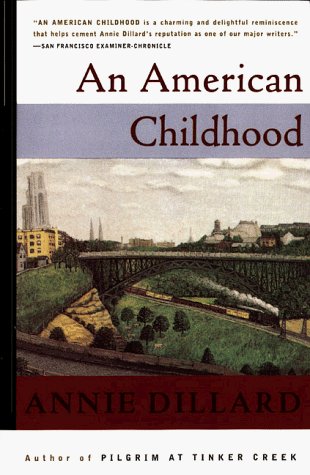
cover of An American Childhood

Finally read this book. It's been on my list for a while and I got the chance to read it this summer. Read the last twenty pages the night before I left on a long trip. Dillard's writing is a gift -- something to savor. Her childhood ideas are not the same ones I had, but she shares them in a way that gave me a chance to understand and imagine with her. To see through her eyes in very practical ways. Each chapter is centered around a certain idea that connects the vignettes together. Dillard paints beautiful images with her words -- one woman who was created to write.

In a couple chapters, she writes about going to church. About communion and how she wished she'd missed it (at an older age than most of the book) -- but then she looks around at all her classmates and they are actually serious about their praying once they have received the bread and wine (grape juice?). Which she would not have expected. Wondering if she missed out on something. In another, she talks about some of the verses and phrases and ideas which stuck with her. She places them together to form a sort of liturgy which is all scriptural, and sweet to read. And sometimes I think we need to do that -- compare pieces of scripture and answer questions from one place with verses from another. So often people ask questions that have little do with the actual text -- but more truth is to be found in God's Word than we often realize. It's worth it to search it out and memorize pieces and take it into our being in such a way that it somehow affects our thoughts and actions and words. That's part of what it means to be a Christ-follower.

Title:An American Childhood
Author:Annie Dillard
Date published:1987
Genre:Biography
Number of pages:255

Read more...

Monday, September 04, 2006

read full post >

cover of The Man Who Knew Infinity

A book which is both narrative and explanation. I usually don't enjoy history all that much -- but I do like biographies and personal histories. And this book is mostly personal history, with lots of extra stuff thrown in. The main character is Ramanujan, a man born in southern India who grew up in the early twentieth century. He didn't have much training, but liked to please people so did well in school until he finished high school. From then on, he wanted to do little but work with mathematical formulas and possibilities. It wasn't the application of math that he enjoyed - but simply the abstract formulas and ideas. (Very different from your typical student.) By a series of events, he ended up in England working with and studying under a Cambridge fellow named Hardy. Together they created an incredible number of papers and had an impact on the mathematical world. In a speech Hardy gave after Ramanjuan died, he said that the most important thing he had done in his life was discover Ramanujan.

Now, Ramanujan was not just any southern Indian -- but a Brahman, meaning he was part of the highest class simply because of the family he was born into. His mother in particular taught him to follow all regulations in terms of what he would and would not eat, how things were to be prepared, and worshiping their goddess. Throughout his life, he gave credit to this goddess for intuitive jumps, for visions, for his genius. Many colleagues (especially those from England) had a hard time believing he was serious -- for them, science and logic excluded any religion. But for Ramanujan they were closely linked and one did not make sense without the other. In fact, he drew connections between certain mathematical series and facets of the gods of Hinduism. Seems so true that neither logic and reason, nor spirituality and emotion, can be the sole answer to life's questions. Both must be involved!

Enjoyed getting pieces of India's history, especially during the beginning of the book. Ramanujan was around while the British occupied, so all those ties and differences and beliefs color the personalities on both sides and what sort of connections were possible. Many Indian mathematicians didn't know if Ramanujan was a genius or a fool -- because his math notebooks were full of ideas they had never heard of and couldn't prove or understand themselves. Once this book got into Ramanujan's (and Hardy's) story, I was frustrated at the end. The last thirty or forty pages were mostly about repercusions, debates, ideas of his effect on India and the world. Took me probably an extra two weeks for those last thirty pages -- and ended up skimming them. Guess I got attached to Ramanujan and when he died, my interest in the story lagged quite a bit. But -- overall, a book that shares complicated math in understandable terms while sharing the mathematician's life (beyond math) in comprehensible ways as well.

Title:The Man Who Knew Infinity: A Life of the Genius Ramanujan
Author: Robert Kanigel
Date published:1991
Genre:Biography, Math
Number of pages: 373
Notes: Recommended by JAW

Read more...

Saturday, June 24, 2006

read full post >

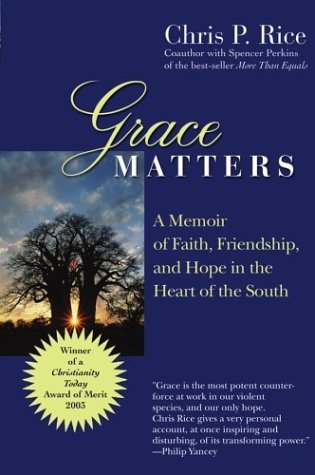
cover of Grace Matters

This is a different man than the one whose music fills 5 of my cd's, in case you were wondering. A good story. Which is high praise! I like stories and have a hard time slogging through boring or repetitive stories. But this one is real life in a microscope. Typically, we don't get opportunities to hear others' experiences as honestly as this -- even if we are friends, so this book is a gift from Rice to anyone who reads it. To be so honest is dangerous in any context, let alone when so many people might judge.

As a young man, Rice moves down to Jackson, Mississippi, to be part of Voice of Calvary Church, in a largely African American community. Rice is white, and stepped out of his comfort zone in many ways to join this community. (Although he was brought up in Korea, so he was a third culture kid, meaning he had to live in more than one culture and know how to adjust between them, so connects with others who have had to adjust in similar ways. Perhaps this gave him better ability to learn, enjoy, and flex with the African American culture he joined). One thing that he learned throughout his many years in Mississippi is that for reconciliation to take place, everyone has to leave their comfort zone and reach toward the other to find some sort of similar ground, similiar pain, similar joys, similar humanity.

Partway through his time there, Chris gets to become friends with Spencer Perkins (oldest son of John Perkins, who is well known in this field of reconciliation and community development). They both have expectations that aren't met, but they decide to stick together and work through all the problems and issues which arise. Of which there are many. They become yokefellows -- not just friends or coworkers, but two who together can pull a heavier burden than one, to further God's Kingdom. Along with some others, they move into a communal house and get to enjoy and be frustrated by what it means to live in intense community, especially with others who are from another culture and race. Spencer and Chris get to speak in many venues, where their biggest witness is that they get up to speak together (both standing the whole time) as friends who are connected and strong together. Which is what 1 John says -- that as Christians we will be known by our love for one another. A big challenge to live up to, but so sweet when it happens in the power of the Spirit and by the grace of God.

Title:Grace Matters : A Memoir of Faith, Friendship, and Hope in the Heart of the South
Author: Chris P. Rice
Date published:2002
Genre:Biography
Number of pages: 300
Notes: Borrowed from Jude

Read more...

Monday, December 19, 2005

read full post >

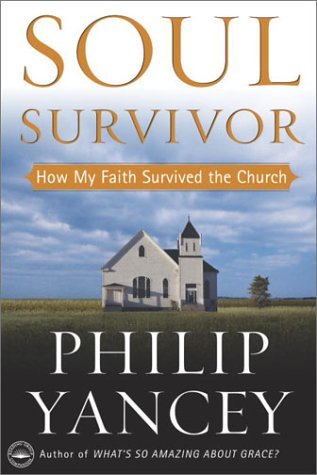
cover of Soul Survivor

This book deals somewhat with Yancey's own wounding by the church, and most of the pages are dedicated to the people that Yancey believes helped him to survive, and even thrive, as a Christian. In each case, he provides biographical data, and his own interactions with these people-- whether he has met them (which he has, in many cases), or how their writing or work have affected him. It is a book that takes a while to read, because there is so much to digest and take in, but it is well worth the time.

The book is made up of 13 chapters, and each one focusses on a different person (or people, in the case of Tolstoy & Dostoevsky, who are paired together). Each person provides different kinds of lessons and encouragement.

  • Martin Luther King, Jr. - the courage to make moral choices, despite being a flawed person
  • G. K. Chesterton - the joyous, energetic outlook of the prolific journalist and author
  • Dr. Paul Brand - a physician who studied pain and made great progress working with leprosy patients
  • Dr. Robert Coles - an insightful psychologist who studied the poor and downtrodden, among others
  • Leo Tolstoy and Feodor Dostoevsky - two Russian authors who understood the human psyche and could portray it so well, and who grasped different parts of the gospel; Tolstoy understood the call to perfection in spite of human flawedness, while Dostoevsky understood grace.
  • Mahatma Ghandhi - one man who accomplished amazing things, often more than armies could do; while not a believer, Ghandhi adopted principles from the life of Jesus, and lived more like him than most believers did.
  • Dr. C. Everett Koop - a Surgeon General who did his best at his job, remained upright in a corrupt political world, and alienated many because of the stands he took
  • John Donne - the poet and pastor who dealt with death and faith honestly in the meditations he wrote when he thought he was dying
  • Annie Dillard - the contemporary author who observes the things around her so carefully, and can see such horror and splendor in the world of nature.
  • Frederick Buechner - the author who wrote sermons and theological works that read more like novels and memoirs
  • Shusako Endo - the Japanese author who experienced alienation in so many ways, and instead of the martyrs and heroes of the faith, identified more with the Japanese Christians who renounced their faith in order to survive
  • Henri Nouwen - the priest and professor who gave up worldly success in exchange for "downard mobility" and "inward mobility", choosing poverty and life in a community of the kind of people society does not value

Many of the people Yancey writes about are authors, so the topic of writing and what it means to be a writer comes up more than once, in interesting ways and with different insights. At the end of each chapter, Yancey also provides suggestions for books to read as a starting point to find out more about each of these amazing people.

Title:Soul Survivor: How My Faith Survived the Church
Author:Philip Yancey
Date published:2001
Genre:Spiritual Biography
Number of pages:336
Notes:Read over a couple of months.

Read more...

Friday, August 26, 2005

read full post >

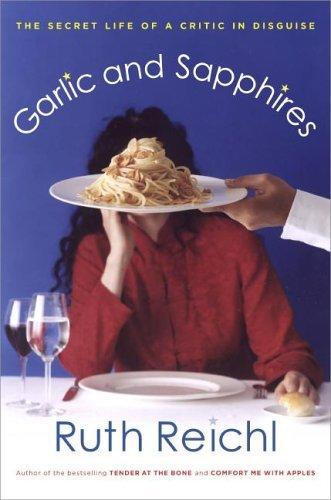
A woman becomes a restaurant critic for the New York Times, but before she actually gets there every restaurant has pictures up so they can make sure to give her the best treatment. Basically wherever she goes people will know who she is and she won't get to see what the restaurant is really like.

So, she contacts her mother's friend who is an acting coach, and together they come up with a disguise. Eventually she has five or six different disguises and different personalities, discovering that she has all sorts of characteristics inside of her to become a variety of people. This book is very well written – since she wrote articles for a long time, she knows how to use words well.

Reichl loves food, so in her descriptions she allows you to understand a little bit of what it would taste like and how one might enjoy the food if one knew what it was. She makes irregular food seem like it could be eaten regularly. Not everyday, but Reichl makes it seem like anyone could eat it, which is an amazing feat. She also includes some of her magazine articles and some recipes to round out the book. This book is honest and insightful. An enjoyable read, and not too hard to understand (not too complex..)

Title:Garlic and Sapphires
Author: Ruth Reichl
Date published:April 2005
Genre: Biography
Number of pages: 328 pages
Notes: Recommended by my friend Amy P.

Read more...

Google Search

Google