Book/page totals

Top 10 Lists

Showing posts with label anne mccaffrey. Show all posts

Sunday, September 14, 2008

read full post >

Jaxom has the 'privilege' of being both a Lord Holder and a Dragonrider in the land of Pern. In his mind, this means he can do neither fully - he must live in the hold, so he cannot do all the activities Dragonriders are allowed to do .. and yet because of his dragon he cannot fully participate in training to become Lord Holder of Ruatha. This book is about his coming of age .. learning to trust himself, to take care of those he loves, to provide solutions to tricky problems (even though he might have helped to cause the problem :), to know what he wants and how to get it. Jaxom is a character who truly cares about others, which makes him very enjoyable to read about and follow.

Ruth is one of the best characters in the book! He is a dragon .. white, which is unusual .. and also much smaller than any other dragon. Some tease Jaxom that Ruth is an overgrown fire-lizard instead of a real dragon. But Ruth has all the capabilities of a dragon and is more sensitive to other things as well. In part because of his size, fire-lizards always congregate around him, so he hears more stories and sees more pictures than most dragons. And actually pays attention to them! This turns out to make it possible for Jaxom and Ruth to save Pern in regards to a stolen egg. Also .. because Ruth is so small, he is fast and accurate and highly capable when it comes to fighting thread (sorta like rain, except it's longer and burns anything it touches). Ruth seems to be humble in the best sense .. knows what he can do and admits it without making little of others, and if he can help those he loves he jumps at the chance. A sweet character .. too bad it's not quite possible to go for a ride with him! One theme which runs throughout is that of discovery. Jaxom is discovering who he is and what he values and how he wants to live. Robinton, the Masterharper, is discovering that he must take care of himself and his heart, even though he longs to participate in adventures. Wansor, the Starsmith, is in the process of discovering how to tell time based on stars and their patterns (and thus discovering that the three dawn sisters are not normal stars..). The southern continent is being discovered to be much, much larger than they imagined. Through the memories of fire-lizards, they are able to discover the place their ancestors lived and even find important pieces of their history (can you say spacecraft?!). Exciting to be along on the journey, discovering with the characters and wondering along with them.

Title:The White Dragon
Author: Anne McCaffrey
Date published:1978
Genre: Fantasy
Series: Dragonriders of Pern
Number of pages: 445
Notes: repeat reading

Read more...

Tuesday, September 13, 2005

read full post >

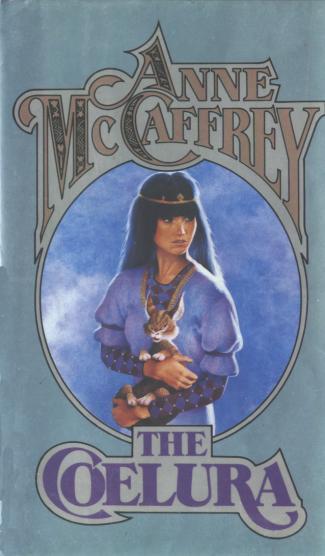
cover of The Coelura

This novella paints an interesting picture of a highly advanced interplanetary society which is backward in a few specific ways: most notably, the very hierarchical class structure, and the importance of hunting. Because this society is so interested in wealth and physical appearance, they nearly destroyed the initially mysterious coelura of the title-- lovely, colorful, joyful creatures who are able to spin a wonderful fabric, which is beautiful and mood responsive, personalized to its wearer. In the time of the book, these coelura have been mostly forgotten, and the lands where they live have been interdicted and cut off from the rest of society on the planet and elsewhere. The main character, Lady Caissa, is a "body-heir" torn between her duty to her sire, an attraction to the mysterious stranger she rescues, Murell, and her delight in the beautiful coelura, which she fears her father will destroy in his greed to control them and re-establish the trade of coelura-spun fabric.

A lot of action is condensed into very few pages, which means that you get a little taste of this interesting society, but you don't get all the details; and you don't really have enough to be able to completely understand all the political machinations until the end. Some of the details of this story are very appealing and appropriate. For instance, when Caissa first meets Murell, he has been injured and has healed poorly because he has been stranded; in a society with advanced medicine, where a child can only be declared a body-heir once they are determined to be "physically perfect", Murell's imperfections are strange to Caissa-- but she is attracted to him in spite of his physical imperfections. Also, I like the way McCaffrey ties the abuse of the Coelura to their near extinction: each coelura has a limited amount of spinning it can do in its lifetime, and this is included in the mating net they must spin to mate and continue their species. Murell is introduced in such a way that we are supposed to be attraced to him and think highly of him, as Caissa does, but it must be admitted that he is both clever and wise in his plan to protect and preserve the coelura.

The plot is not too sophisticated, and is fairly predictable (you know that Caissa and Murell will end up together, and it is obvious that he is a person of some importance in this hierarchical society); however, I still found it fairly entertaining to follow the story to its conclusion. Because of the brevity and simplicity of this book (I read it in just one evening), I wondered if this book should be classified as Young Adult material, but the slightly risquée illustrations and the romantic encounter between Caissa and Murell suggests that it might not be completely appropriate for youngsters. The illustrations in the book are interesting, although unfortunately the jacket cover for this edition is not consistent with them.

Title:The Coelura
Author:Anne McCaffrey
Date published:1983
Genre:Science Fiction
Number of pages:156
Notes:This edition is illustrated by Ned Dameron.

Read more...

Monday, April 25, 2005

read full post >

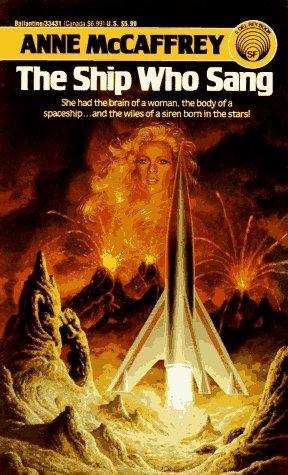
cover of The Ship Who Sang

This is the first book in one of the prolific Anne McCaffrey's many series. I have never (yet) read the other Brainship books, but it is a compelling idea-- to put humans born with damaged physical bodies and capable brains into powerful, new bodies shaped like cities and ships. McCaffrey plays out many of the problems that might accompany such a society-- how to treat brainships ethically and humanly, how they might interact with normal-bodied humans, and what some of their specific weaknesses might be despite their immense capabilities. But the reason this book really works is because Helva herself, the singing ship of the title, is so compelling. Far from feeling sorry for her, you may come to envy her cleverness and her strength-- both physical and mental, along with her ability to speed through space.

This book introduces us to the world of the brainships through the character of Helva, and after her intitial training, the plot follows Helva on a series of missions-- and of course, she runs into (and handles successfully, sometimes in spite of her human partner) some of the most dangerous missions and becomes the youngest ship ever to buy back her freedom (by paying for her education and the care that turned her into a brainship).

This book was published a while back, so it is a bit funny to see the technologies portrayed-- they have technology to connect a human brain to a "shell" so a person like Helva can control a powerful space ship, but their communications are somewhat behind-- they can use a "tight beam" like a radio to communicate, but Helva's human partners often bring her tapes or reels to convey the necessary information for their mission.

By making Helva a musician, McCaffrey makes it possible to explore how the world of art might interact with a technological world like the one she has created here. One more than one occasion, Helva uses her musical ability to help or manipulate humans in significant ways. One of Helva's stranger missions involves a delegation of actors and actresses who are sent to an alien society to perform teach Shakespeare's Romeo and Juliet for these aliens, and then teach it to them, in exchange for certain technologies and knowledge. The aliens conceive of drama in terms of energy exchange, and by the end of this mission, those ideas and terminology for drama make a great deal of sense.

Title:The Ship who Sang
Author:Anne McCaffrey
Date published:1969
Genre:Science Fiction
Series:Brainship series
Number of pages:248
Notes:Second reading.

Read more...

Google Search

Google