Book/page totals

Top 10 Lists

Showing posts with label world war one. Show all posts

Friday, May 30, 2008

read full post >

cover of the War Romance of the Salvation Army

The title of this book is a bit misleading. I've owned it for years, but apparently never read it, because somehow I thought it was a collection of fictional short stories about the Salvation Army during the war, and it's really nothing like that. Instead, it is a factual, anecdotal account of the work of the Salvation Army with the soldiers in France during World War I, pieced together from journals and letters from the people who were over there. Most of the anecdotes are very brief, a page or two at most, so there's not a lot of continuity; stories are organized by region and apparently by some kind of chronology, although this is not obvious. At times it feels like propaganda, as anyone who speaks ill of the Salvation Army soon comes to love and respect them, and the "lassies" are all pure of heart and motive-- and apparently most of their work involved making doughnuts and pies to give the lonely soldiers a taste of home. Still, it was interesting to get a very different perspective on the war and the living conditions near the front-- as Hill points out repeatedly, the Salvation Army workers went as near to the front as they were able, and endured the hardships along with the "doughboys" rather than associating with the officers.

There's a section at the beginning about "Commander" Evangeline Booth raising money and support to send her people to Europe (when someone asks where the Salvation Army is, she somehow correctly intuits it is a spy trying to find out where the American troops are), a bit at the end about the work of the Salvation Army for soldiers returning home, and then a long section at the end full of letters from presidents and governors endorsing the Salvation Army, and then from military people of every rank thanking them for their work. These are interesting, but they also make the book feel even less consistent.

I felt like this would have been a much stronger and more compelling story if Hill had taken all the anecdotes and stories and threaded them into a fictionalized account, creating a few characters that the reader could follow throughout, rather than jumping back and forth to unnamed people. And the moments when she talks about the Salvation Army "lassies" and heroes the way she describes the heroines in her fiction-- in spite of their blond curls and pretty faces, if you look into their eyes you just know how sweet and dedicated they are, etc. These kind of descriptions are silly enough in her fiction, but here in what is otherwise almost too dryly factual, it stands out even more.

Couldn't figure out how to classify this one-- it's not fiction, but I'm not sure it really counts as history either.

Title:The War Romance of the Salvation Army
Author:Grace Livingston Hill
Date published:1919
Genre:History ?
Number of pages:327

Read more...

Friday, October 21, 2005

read full post >

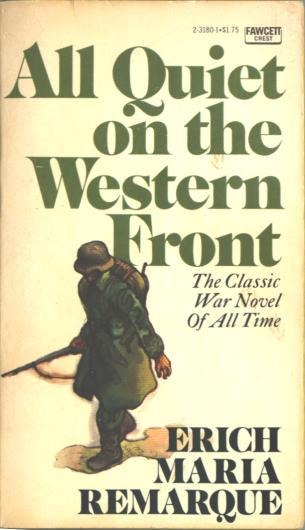
cover of All Quiet on the Western Front

This is the story of Paul Baümer, a young German soldier in World War one. At the age of twenty, he is familiar with the brutalities of trench warfare, since he signed up with his classmates, after being encouraged (or shamed into it) by talk of patriotism by their teacher. The story follows Paul, and the various men in his unit, as they move up and back to the front lines of the war. Paul also goes home on leave for a brief, painful week, and returns to his unit; eventually, he gets injured, and spends some time in a crowded hospital, before returning to his unit. The book is narrated from Paul's perspective, except for the last paragraph, which is when the silence of the title falls: only after all of Paul's classmates and friends, and finally Paul himself, have also fallen.

This book is very bleak. I found it so dark that I had to intersperse my reading of this with something lighter. Horrible brutalities are related in a very matter of fact tone-- and Paul makes it clear that the soldiers must treat things in this way, because if they think about the war too much, they will go mad. They believe, and have to accept, that their survival (while others are blown to bits, or horribly wounded) is merely a matter of chance, so that they learn to be indifferent.

We have almost grown accustomed to it; war is the cause of death like cancer and tuberculosis, like influenza and dysentery. The deaths are merely more frequent, more varied and terrible.
One of the more believable and sympathetic problems Paul faces is his life before the war: when he goes home, it is difficult because his mother is dying of cancer, but also because he is not the same person he was before. He knows that the older soldiers, when the war is done, will go back to whatever trade they had before. But he is young enough that he has nothing to go back to, and can't imagine what he could do after this. He can't think about the war too much while he is on the front lines, or it will paralyze him; but he knows he will have to think about it later.

I can well believe that this is an important book, as a record of terrible things that should never have happened. As hard as it was for me to read this, it is good to be reminded of the atrocities of war, and to remember the horrible things that humans are capable of. It is hard to believe that, after suffering through all of this, Germany could go to war again so soon.

Title:All Quiet on the Western Front
Author:Erich Maria Remarque (translated from German by A. W. Wheen)
Date published:1928
Genre:Fiction
Number of pages:256

Read more...

Google Search

Google