This is a collection of short essays, taken from Chesterton's column in the Daily News. He describes them as "a sort of sporadic diary - a diary recording one day in twenty which happened to stick in the fancy - the only kind of diary the author has ever been able to keep." They range widely in topic-- from fairy tales, to art and color, to travel, and morality, and what it means to be human. As he says in one essay, "let us learn to write essays on a stray cat or coloured cloud." Many of them are little stories of moments in time, an interesting experience or an instant of insight; as he describes in one of these essays, the kind of moment that has "no explanation and no conclusion; it is, like most of the other things we encounter in life, a fragment of something else which would be intensely exciting if it were not too large to be seen." Some of them are more entertaining or illuminating than others, but overall I quite enjoyed reading this book. Because most of the pieces are fairly short, it is an easy book to read a little at a time.
On this page:
Saturday, August 20, 2011
Tuesday, October 31, 2006
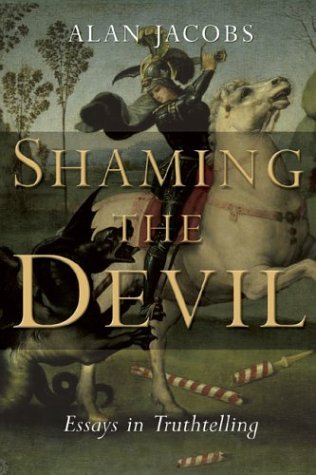
Another collection of essays, this one loosely grouped by the idea of telling and seeking the truth. The first section of essays focuses on those who have devoted their lives to the pursuit of truth, the second section on thinkers who engage with important questions but don't necessarily always arrive at truth, and the last section considers the idea of "computer control." This book doesn't have any of the personal essays which I found so amusing and moving in Jacob's A Visit to Vanity Fair, and sometimes the connection with truthtelling seemed a little more tenuous than others, but the essays are always interesting and thought-provoking.
Among of the exemplars of the first section, I was most impressed with Jacob's portrayal of Auden, who rejected one of his earlier, and very popular, poems as "a resonant lie," and determines instead to seek truth in his writing. Jacobs has convinced me (yet again) that I need to read more Auden. Also interesting are the portrayals of Camus (more distinct from the other existentialists than I expected) and Solzhenitsyn, who saw himself called upon to bear witness to the terrible things he, for some reason, survived (what sacrifices should be made or demanded from others for the sake of great art?).
Among the "explorations," or those who fall short of truth telling and seeking, are Rousseau (who considered himself the "only honest man" and used this as an excuse for all kinds of incivility), Iris Murdoch (who writes of religious matters, but substitutes the Good for God), Wole Soyinka (whose brilliant writing has been forced by the political situation in his homeland into more polemical and less literary modes), and the fantasy author Philip Pullman of the His Dark Materials series.
I found Jacob's comparison of Rousseau with Voltaire quite enlightening-- particularly when he elaborates on why Rousseau's vision of humanity is the one that won out-- because it is so much more appealing. Rather than requiring hard work and discipline to fight corruption and return to innocence, one need only follow one's own heart to know what is right-- and any of failures are someone else's fault, because they have corrupted that original innocence.
The last section, on "computer control," is quite different from the essays-- and perhaps more interesting to me (although I was surprised at how engaged I was with the essays throughout) because of my own interests in technology. Jacobs chronicles his own engagement with computers, including his attempt to install and use the operating system Linux on his own. His attempts are quite interesting and sometimes comical, but he makes the somewhat surprising (and the very interesting) argument that the more smoothly a computer user's experience goes, the less they are in control-- because, if things go smoothly, it is the computer (or the logic embedded in the software by programmers) that is in control. Jacobs makes the counter-intuitive claim that resistance-- which a user encounters when the computer doesn't exactly do what they want-- is important, and even a virtue. One other detail I found interesting was the idea that the overriding metaphors we use for our computer interfaces (that of a desk, with files and folders) is not the only, and perhaps not the best, metaphor-- because (like any metaphor), it has limitations.
| Title: | Shaming the Devil: Essays in Truthtelling |
|---|---|
| Author: | Alan Jacobs |
| Date published: | 2004 |
| Genre: | Essays |
| Number of pages: | 231 |
Saturday, September 30, 2006
A collection of thoughtful essays-- sometimes humorous, frequently insightful. Some essays are inspired by particular books and others by personal experience (such as a young son eating paper torn from a Bible), but Jacobs always moves from these starting points towards deeper and more significant issues so that a review of a historical study of children's Bibles addresses our modern perceptions of children's spirituality, and whether editors of children's Bibles are justified in editing out violent and racy stories (other than the violence of the cross, of course, which is generally portrayed in some fashion). The essays range from personal experiences of fear and death to musings on such personages as C. S. Lewis, Bob Dylan, and Harry Potter, among other topics. Throughout, the essays are entertaining, readable, and thought-provoking.
A few favorites that particularly stood out, for some reason or another:
In "Dowsing in Scripture," when his two-year-old son eats paper from the Bible, Jacobs muses on the common, deprecated habit of opening the Bible at random as a kind of prophecy-- and finds himself unable to resist attempting to interpret his own son's act of eating scripture, with resonances of the prophets who were fed scrolls.
"In on the Kill" addresses the preponderance of violence in animal and nature shows and points out our society's preoccupation with, and entertainment by, death-- and even suggests that by watching we participate in this. In "Friendship and its Discontents," a review of an anthology of writing about friendship becomes an occasion to delve into what does and does not constitute true friendship, along with the question of whether friends must share spiritual beliefs.
"Lewis at 100" addresses the evangelical appropriation of C. S. Lewis as almost a saint, and the oddities that this has brought with it (such as a refusal by some to believe that Lewis consummated his marriage with Joy Gresham, as if Lewis must be 'pure' according to evangelical standards-- even though he was also known as a drinker and smoker, which such people happily ignore). One interesting point: Lewis did not think he was, or intend to be, original. He merely tried to articulate Christian views in a way that people of his time period could understand, and he did not expect his work to last. Jacob raises the question, why have there not been other writers and thinkers who might supersede Lewis by articulating these same points in a new way, for a new age?
"Harry Potter's Magic" is an insightful response to the mixed reception of the popular books in evangelical circles. Jacobs describes Rowling as a "world-maker" akin to Tolkien, and goes on to address ideas of magic in comparison to technology and science. He also makes a point that I have often thought myself-- many evangelicals condemn as "dangerous" the magical elements in books such as this, all the while holding the contradictory belief that magic isn't real. Jacobs also clearly points out the powerful moral dimension to the Harry Potter books-- the dangers of dark magic, the consequences for actions, and the power of the choices we make (such as Harry's desire not to be put in Slytherin's house) forming we who become.
The last section, "Lives of the Essayists," is a humorous look at a book Jacob's says will never be written, because it is more along the lines of "Lives of the Dentists" than the more dramatic-sounding "Lives of the Poets," or novelists, or painters. This gives him an opportunity to touch on some of the more interesting and famous essayists (some of whom did have very strange and dramatic life experiences), and even on the place of the essay itself as a genre, however poorly respected in some circles.
| Title: | A Visit to Vanity Fair: Moral Essays on the Present Age |
|---|---|
| Author: | Alan Jacobs |
| Date published: | 2001 |
| Genre: | Essays |
| Number of pages: | 173 |
| Notes: | Christmas gift from Mom |
Thursday, May 11, 2006
A collection of essays and short stories asking questions about the future. About our world -- where we have come from, where we are going, how we are going to get there. These are good questions, asked in interesting ways, which makes them all the more palatable instead of frightening. Recently at church, we've been talking about the end times, and that the world is getting worse in many ways, so we need to be ready for the end. Which was an intriguing contrast to this book with ideas stretching far into the future. A strong tension -- but both have things to teach us today.
One idea that asks more thought is that of human purpose. Say that we do succeed in making the world a better place, a place that most, if not all, individuals have a chance to live and also to enjoy life. If there was then a generation that has everything they need and everything they want, what would they do with their time? Seems like there are a lot of people who are striving for the next best material thing to own or control. But what if they got all they wanted? How much more valuable to have a purpose, a calling, a vision -- than to have things, money, power.
Another piece is historical fiction (heavy on the fiction part), which asks the question of what one individual can affect. This idea keeps coming back to me in one form or another. My favorite ways of thinking about it is 'good ripples' and 'bad ripples' (thanks to Joan of Arcadia). Humans to have deep affects on others, regardless of their power. So often we get trapped by the idea that to have an impact we need to be powerful, have a strong influence, or control something. But sometimes all we need to do is be consistent in our choices and attitudes. Choosing well at most opportunities (good to strive for all, but that doesn't seem possible...) gives those around us hope of a different reality. I may not have brilliant ideas, but I can take what I believe and actually try to live it out. Asking questions that don't have easy answers seem like a good way to keep myself humble -- seeing myself clearly, being willing to learn from others, being excited when others are challenged to become more like Christ through me.
An essay titled 'The Self-Preventing Prophecy' also caught my attention. What an interesting idea that one way to help our world is to share stories of what could be. For example, Orwell's 1984 helped society to fear such intrusive objects and power, so that it hasn't happened. Other movies and books about our environment and what it is in danger of becoming have given environmentalists and others cause to care, and to act. There are places throughout the world that nature is being cared for well, and one could argue that this has something to do with the fear of what could be shown in stories. Often individuals become what they hear about themselves. If kids are constantly told by their parents, siblings, teachers, friends that they are dumb, they live down to that expectation and do poorly in school. But every once in a while, an individual (or society, or world) comes along that has enough courage and strength to fight that expectation and do the opposite. May we be such a society, and such a world -- that we are able to live into the good ideals and prove wrong the pessimistic prophecies.
| Title: | Tomorrow Happens |
|---|---|
| Author: | David Brin |
| Date published: | 2003 |
| Genre: | Science Fiction - Essays & Short Stories |
| Number of pages: | 219 |
sapphire
on
Thursday, May 11, 2006
add a comment
Sunday, September 11, 2005
Reading Annie Dillard is like keeping good company. Her writing is so beautiful and thoughtful; she is incredibly well-read, and always brings in interesting details or stories from a variety of sources; and she can also be both funny and deeply moving (although not usually both at once). She relates how she had to lose her self-consciousness and stop worrying about looking silly as she stalked shy animals like the muskrats-- and she is willing to do that with her readers, too: she is willing to be make a fool of herself, or be wrong about something and figure it out later, and that makes her writing all the more real and human.
This is one of those books that is pretty well-known in literary circles. I've read parts of it before (sometimes single chapters are included in essay collections), but never the whole thing. I bought a used copy of the book several years ago, and it's taken me until now to finally read it. It also took me quite a while to finish it as well, because this book requires a fair bit of concentration-- you have to pay attention to Annie Dillard's prose, much the way that she pays attention to creation around her that she writes about. But it is definitely worth the effort to read.
One of the things that impressed me about Pilgrim at Tinker Creek is that Dillard has a substantial knowledge of science, but still manages to retain her sense of wonder about the world-- even as she is repelled by certain aspects of nature, she is fascinated by others. There are several points where she struggles with the tension between the world as it is and the idea of a creator-- what kind of creator would make nature that is like this?
Dillard is incredibly well-read, and borrows from many different authors and traditions, but I was interested to find quite a few references to the Bible. The chapter of one title refers specifically to ancient Hebrew sacrifices described in the Old Testament, and Dillard suggests that the wind and nature are offering a "wave offering" of praise. There also are many smaller Biblical references, that people not familiar with the Bible might not notice; this suggests to me that, whatever Dillard's beliefs, she is familiar with the Bible that it is part of her thinking and her language.
I firmly believe that titles matter, so I find it interesting that Dillard calls herself a "pilgrim", which usually denotes some kind of travel to a holy location. It seems that Dillard's pilgrimage is one of standing still and noticing what is around her. In the chapter "Northing", when she writes about all the birds migrating, so much of creation straining northwards, and she suggests that her own northing travel is accomplished by staying still. It seems to work the same way with the travelling part of her pilgrimage. Also, pilgrimage is almost always a spiritual endeavour, which is also relevant here, because Dillard's time at Tinker Creek is also clearly spiritual.
| Title: | Pilgrim at Tinker Creek |
|---|---|
| Author: | Annie Dillard |
| Date published: | 1974 |
| Genre: | Essay |
| Number of pages: | 271 |
Lark
on
Sunday, September 11, 2005
1 comment