Book/page totals

Top 10 Lists

Saturday, August 06, 2011

read full post >

Jerusha Abbott (or Judy, as she decides to call herself) is the oldest girl at the John Grier Home (an orphanage), and when the subject of her future comes up at a Trustee meeting, along with the fact that she is quite good in school (particularly in English)-- they read a humorous essay she's written for school about the Wednesdays when Trustees come to visit the orphanage, and one eccentric Trustee decides to pay for her to go to college and educate her as a writer. He prefers to remain anonymous - she doesn't even know his name, and all she sees is a tall silhouette, and a shadow from car headlights that looks like a daddy-long-legs spider, which is where Judy comes up with her nickname for him. His only requirement for putting her through college is that she write him a letter once a month. From there on, the book is told entirely through Judy's letters to her benefactor as she goes through her four years of college. The book is a quick, entertaining read, and Judy is delightfully engaging letter-writer: the letters change style depending on her mood or the things she is learning in college, and she is good company.

Read more...

Monday, August 01, 2011

read full post >

cover of Connie Willis' 'D.A.'

This fun novelette (even shorter than a novella!) takes us into the world of Theodora Baumgarten, a student at Winfrey High School where just about everyone (except her) wants to get into the fiercely competitive IASA Space Academy. The story is told from Theodora's perspective, with her wry commentary on everything that goes on; she'd wanted to do remote learning but her mother was a "nostalgia freak", and her dad went along with the idea because he wants her to be independent, and what better place to do that than in a crowd? Shortly after the story begins, there is a mandatory assembly called, and the rumor is that one of the students has been selected to for Space Academy. No one is more surprised than Theodora that it is her name the visiting admiral announces-- particularly since she didn't apply, and really doesn't want to go into space. But things happen very quickly, no one will listen to her protests that she didn't apply and doesn't want to go (mostly because none of them understand why you wouldn't want to go or be selected for something so prestigious), and she is whisked away to Space Academy where she is sent aboard the RAH (a spaceship named for Robert A. Heinlein) and launched into space before she can clear up the mistake. Fortunately, she's got a good friend on the outside, Kimkim, who can hack into just about anything; they manage to re-establish communication and work together on figuring out just what has happened.

Read more...

Sunday, July 31, 2011

read full post >

cover of Connie Willis' 'Inside Job'

Rob is a professional skeptic and debunker who edits and publishes the The Jaundiced Eye, a little publication that tries to keep up with and discredit the various scams of mediums, channelers, psychics, and the like that people are so eager to believe and pay. He is joined in his work by Kildy Ross, a beautiful and wealthy former actress who decided she didn't want to pursue the fame game (as she tells him, she didn't want to play the love interest in "Hulk IV", date Ben Affleck, or end up in rehab). Kildy takes Rob to see Ariaura, a new psychic who claims to channel Isus, an ancient priest of Atlantis; Ariaura is clearly a poor fake, speaking in thees and thous without even getting the grammar right, and Rob can't figure out why Kildy would bother bringing him; but then, in the middle of the session, something strange happens-- another voice speaks out, a gruff, skeptical voice that sounds an awful lot like H. L. Mencken.

Read more...

Friday, July 15, 2011

read full post >

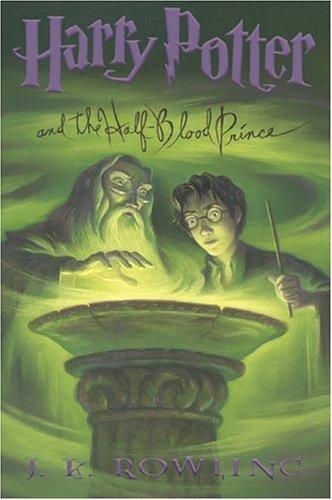
Cover of Harry Potter and the Half Blood Prince

I haven't felt very "into" Harry Potter in a while-- I think that maybe after I finished reading the last book, I felt like I was done; I found it to be a satisfying conclusion to a good series. When "The Deathly Hallows Part 1" movie came out last fall, I wasn't excited about it and I didn't actually end up seeing it until just a few weeks ago. But I guess the enthusiasm of other Harry Potter fans and seeing a few of the later movies again was contagious and got me back into it. So, I decided to re-read the last two books in the series, leading up to seeing the last movie, and I'm glad that I did. This is the book where we, with Harry, learn who Voldemort really is, and how the boy Tom Riddle became the fearsome Lord Voldemort. And we also get to see a bit more human and vulnerable Dumbledore.

Read more...

Monday, June 20, 2011

read full post >

cover of Elizabeth Moon's 'Speed of Dark'

In a near-future world, this book tells the story of an autistic man named Lou. Lou seems like a very high-functioning autistic person: he lives by himself, he drives a car to work, where he works with a team of autistic people who do some kind of abstract, pattern analysis or pattern generation that seems pretty technologically advanced and profitable to their company, and he even goes to a weekly fencing group. Early in the book, Lou is thinking to himself (during his required quarterly psychiatric evaluation, where he is careful not to say to much or say the "wrong thing") that "the speed of dark is as interesting as the speed of light, and maybe it is faster and who will find out?" This is a recurring question, which is pretty interesting in itself-- because of Lou's notion that dark must be at least as fast as light, since it is moving ahead of the light to get out of the way; but it also comes to have a larger significance in the book: certainly the darkness hints at ignorance and the unknown, but there is also Lou's discovery that the questions he asks aren't necessarily invalid even though he is "different" and has been told this all of his life.

Read more...

Sunday, May 22, 2011

read full post >

cover of Dogsbody

dogs·bod·y: A person who is given boring, menial tasks to do; naval slang for someone of very little importance.

Like the title, this book works on so many levels; it is well worth repeat readings. The luminary of the dog-star Sirius, as punishment, is sent to Earth where he is born as a half-breed pup. So, he is literally born into a dog's body, but in the process, he's also given a pretty low status, especially for someone who used to be something like an angel. I've lost track of how many times I've this book, but I still had new insights into the book this time around. When I first read of Diana Wynne Jones' death, my first thought was that I should re-read my favorite of her books as a kind of memorial, and this was the first favorite DWJ book that came to mind (although then I remembered the Chrestomanci books, and Howl's Moving Castle...).

Read more...

Sunday, May 15, 2011

read full post >

This sequel to The Eight primarily follows Alexandra, the daughter of Cat and Solarin-- although it couldn't follow The Eight properly if it didn't also have a parallel story in another time line (filled with cameos of famous historical personages); among others, this alternate story includes Charlot, the prophet son of Mireille, but it also includes some new characters including the young Haid&eactue;e, the adopted daughter of Ali Pasha who makes a journey from Albania to Europe- in part to find her natural father, Byron; but of course, there is something to do with pieces from a certain chess set. As a child, Alexandra was a chess prodigy, and on a fateful trip to Russia - where she might have become the youngest chess grandmaster ever had she won - her father is shot and killed. Now, Alexandra is a young woman living in D.C., working at an open-hearth restaurant, and completely estranged from her mother-- until she gets a strange, mysterious invitation to her mother's birthday party in Colorado. what Alexandra doesn't know is that she is being drawn into the Game that her mother has tried to protect her from since Alexandra was a child.

Read more...

Saturday, April 09, 2011

read full post >

cover of 'The Tough Guide to Fantasyland' by Diana Wynne Jones

This is Diana Wynne Jones' hilarious skewering of the many tropes and clichés of fantasy fiction. It is structured as a guidebook written for a traveler, to help them make sense of or prepare for their journey through Fantasyland. The book, after an initial intro, is ordered into alphabetical sections, each of which starts with a "gnomic utterance" and has entries for places, features, or stock characters in the many worlds of Fantasyland. Throughout, the entries refer to things that "the Management" may or may not do (the managers organizing your tour through Fantasyland, of course-- i.e., the authors), and many of the entries have italicized phrases of words marked with "OMT" to indicate an "Official Management Term" (for those phrases or adjectives that somehow seem to always get used in Fantasy novels).

Read more...

Google Search

Google