Book/page totals

Top 10 Lists

Sunday, September 11, 2005

read full post >

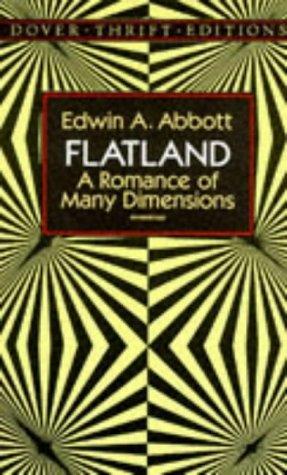
Flatland has only two dimensions, and they have no idea there are more dimensions which exist. Because of this, there are many elaborate rules and societal parameters (like any society), which help to make the setting believable. Very interesting connections to be made with our lives and dimensions that we are unaware of.

I have been trying to read this book for a few years, and finally realized that it is a story and then it became interesting enough to get through the first half of the book, which is largely explanation. Flatlanders see only lines, but have ways of feeling angles and seeing angles as well (due to fog helping so lines look like they are receding). The narrator receives a visit from a 3 dimensional sphere, but can only perceive him as a circle which can diminish and increase in size. The visitor can see hidden things and enter closed areas, and knows things he shouldn't know because of his multi-dimensionality. Finally, since the 2d narrator will not believe him, the visitor takes him into 3d spaceland.

The narrator grasps a large amount of truth, and takes it beyond what his teacher did – saying there must be many more dimensions if there are 1d and 0d places. (1d people have good hearing but cannot imagine life as more than sounds, while there is a being in 0d who loves himself and can imagine nothing outside himself, and worships himself because he knows nothing else.) There are some very interesting connections to be made with Christ entering our world and teaching us things we can't imagine possible. This is a wonderful book – worth ingesting slowly and processing well.

Title: Flatland: A Romance of Many Dimensions
Author: Abbot, Edwin A.
Date published: 1992 (originally published 1884)
Genre: Science Fiction
Number of pages: 96
Notes:

Read more...

read full post >

Reading Annie Dillard is like keeping good company. Her writing is so beautiful and thoughtful; she is incredibly well-read, and always brings in interesting details or stories from a variety of sources; and she can also be both funny and deeply moving (although not usually both at once). She relates how she had to lose her self-consciousness and stop worrying about looking silly as she stalked shy animals like the muskrats-- and she is willing to do that with her readers, too: she is willing to be make a fool of herself, or be wrong about something and figure it out later, and that makes her writing all the more real and human.

This is one of those books that is pretty well-known in literary circles. I've read parts of it before (sometimes single chapters are included in essay collections), but never the whole thing. I bought a used copy of the book several years ago, and it's taken me until now to finally read it. It also took me quite a while to finish it as well, because this book requires a fair bit of concentration-- you have to pay attention to Annie Dillard's prose, much the way that she pays attention to creation around her that she writes about. But it is definitely worth the effort to read.

One of the things that impressed me about Pilgrim at Tinker Creek is that Dillard has a substantial knowledge of science, but still manages to retain her sense of wonder about the world-- even as she is repelled by certain aspects of nature, she is fascinated by others. There are several points where she struggles with the tension between the world as it is and the idea of a creator-- what kind of creator would make nature that is like this?

Dillard is incredibly well-read, and borrows from many different authors and traditions, but I was interested to find quite a few references to the Bible. The chapter of one title refers specifically to ancient Hebrew sacrifices described in the Old Testament, and Dillard suggests that the wind and nature are offering a "wave offering" of praise. There also are many smaller Biblical references, that people not familiar with the Bible might not notice; this suggests to me that, whatever Dillard's beliefs, she is familiar with the Bible that it is part of her thinking and her language.

I firmly believe that titles matter, so I find it interesting that Dillard calls herself a "pilgrim", which usually denotes some kind of travel to a holy location. It seems that Dillard's pilgrimage is one of standing still and noticing what is around her. In the chapter "Northing", when she writes about all the birds migrating, so much of creation straining northwards, and she suggests that her own northing travel is accomplished by staying still. It seems to work the same way with the travelling part of her pilgrimage. Also, pilgrimage is almost always a spiritual endeavour, which is also relevant here, because Dillard's time at Tinker Creek is also clearly spiritual.

Title:Pilgrim at Tinker Creek
Author:Annie Dillard
Date published:1974
Genre:Essay
Number of pages:271

Read more...

Wednesday, August 31, 2005

read full post >

cover of Rossetti's Selected Poems (Bloomsbury edition)

Christina Rossetti's poetry (at least, as represented by those poems which are collected here) deals with the fairly familiar themes of death, love, nature, and faith. Early on in the book, I noticed several references to the vanity of life, as dwelt upon in the book of Ecclesiastes. Most of the poems are fairly short, and take up only one page or two (and these are not large pages), which makes them easier to take in and re-read. There are also a few longer poems, though, most notably "The Convent Threshold" and "Goblin Market". The last section of this book is a sonnet sequence based on the poetry of Dante and Petrarch, and is Rossetti's idea of what we might have if some the beloved and often unnamed ladies in poetry had been allowed to write poetry for themselves, rather than only appearing in the words of their lovers.

Some people say that you shouldn't read selected poetry, because you are at the mercy of the editor and their interpretation of the poet-- you can't see the whole picture. However, selected editions of poetry like this do have the benefit of being short enough that you can read them in a relatively brief time period, maybe in the space of a day or two, which seems like a good thing to me. I have lots of anthologies of poetry, huge collected works-- but they are too massive and intimidating to just pick up and read. And while I may not get the bigger picture of Rossetti's work, there is certainly much to enjoy here.

Rossetti lived from 1830-1894, and wrote during what we call the Victorian period, so her word choice and order might sound a little stilted or archaic to people who read only modern verse. But if you are able to get past that, there are some lovely poems and great ideas. Some of the poems about love are rather playful-- for instance, Rossetti's poetic version of the infamous "let's just be friends" line, where the final rhyme makes her refusal quite emphatic:

Here's friendship for you if you like; but love,--
No, thank you, John.

The longer poem "Goblin Market", which has quite a range of metrical variation, tells the story of two sisters, Lizzie and Laura, who are tempted by the forbidden fruits offered by Goblin sellers every evening. One of the sisters gives in and tastes the luscious fruit-- but afterwards, can no longer here the Goblin voices nad pines away for desire of the fruit. Finally her sister screws up her courage and goes to the Goblins to try to buy fruit for her dying sister-- the Goblins refuse, of course, but when they attempt to force the fruit down her throat, she lets them do so, and runs home with the streaming juices on her face to save her sister with her love. It may be intended as a morality tale about innocence and sisterly love, but the poem would be just as at home in a book of fairy stories.

Many of Rossetti's poems are pervaded by her religious convictions, which seems, unfortunately, to make her unpopular with the literati in this day & age. People seem inclined to think she was deluded, or not brave enough to think for herself and move beyond religious faith; there is plenty of tension and doubt even in her religious poetry, and the conflict between earthly love and faith is certainly clear in "The Convent Threshold." But Rossetti herself wrote that she didn't mind being forgotten, in the concluding lines of the beautiful poem "Remember."

Yet if you should forget me for a while
And afterwards remember, do not grieve:
For if the darkness and corruption leave
A vestige of the thoughts that once I had,
Better by far you should forget and smile
Than that you should remember and be sad.

Title:Selected Poems
Author:Christina Rossetti
Date published:1992 (Bloomsbury edition)
Genre:Poetry
Number of pages:127
Notes:Purchased in London. This is a repeat reading.

Read more...

Friday, August 26, 2005

read full post >

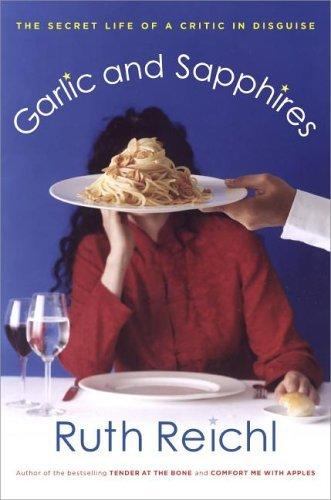
A woman becomes a restaurant critic for the New York Times, but before she actually gets there every restaurant has pictures up so they can make sure to give her the best treatment. Basically wherever she goes people will know who she is and she won't get to see what the restaurant is really like.

So, she contacts her mother's friend who is an acting coach, and together they come up with a disguise. Eventually she has five or six different disguises and different personalities, discovering that she has all sorts of characteristics inside of her to become a variety of people. This book is very well written – since she wrote articles for a long time, she knows how to use words well.

Reichl loves food, so in her descriptions she allows you to understand a little bit of what it would taste like and how one might enjoy the food if one knew what it was. She makes irregular food seem like it could be eaten regularly. Not everyday, but Reichl makes it seem like anyone could eat it, which is an amazing feat. She also includes some of her magazine articles and some recipes to round out the book. This book is honest and insightful. An enjoyable read, and not too hard to understand (not too complex..)

Title:Garlic and Sapphires
Author: Ruth Reichl
Date published:April 2005
Genre: Biography
Number of pages: 328 pages
Notes: Recommended by my friend Amy P.

Read more...

Saturday, August 20, 2005

read full post >

cover of Stargirl

Stargirl is one of those unique, delightful characters who seems most likely to exist only in fiction-- but you can't help hoping you might get to meet someone like her, or wondering if there have been other stargirls in your life that you have missed out on getting to know because you care too much what other people think. Stargirl's self-chosen name suits her perfectly-- she is full of light, and can't help shining. There is a twinkle about her, but at the same time it's hard to focus on her clearly-- it's difficult to see her well. You might say that, in a sense, Stargirl lives out Walter Pater's ideal:

To burn always with this hard, gem-like flame, to maintain this ecstasy, is success in life.

This book came up because Sapphire and I were talking about the delightful character Luna Lovegood (she wanted to know if Luna was in Harry Potter and the Half Blood Prince, which she has not yet read)-- Sapphire was dismayed that I had not yet read this wonderful book, and immediately brought it out for me to read. I finished it a day later.

It was a bit strange to be reading about high schoolers-- in some ways they seemed too young, and in some ways too old, to be in high school. (Has it been so long since I was in high school? I guess if I met some high school students today I probably would think they were pretty young...) It was fascinating to watch the roller-coaster ride of Stargirl's relationship with the school-- first as the oddball weirdo, then as someone to be emulated. Even in their adoration of Stargirl they were still conformists-- they copied her actions, without really even beginning to understand her, and certainly without living the way she lived.

The story is told through the eyes of Leo Borlock-- an ordinary person who understands peer pressure, and doesn't want to stand out of the crowd or be in the spotlight, but is incredibly drawn to the extraordinary Stargirl. His experience shows how wonderful it can be to spend time with someone so caring and thoughtful and unself-conscious and forgiving, but also shows how easy it is to care too much what other people think of you-- even though they are people you don't love, and who certainly don't love you.

There's a certain sadness to the end of Stargirl, because it shows how easy it can be to overlook or undervalue someone so unique and precious and extraordinary as Stargirl, or yield to peer pressure even when you know and love someone as amazing as this. But there is also a note of hope... It seems that there is hope for humanity, just to know that there might be someone like Stargirl out there.

Title:Stargirl
Author:Jerry Spinelli
Date published:2000
Genre:Young Adult
Number of pages:192

Read more...

Tuesday, August 16, 2005

read full post >

cover of The Moviegoer

Jack Bolling, aka Binx, loves the movies, and thinks movie stars are surrounded by more reality than ordinary people. He likes going to theaters in different neighborhoods, and always has to anchor himself in a specific place by getting to know the theater owner or the ticket lady. One of his greatest fears is becoming an Anyone, and living in an Anywhere. He doesn’t go to that many movies in the course of the book, but for Binx being a moviegoer is more of an attitude, because when he meets a romantic young man on a bus, he thinks of him: "He is a moviegoer, though of course he does not go to movies."

Binx is an odd character. His aunt begins to understand him when she tells him,

Your discovery, as best as I can determine, is that there is an alternative which no one has hit upon. It is that one finding oneself in one of life’s critical situatiosns need not after all respond in one of the traditional ways. No. One may simply default. Pass. Do as one pleases, shrug, turn on one’s heel and leave.
In spite of this, Binx has a certain wisdom. Now and then he mentions his idea of search, and while he is cagey about naming or labeling what exactly he is searching for, he notes that "the polls report that 98% of Americans believe in God and the reamining 2% are atheists and agnostics-- which leaves not a single percentage point for a seeker." At another time, he notes that it is better to be "selfish" in conversations-- that is, to ask people about their work or lives because you are genuinely interested in it, rather than simply to be nice.

Binx's refusal to subside into an Anyone in an Anywhere is most evident in his need to get a sense of places. When he travels to Chicago, as soon as he steps off the train, before he can go anywhere, he must get the scent of the place.

Nobody but a Southerner knows the wrenching rinsing sadness of the cities of the North. Knowing all about genie-souls and living in haunted places like Shiloh and the Wilderness and Vicksburg and Atlanta where the ghosts of heroes walk abroad by day and are more real than people, he knows a ghost when he sees one, and no sooner does he step off the train in New York or Chicago or San Francisco than he feels the genie-soul perched on his shoulder.

There was a moment early on that resonated for me, and confirmed the fact of Binx as a moviegoer-- he is on a bus and catches the eye of a pretty girl. He knows that nothing will come of it, but thinks that if it were a movie, some disaster would strike and they would be thrown together. He comments early on that the movies are onto the search he has undertaken, but that they always mess it up. And the ending is ambiguous as to Binx's own success; he says something about abandoning his search, but he seems at least to have moved somewhere beyond where he started.

Title:The Moviegoer
Author:Walker Percy
Date published:1960
Genre:Fiction
Number of pages:191

Read more...

Monday, August 08, 2005

read full post >

cover of Fearfully and Wonderfully Made

A wonderful book that takes the Biblical metaphor of the Body of Christ and looks more deeply into the metaphorical connotations. For a kinesiology major it made a lot of sense – but took many things I had learned and tied them together practically. This is a book worth reading, and probably re-reading. Christians are all part of the Body – and are called to be so in tangible ways – being aware of other parts of the body, obeying the head, being connected to those who are on the front lines and struggling with being the 'skin'. Two authors who love Jesus a lot and want to share what He has taught them with wisdom.

Title:Fearfully and Wonderfully Made
Author: Dr. Paul Brand and Philip Yancey
Date published:1980
Genre:Spiritual
Number of pages: 206
Notes:

Read more...

Saturday, July 30, 2005

read full post >

The Greater Trumps seemed to move more slowly than some of Williams' other novels, and some of the prose seemed a bit thicker than usual even for him (although that may be a matter of perception since it's been a while since I've read any of his novels). However, in spite of this slowness, there are some powerful images and ideas from this book that are still dancing in my imagination. There is a kind of extremity to this book that made me want to think it must be either the first or last of his novels, although it was actually somewhere in the middle.

What fascinates me most about this book is Williams' presentation & interpretation of the dancing figures of the Tarot (which I know very little about). The introduction says that Williams' interpretation of the Fool is quite unique, and I would imagine so, because he turns it into a Christ figure. In one scene he conjures up a beautiful connection between the Fool and the Juggler, who has already been vaguely suggested as a Creator and God.

What's particularly fascinating to me is Wililiams' diea of the dance, and the Fool sitting motionless at the center-- it is only Sybil who sees him moving everywhere, and moving so quickly that the golden aura around all the dancers is really the glint from his golden, moving form. This image, as I interpet it, it strikingly similar to the dance of T. S. Eliot's Four Quartets, and the still point of the turning world.

There are several other interesting points about the novel-- and I haven't figured them all out yet. For instance, the main action of the book takes place on a Christmas weekend, which seems significant, but I'm not sure exactly how. No explicit connection is made, although perhaps it relates to the woman looking for her baby, and Sybil's cryptic statement that Nancy is Messias.

There are also some interesting points about motivation in the search for knowledge. The gypsies have been entrusted with this great treasure, the originals of the Taros, and Aaron & Henry Lee have spent their lives trying to discover its secrets-- and yet Sybil is the only one who can see the Fool moving. They are astounded that she refuses to use the Tarot cards to tell the future-- she has no interest in the future (that is, in knowing it ahead of time) because she is so completely content and settled in the present-- which is why, the text suggests, she is able to see the Fool.

As a side note, I take Sybil as a sort of presentation of the ideal Christian-- or maybe Williams' idea of one-- but she is presented in very different language & terms. It is a bit difficult to interpret, but she is clearly well-connected to-- and completely trusting of-- her higher power, which she considers in terms of Love. At one point we even see her doing something Christians today might call intercessory prayer and healing, but in this text it is communicated in far different terms.

Greediness in the search for knowledge is evident in Nancy & Henry's relationship. She clearly loves him the way a normal girl her age might; he does seem to care about her, but he is also using her-- he wants them to become lovers so that he can understand the dance of the figures from the inside-- presumably for the purpose of knowledge and power, so he can control the dance. What he doesn't realize is that his very motivation interferes with his aims, and it seems clear by the end of the book that Nancy has gained far more [experiential] knowledge of the dance han he has.

Title:The Greater Trumps
Author:Charles Williams
Date published:1932
Genre:Fantasy? Spiritual Thriller?
Number of pages:288

Read more...

Google Search

Google