Book/page totals

Top 10 Lists

Sunday, June 27, 2010

read full post >

cover of 'The Talisman Ring'

Sir Tristram Shield comes to visit his dying uncle Sylvester, the Lord of Lavenham, and since it is Sylvester's wish, Tristram agrees to marry his younger, half-French cousin Eustacie. Tristram is a practical, unromantic kind of gentleman, so to Eustacie he seems completely unfeeling when he won't follow along in her flights of fancy at how sorry he should feel to see her going to the guillotine wearing a white dress (she was brought out of France long before there was any danger of that), or when she asks him to ride at full-speed to her deathbed when she dies in childbirth-- he replies quite practically that he wouldn't go out on such an occasion, but this doesn't suit Eustacie at all. Quite quickly, Eustacie convinces herself and her maid that she will be completely miserable married to Tristram (she's probably right-- and she would likely make him miserable as well), so she decides to run away and become a governess (her only qualification for such a job is that she speaks French). As she makes her way out in the night, she runs into a group of smugglers (or "free-traders")-- and their leader is, of course, her disgraced cousin Ludovic Lavenham, heir to Sylvester. Everyone assumed he had fled the country due to the suspicion that he murdered a man who took a family heirloom, a talisman ring, in payment for gambling debts and then would not return it. When Ludovic, Eustacie, and Tristram all end up together again and Tristram and Ludovic finally believe each other that neither of them killed the man, they set about finding the person who did-- and in particular, finding the talisman ring that will clear Ludovic's name.

Read more...

Tuesday, June 22, 2010

read full post >

cover of 'Sophie's World'

14-year-old Sophie Amundsen is a normal school-girl who discusses normal school-girl things with her friend Joanna-- until she gets an unusual note in her mailbox, which begins her on a course of studying the history of philosophy with her equally unusual teacher, Alberto Knox. The first few lessons begin with thought-provoking questions like who are you? and where does the world come from?, or why is the Lego the most ingenious toy in the world?. These simple questions get Sophie to wondering, and then are usually followed up by a lesson-- initially in written form, later on via in-person discussions with Alberto Knox. In addition, to the philosophy course, Sophie starts finding postcards and other things that belong to a girl she's never heard of, Hilde Moller Knag-- and something about the postcards doesn't quite add up (they are sent from Lebanon but apparently took no time to get to Norway, Hilde's birthday is the same as Sophie's, Sophie is being relied upon to deliver the postcards, etc.). About half-way through the book, when Sophie and Alberto are discussing the philosophy of Berkeley (who believed that the only thing we could be certain of were our perceptions and not physical reality, and thus we exist in the mind of God), they discover that they (Sophie and Alberto) are characters in a book that Major Knag is writing for his daughter Hilde-- so they exist only in his and Hilde's imaginations.

Read more...

Wednesday, May 05, 2010

read full post >

I read this for church, which is a little weird to begin with (it's odd to hear sermons connected or organized based on anything other than the Good Book), and I found it so poorly written and edited that I really struggled with finding much of anything that was spiritually valuable. The basic premise is that Christians have gotten so accustomed to living in the day-to-day life of the world that we've lost sight of the larger Kingdom that we have been invited to be a part of. Tripp expresses this repeatedly by saying that we have shrunk "the size of our lives to the size of our lives", which doesn't work for me because it just seems like a nonsensical tautology. It finally occurred to me that the poor writing is, in part, due to the use of a rhetorical preaching style (which at times shifts into an almost colloquial, conversational style), so that the words on the page might actually communicate something meaningful if they were spoken aloud and accompanied by gestures and facial expressions.

Read more...

Wednesday, March 24, 2010

read full post >

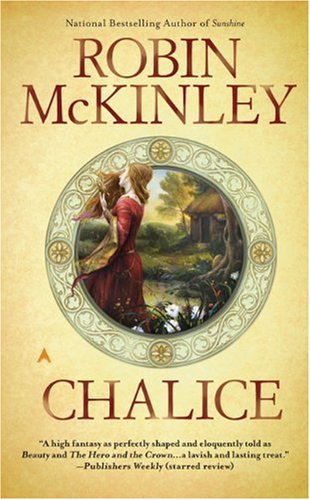
cover of Robin McKinley's 'Chalice'

Mirasol was a beekeeper and woodskeeper until the Master and Chalice of the Willowlands were both suddenly and violently killed, without heir and apprentice. The land chose Mirasol to be the next Chalice, and so she had to step into the official role, second in the Circle, without any training or apprenticeship (and to the apparent dismay of the remaining members of the Circle). The Chalice is a magic user and a cup-bearer who mixes drinks to bind, or connect, or help make decisions, and is part of many rituals of the ruling of the demesne, and who works with the Master of that demesne to protect the land and the people. But the Master that Mirasol must learn to work with is the younger brother of the dead Master, who was sent away to become a Fire Elemental Priest six years ago. The Grand Seneschal sent for him out of desperation, and he returned out of loyalty and responsibility to the land; but he had gone far enough into the priesthood that he is no longer quite human, and certainly looks and moves very strangely, with blackened skin and reddish eyes. However, Mirasol is also different than any other Chalice; usually their magic runs in wine or water, or occasionally milk (and, in ancient, more violent times, occasionally blood); but the power of the Chalice manifests itself in Mirasol's honey and her bees.

Read more...

Tuesday, February 02, 2010

read full post >

cover of McKillip's 'Bell at Sealey Head'

Every night in the small harbor town of Sealey Head, just as the sun goes down, an invisible bell tolls. It's happened every day for as long as any of the inhabitants can remember, and most of the inhabitants don't even notice it anymore. But a few of the younger people are fascinated, or perhaps even obsessed with it-- Judd Cauley, the innkeeper's son; the merchant's daughter, Gwyneth Blair, who sits at her little desk in the attic and writes story after story trying to make sense of the bell; and even a visiting scholar from the city, Mr. Ridley Dow. Emma, who works as a scullery maid at Aislinn House, also knows there is something magical about the place-- ever since she was a child, sometimes the doors in the house open onto a castle in some other place, where she sees a girl near her own age, a princess named Ysabo.

Read more...

Tuesday, January 19, 2010

read full post >

cover of Octavia Butler's 'Parable of the Talents'

In a post-apocalyptic California, with the U.S. in political and economic chaos, Lauren Oya Olamina builds a small community called Acorn, where people can live and survive and learn. But for her, this small community is also an opportunity to spread the ideas of the religion of Earthseed, which she created (she feels that rather she discovered it, as something that was already true)-- that "God is change", but change can be shaped and guided, and that humanity has a destiny to go out and take root among the stars, to spread the seed of Earth, which gives a much deeper purpose and a reason for learning almost any field of study, since it is a means to that destiny. Lauren Olamina is the daughter of an African-American preacher, and the novel is bookended with the Biblical story of the parable of the talents-- she remembers one of the last sermons she heard her father preach, on that text, and it ends by quoting the passage.

Read more...

Sunday, December 13, 2009

read full post >

cover of 'Searching for Dragons'

The sequel to Dealing with Dragons, this story starts with Mendenbar, the young king of the Enchanted Forest, out for a walk when he discovers a patch of forest that seems to have been burned, and all the magic sucked out of it.  A little investigation and a consult with Morwen shows that someone is trying to frame the dragons for this destruction, and perhaps provoke war between the dragons and the Enchanted Forest, so Mendenbar sets off to meet with King Kazul (although he's a little dismayed to hear the dragon has a princess, as he prefers to avoid silly, hero/husband-hunting girls).  When he arrives, he meets Cimorene (not at all what he expected from a princess), who is just about to head out to try to find Kazul, who seems to have gone missing.  Since it seems to involve his kingdom as well, Mendenbar joins her.  Along the way, they sup with giants, ride on a broken-down magic carpet (decorated in pink with teddy bears!), meet Rumpelstiltskin's descendant Herman, as well as a scholar-magician named Telemain, before they face the nefarious wizards and, of course, fall in love.

Read more...

Friday, November 27, 2009

read full post >

cover of 'Dealing with Dragons'
Cimorene is a princess who gets bored with all the proper things she is supposed to learn (etiquette, sewing, and the like), and keeps finding more interesting things to do-- like fencing lessons, learning magic, or even how to cook-- but her more interesting lessons are always halted as soon as her parents find out. Despairing over what to do with her, they decide to marry her off to a prince in a neighboring kingdom. When Cimorene figures this out, she decides to run away-- and with a helpful tip from a talking frog, she finds some dragons and volunteers to be a dragon's princess-- which is quite "proper," since it happens to princesses all the time, and much more interesting for Cimorene.

Read more...

Google Search

Google