Book/page totals

Top 10 Lists

Monday, October 10, 2005

read full post >

cover of View with a Grain of Sand

This collection of Szymborska's work contains 100 poems, selected from seven different volumes of poetry, which were published between 1957 and 1993. The poetry is thoughtful and intriguing; often, they offer a fascinatingly different take on life and reality. There is also a great deal of playing with language (most notably in "The Onion"). It seems like it must have been a very difficult to job to translate Szymborska's work into english; the translators did a fabulous job in keeping a sense of play and rhythm and even a distinctive voice in these english versions of the poems.

Some of Szymborska's poems are quite playful. Sometimes the playfulness is in the language, as in "The Onion":

In an onion there's only onion
from its top to its toe,
onionymous monomania,
unanimous omninudity.
Sometimes the playfulness is in the ideas, in a reversal of opinions, or suggesting a new and different interpretation of something familiar. For instance, in "True Love", almost the whole poem is spent discussing the ridiculousness and illogicality of so-called true love, but the ending flips the whole poem around, suggesting that this is the belief of people who never find love, and that this belief makes life easier for them. The poem "Pi", where the lines are interlaced with numbers from pi, among other things, Szymborska compares the never-ending, irrational digits of pi to various other things of long and short duration and length. In the delightful poem, "Theater Impressions", Szymborska plays on an extended metaphor of the "sixth act" of a tragedy, when all the dead come back to life, and enemy and villain grab hands and bow together for the cheering crowd.

It's hard to trace any kind of progression in a poet's work, and especially from any kind of selected poems, but it did seem like there was a greater preponderance of heavier, darker poems in the selections from the later volumes-- although even these are still consonant with the witty, clever, playful style of the other poems.

What I valued the most in Szymborska's poetry is the attention she gives to the world-- to notice the grain of sand of the title in the midst of a larger view, and consider the fact that the grain of sand has no awareness of itself. Her poetry comes across as the work of a very thoughtful person, who considers things carefully, and is not afraid of interpreting what she sees differently than the rest of us.

Title:View with a Grain of Sand: Selected Poems
Author:Wisława Szymborska
(translated from Polish by Stanisław Barańczak and Clare Cavanagh)
Date published:1995
Genre:Poetry
Number of pages:214

Read more...

Sunday, October 09, 2005

read full post >

cover of Rose Cottage

The heroine of this Mary Stewart novel is a young war widow who returns to her childhood home (the cottage of the title) to take care of a few things for her grandmother. One of those things is a secret safe, hidden behind the plaster and the wall-paper; the contents of the safe are not rare jewels, but rather the family treasures and documents (birth, baptism, and marriage certificates, and the like). Our heroine is surprised to find that the safe has been uncovered and opened-- with a key-- and that the documents are gone. Her perplexity increases, as she and her childhood friend Davey keep running across odd stories from the neighbors and strange occurrences around the cottage which suggest someone has been around. Although there's no evidence of maliciousness or mischief, the missing papers make no sense to Kathy, because the only living family members are herself and her grandmother.

I enjoyed this book because it seemed to deviate a bit more from the usual Mary Stewart mysterious romance book. In this case, the main character is a widow, which means she isn't looking for love; there is still a romantic sub-plot here, but it is more subdued than in some of Stewart's other books. Certainly, there isn't more than one love-interest, one of whom turns out to be evil. I also enjoyed the mystery, because it is so much more personal to the character, rather than a dangerous political conspiracy or illegal smuggling. The heroine is struggling a bit with her identity-- this is brought to the fore by the play of names. Her married name is Kate Herrick, but when she returns to Rose Cottage she is once again the Kathy Welland everyone knew. Kathy's identity questions are compounded by the fact that she was born out of wedlock, never knew who her father was, and was left by her mother at a young age. So it's quite charming that the mystery touches on Kathy's own questions about her identity and roots.

Rose Cottage is an entertaining read, which doesn't take long to finish. Stewart's descriptions of rural English and Scottish countryside are pleasant, and there is enough local color in the dialogue of the characters to be both believable and entertaining. The central mystery of the plot is not a complete surprise; I guessed the main secret a while before the main characters figured things out-- but this story is different enough from the other Stewart novels I have read, and more personal in its dynamics, that it was still quite fascinating to find out how exactly the story ended. As in other novels by Mary Stewart, she doesn't give you all the details, doesn't bring everything to complete closure-- she gives enough to satisfy the reader, and finish the main story threads (or suggest where they will end), while still keeping a slight air of mystery.

Title:Rose Cottage
Author: Mary Stewart
Date published:1997
Genre:Mystery / Romance
Number of pages: 264

Read more...

Saturday, October 08, 2005

read full post >

This is the true story that 'The Sound of Music' was based on, but is much better than the movie. The Trapps were a family that sought to follow Christ and do the will of God in all things.

To hear the story of what they learned and who God provided to take care of them is very encouraging. They came to America to escape because both the father and oldest son were called to serve Hitler, as well as their family being called to sing at his birthday celebration. So – they left the country (with their own priest/choir director) and ended up in America, where they got to discover all sorts of new things. Scripture is referenced throughout, to see that God does come through on His promises. This remarkable family did not call themselves poor – just without money – because they got to see God provide all they needed, to see what skills and talents each family member had because of necessity, and to see God giving family and friends and home more than they imagined. This is a biography of faith and a testament to God being who He says He is. It is also fun to read, and I believe it would have been enjoyable and refreshing to hang out with maria and her family! And to sing beautiful music.
Title:The Story of the Trapp Family Singers
Author: Maria Augusta Trapp
Date published:1957
Genre: Autobiography
Number of pages: 312 pages
Notes: Way better than the movie!

Read more...

read full post >

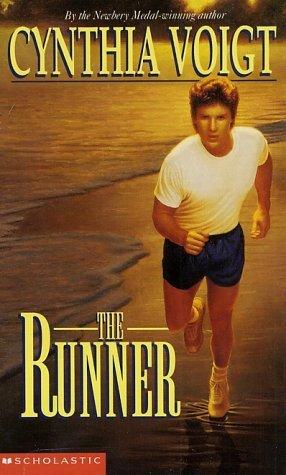
A book for teens by a woman who isn't afraid to acknowledge that life isn't always easy. The main character, Bullet, was created to run - and does so throughout the book as a way to deal with life.

Running comes naturally to Bullet, but he also works hard to make himself better. Not for the purpose of winning, but to feel how his body can work well and for the pleasure it brings him to conquer his body. His father isn't a father and has nothing but pain and mistrust to bring into his son's life. There are very few characters – Bullet, his family, one main runner from school, one friend he works with – and that's about it.

Interesting that a book can be 281 pages and get the reader interested enough in the story of one person and their story alone, mainly. A well-written book worth reading and digesting. Bullet is confident and makes his own decisions and takes responsibility for himself, something which few people do today – refreshing to read that it is possible, though not easy.

Title:The Runner
Author: Cynthia Voigt
Date published:1994
Genre: Young Adult Fiction
Number of pages: 281 pages

Read more...

Thursday, October 06, 2005

read full post >

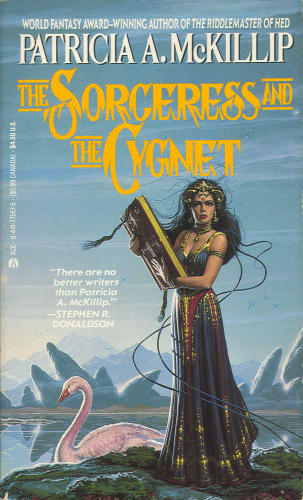
cover of The Sorceress and The Cygnet

Corleu is a young man of the Wayfolk, a wandering people hesitant to pass over thresholds, but his mysterious heritage is visible in the white-blond hair he inherited from a great-grandfather he knows only by a story. He loves to read and tell stories to the other Wayfolk children, but discovers that words have power when he begins to encounter the characters from the tales he tells-- the Gold King, the Blind Lady who wears the silver ring of time, the dancer who brings dreams to humans, the blood fox with the shadow of a man, all of whom are also constellations, bound by the powerful Cygnet. These powerful beings send him on a quest, and he encounters the sorceress Nyx, the daughter of the Lauro Ro, the powerful mistress of Ro Holding. Nyx helps Corleu in his quest, but out of a desire for more knowledge and power. Along the way, Corleu's story intertwines with that of Nyx's cousin Meguet, a woman with her own unknown and powerful heritage.

McKillip has created a complete world here, with different peoples and customs, and their own legends and constellations, which come to life. As in many of McKillip's books, we also find many strong female characters, of several different types-- the powerful sorceress Nyx, who left behind family and love to study the arcane arts anywhere and with anyone who might increase her knowledge; Meguet, who is a warrior and guardian; Lauro Ro, loving mother to Nyx and her sisters, but still managing an entire holding. Even Nyx's sisters are all different. Iris is practical and unmagical, but discovers she has the ancient power to move the entire house of Ro Holding, when necessity demands it. Nyx's sister Calyx loves to read the histories and ancient books in the tower of Ro Holding.

"I watch the stars," Calyx said simply. "Sometimes it seems that all the constellations exist in a strange, ancient tale that we only catch glimpses of in our short lives, while they move slowly as centuries through it."

Where do you hide your heart? Is it hidden away somewhere? Corleu's "heart" is Tiel, the Wayfolk girl he loves; this is why he does the bidding of these powerful beings he fears, because they have captured his heart. When Corleu frees the Warlock from the shape of a blood fox, he makes a blood star to do so-- the Warlock's heart. Nyx is so caught up in knowledge and power that she has forgotten about her heart. And the Cygnet's heart itself, which Corleu is looking for, is hidden in an unlikely and surprising place.

I read this book once many years ago, and did not understand it. I remember feeling like I was reading the sequel to something, as if I had come into the middle of a story and things didn't make sense. As for the conclusion... what happens is only touched on briefly, once. Things aren't explained completely (this is a McKillip book, after all), and what happens is a bit of a surprise-- so if you aren't paying careful attention at that one point, it seems possible to be very confused about what has actually happened. This strange, evocative ending suggests that the tales, and the stars, don't always mean what we think, and that the stories don't always end or begin where we think they do. In the evocative words of the tinker,

... whatever sun touches, whatever dreams, whatever works magic, whatever flies... When the heart casts a shadow instead of dancing light, there story begins.

Title:The Sorceress and the Cygnet
Author:Patricia McKillip
Date published:1991
Genre:Fantasy
Series:Cygnet
Number of pages:248
Notes:Second reading.

Read more...

Wednesday, September 28, 2005

read full post >

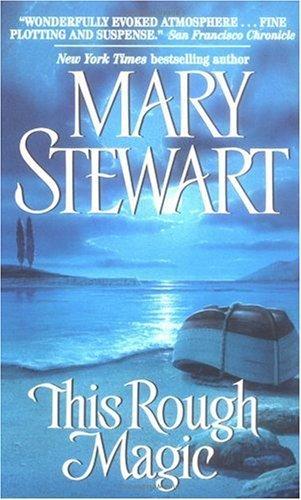
cover of This Rough Magic

Lucy Waring is an aspiring actress on the London stage, whose latest play has just folded. So, she comes to the Greek isle of Corfu for an idyllic holiday with her sister, who happens to be married to a wealthy Roman lawyer, and owns some property on the island. But, of course, this is Mary Stewart, so the idyllic vacation is quickly swallowed up by mystery and adventure. It is almost inevitable that our intelligent and brave heroine will meet two men, both handsome, and that one will be a villain, and the other will become a villain. Can you guess which?

The book's title, of course, is from The Tempest, near the end of the play when Prospero is calling an end to his own magic-making:

But this rough magic
I here abjure, and, when I have required
Some heavenly music, which even now I do,
To work mine end upon their senses that
This airy charm is for, I'll break my staff,
Bury it certain fathoms in the earth,
And deeper than did ever plummet sound
I'll drown my book.
There are plenty of references to Shakespeare's play throughout the text. Each chapter begins with an appropriate line or two as epigraph. One of the characters staying on the island is a famous actor, Julian Gale, now living in seclusion. The last role he played was Prospero, and he believes Corfu is the "real" island of the Tempest. There is even a certain conflation with Prospero and the patron saint of the island, St. Spiridion. Many of the boys on the island are named after this saint, and the shortened version of the name, Spiro, sounds even more like Prospero. There is a rather delightful moment when a character thinks that her boyfriend has found proof that Prospero really was on the island, because they have found something that looks like a book hidden underwater, but it is actually proof of the misdeeds of the book's villain. I was a little disappointed that there was no real conclusion to this idea of Corfu being Prospero's isle, no huge connection to the world of the tempest or to the "rough magic" of the title. Stewart does bring those words in near the end, as if to justify the title:
"You've seen the other face of the enchanted isle tonight, haven't you, my poor child? It's a rough sort of magic for such as we are-a mere musician, and a couple of players."

There is also a dolphin in the book, who is mostly present to service the plot, but he gives a few moments of delight. When Lucy first sees him, she notices that someone is shooting at the dolphin with a silencer, and after scaring the dolphin away, she charges up to yell at the only person she can see nearby (who, of course, turns out to be innocent-- although Lucy stubbornly refuses to believe this for some time). Later on, the dolphin strands himself on the beach at night, and Lucy, with a little bit of help, manages to get him back into the water before he dehydrates and dies. Still later, the dolphin returns the favor, and in his turn saves Lucy. It seems a little bit unrealistic, and romantic-- but perhaps also a bit like a friendly spirit such as Ariel, helping out those who are shipwrecked on Prospero's isle.

I was a bit surprised to read on Amazon that several reviewers counted This Rough Magic as one of their favorite Mary Stewart novels, along with Nine Coaches Waiting. Perhaps it is only because I have read enough of Mary Stewart, but I found the plot rather predictable. I guessed fairly early on that the man Lucy was initially most resistant to and suspicious of would be the one she would eventually fall in love with; I suspected the villain's actions had something to do with the political turmoil in Albania, when it was mentioned, although I'm not familiar enough with this kind of illegal maneuvering to guess what the specific crime might be. I was also a little troubled by the portrayal of the natives; Stewart's portrayal of the Greeks seemed a bit racist. She stereotypes them all as delighting to serve, and when it is a matter of one man's word against another, the Greek police are inclined to believe an educated European man rather than a Corfiote boy. This Rough Magic is certainly well-written and entertaining, but I don't feel that it is on quite the same level as Stewart's best work (including the superb and rightly praised Nine Coaches Waiting).

Title:This Rough Magic
Author:Mary Stewart
Date published:1964
Genre:Mystery / Romance
Number of pages:254

Read more...

Monday, September 26, 2005

read full post >

cover of Shadow of the Giant

The latest (and last?) book in the second series set in the world we first met through Ender's Game. When described like that, it sounds complicated and maybe even that the author is trying to make more money out of material he's already used. But, in actuality, this is a good book, and the Ender's Shadow series is quite interesting-- we get to know the children from Battle School more as they grow up, we get to see some of the process of Earth becoming unified under the Hegemon (something that is only glimpsed briefly at the end of Ender's Game), and we get to see a bit more of the fascinating personage of that shadow-caster himself, Bean.

As in Shadow of the Hegemon, in places reading this book feels almost like watching a full-scale game of Risk or Diplomacy-- only with all the details and idiosyncrasies of the particular strengths certain countries and communities bring to any fight. This is not a bad thing; it's actually quite fascinating, to watch the battles and politics unfold, and both the military and political strategies are quite convincing-- with now and then a nod to familiar Earth history, both military and political.

It's been quite a while since I read Shadow Puppets (the book immediately before this one in the Bean series), and a much longer time since I last read Ender's Game, so it's hard for me to remember the characters from Battle School, and what they were like as children there. I felt like I didn't quite recognize them, like there might be slight discontinuities in their personalities-- but feel unfit to judge that, since I can't remember so well. When the kids are all at Battle School, their different nationalities are just one aspect among other particularities to make each of them unique-- but here, the nationality of the members of Ender's "jeesh" comes into prominence, as many of them are thrust into leadership roles and empire-building within their home country.

One of the major components of this book is Peter's attempt to build a one-world government, what he calls the "Free People of Earth", or FPE. His vision is that all nations (and also people-groups not currently recognized as nations) would be similar to what states are now in the U.S.-- each would retain its own autonomy, to some degree, and would still be individual and unique, but would also be part of the larger whole. To some extent, the portrayal of this is quite believable-- it makes perfect sense that the smaller and more oppressed nations (and those not recognized as nations) would be most willing to join the FPE. However, it is a little more difficult to swallow the idea that war-mongering empire-building nations would simply give in and join up when their leadership changes up a bit, or after a few military set-backs. And once all the nations join up, who is to say that no one would later rebel or try to take over the government? Or that the government would not become corrupt? It's a nice idea, but I find it hard to completely buy into.

As a side-note, I find it both interesting and slightly disturbing the way the U.S. is portrayed (as I imagine Card intended). At this point in time, the U.S. has basically withdrawn from the rest of the world-- the borders are closed, and the U.S. no longer takes any interest in what is going on elsewhere (having given up on attempting to be the world police, as had been attempted in prior centuries). At the end of the book, the U.S. is the only country who has not yet joined the FPE. This is an interesting portrayal of America's future-- but I can't see it happening, for several reasons. One of the major reasons is economy: it's already clear how interconnected the economies of different nations are, and I doubt that is going to change in the future (except that things will grow more connected and not less). But it's also hard to imagine the U.S. closing its borders and showing no interest in the rest of the world-- particularly when the U.S. is made up of people from all over the world, even if they have been here for several generations. I imagine there will always be americans interested in and connected to different areas of the world-- and that seems like something likely only to increase, and not decrease. However, perhaps Card intends it more as a wake-up call, rather than a prediction.

The book ends with poetic closure, returning to its beginnings-- Peter Wiggin finally speaks by ansible to his brother Ender, and asks him to write for him as Speaker for the Dead, like he did in the Hive Queen. Here we get Peter's side of the interview that eventually led to the second work by the Speaker for the Dead, the Hegemon. It's a beautiful way to end the book and the series. However, Card has left a small door open for other stories to be told, and I wonder if he will stop here or return us later to Ender's universe. There is one story that we only get a few pieces of its beginnings, and Bean's story is not completely finished-- but, as Peter Wiggin notes, that is not his story to tell.

Title:Shadow of the Giant
Author:Orson Scott Card
Date published:2005
Genre:Science Fiction
Series:Ender
Number of pages:367

Read more...

Thursday, September 22, 2005

read full post >

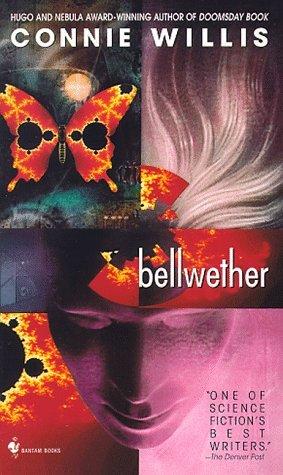
cover of Bellwether

A woman named Sandra studies fads, and she 'happens' to meet a man named Bennett who is a chaos theorist. They 'happen' to share a mail clerk / communications assistant / chaos creator who is named Flip, who 'happens' to do crazy things and think mainly of herself and not of others at all. Makes for interesting situations and attempts at explanations.

I appreciate connie willis – her unique writing and ideas. There is so much foreshadowing that just fits into the story – very fun if you can see it. Each chapter begins with a fad, and many snippets about rivers and their inexplicable beginnings, to mirror how fads and chaos are also inexplicable. Add to this 'Management' (always treated as one powerful and dumb man) and his desire to make science happen more efficiently and more managably, which makes things much more difficult all around.Sandy and Bennett happen to end up working together with sheep, and things get funnier from there. Sheep actually help them to figure out their work, as well as get many unexpected wonderful surprises. I really like this book, and would definitely read it again.

Title:Bellwether
Author: Connie Willis
Date published:1997
Genre: Science Fiction
Number of pages: 247 pages
Notes: 2nd reading

Read more...

Google Search

Google